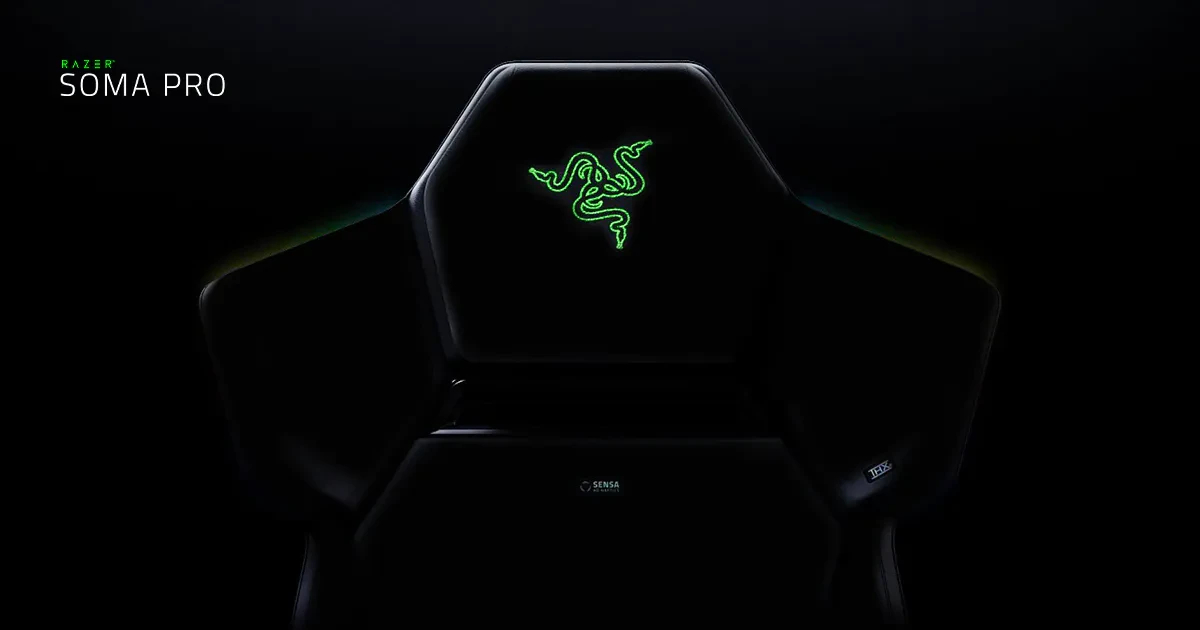
Razer announced on November 13 (U.S. time) two gaming chairs with haptic feedback mechanisms built into the seat. The higher-end Razer Soma Pro, which includes spatial-audio speakers and lighting, is priced at ¥175,880 (approximately $1,100), while the Razer Soma Sensa HD Haptics, focused purely on haptics, costs ¥98,880 (approximately $620), both tax included. Preorders begin in Japan this week, with shipments scheduled to roll out from December onward.
At the core of both models is Razer Sensa HD Haptics, a haptic technology built on six actuators. It converts the intensity, direction and distance of in-game motion into vibration in real time and transmits it to the seat. Working with the Razer Synapse PC software, it operates across more than 100 supported game titles. It also includes processing that converts audio signals into vibration, a design that lets users enjoy the sensation with games, movies, music and streaming content that do not support haptics.
The higher-end Soma Pro adds built-in speakers compatible with THX Spatial Audio and Razer Chroma RGB lighting capable of displaying roughly 16.8 million colors. The speakers can be used on their own or combined with separate front speakers. The lower-tier model omits the speakers and lighting, concentrating its features on haptic feedback.
The shared seat uses a two-layer cold-cure foam that stacks a soft layer over a resilient core material, aiming to balance pressure distribution with support. The built-in lumbar support cushions the lower back, and the backrest reclines up to 132 degrees. The higher-end model has 4D armrests, while the lower-tier model has 2D armrests. The higher-end model also adds a magnetic head cushion and a frog-tilt mechanism.
For connectivity, the chairs support 2.4 GHz Razer HyperSpeed Wireless and Bluetooth LE, allowing users to adjust vibration intensity and switch wireless modes from a control panel beneath the seat. They also link with the Razer Furniture smartphone app (iOS / Android). Power is supplied via USB Type-C, using either the included power adapter or a commercially available mobile battery. Both the power adapter and the mobile battery are sold separately.
The frame is made of steel, and both models have a weight capacity of 150 kg. Mechanical and moving parts carry a three-year warranty.
| Item | Soma Pro | Soma Sensa HD Haptics |
|---|---|---|
| Price (tax included) | ¥175,880 (approximately $1,100) | ¥98,880 (approximately $620) |
| Haptic feedback | Six actuators | Six actuators |
| Speakers | THX Spatial Audio compatible | None |
| Lighting | Chroma RGB (approx. 16.8 million colors) | None |
| Armrests | 4D | 2D |
| Dimensions | 67×71.5×125–135 cm | 67×71.5×125–135 cm |
| Weight | 28.7 kg | 24.5 kg |
| Recommended height | 165–200 cm | 160–200 cm |
| Maximum weight capacity | 150 kg | 150 kg |
Note: Prices are planned Japanese retail prices. Power adapter and mobile battery are sold separately.
Razer has until now pitched immersive experiences mainly through video and audio devices such as headsets and speakers. These products position the chair itself as part of the gaming experience, an attempt to extend the company’s peripheral territory into furniture. Another feature is the broadening of use cases to watching movies and listening to music.
Gaming furniture is gaining a firm foothold in demand as seating that supports long play sessions, but its price range is higher than that of ordinary office chairs, making differentiation a persistent challenge. By integrating haptic presentation and spatial audio into the seat, this configuration aims to sell the sensation itself rather than mere sitting comfort, bringing new added value to higher-priced products.
At the same time, how clearly Razer can spell out usage conditions — such as securing a dedicated power source, app integration and the range of supported content — will be a factor influencing purchase decisions. Razer says it supports more than 100 game titles, and the design is meant to deliver a certain effect through audio-derived vibration even with unsupported content.