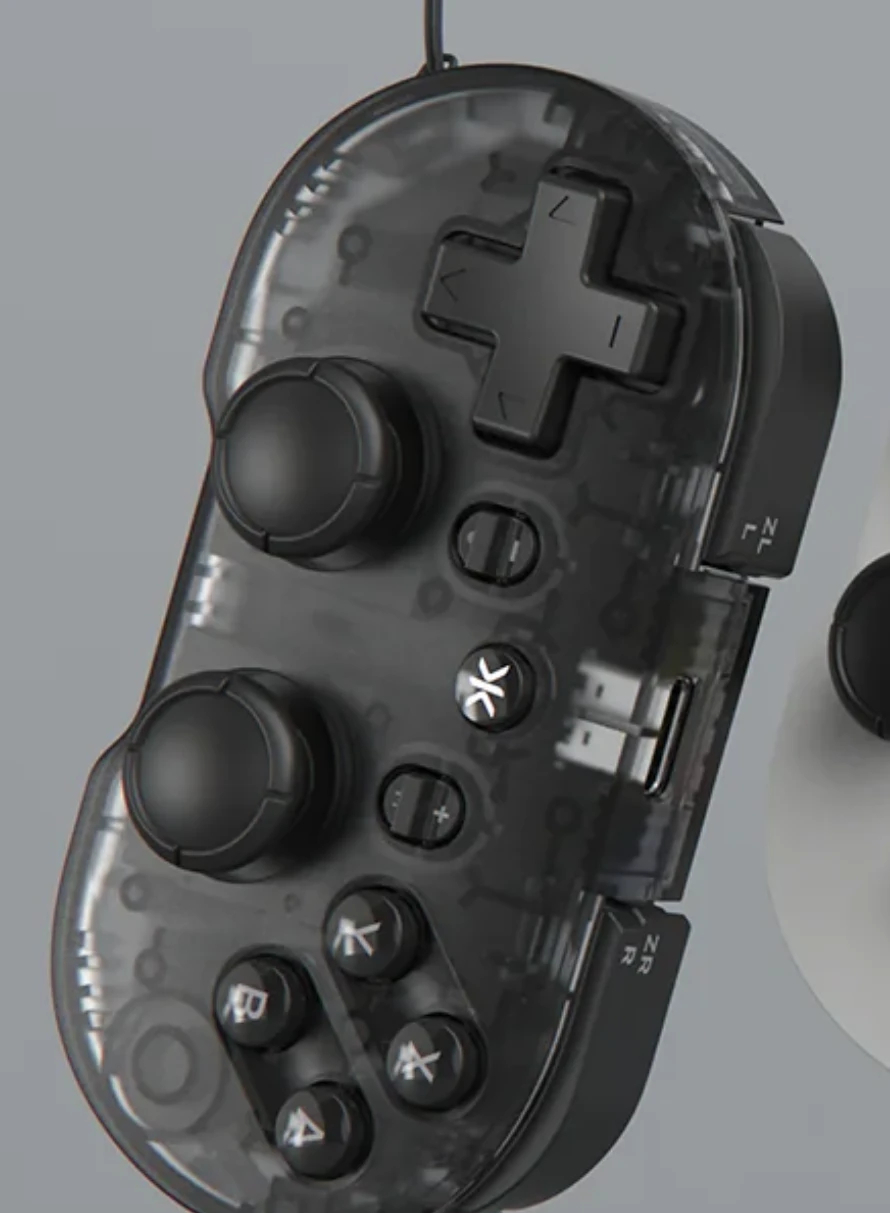
CRKD has squeezed a pair of analog thumbsticks, shoulder buttons, triggers and rumble feedback into a gamepad roughly 3.5 inches wide, and it is selling the result for $29.99. The Atom Plus, as the device is called, arrives as portable controller makers test how much console-grade functionality can be crammed into a pocket-sized shell before ergonomics give out.
The device is about half an inch narrower than 8BitDo’s Zero 2, a controller that has long served as a travel standby for players who need something smaller than a full-size pad. Where the Zero 2 forgoes analog sticks, the Atom Plus includes a symmetrical pair built on tunneling magnetoresistance technology, a sensor design marketed as resistant to stick drift.
Beyond the sticks, the feature list reads like that of a much larger controller: a dedicated home button, motion controls, rumble, and remapping through a companion mobile app. The app also reports remaining charge, can disable vibration, and exposes the unit’s product number when a phone is tapped against an NFC chip inside the housing. A pair of dual-function levers on the edge replicate the Switch’s plus and minus buttons along with the screenshot shortcut.
| Feature | CRKD Atom Plus | 8BitDo Zero 2 | Xbox Nano Controller |
|---|---|---|---|
| Price | $29.99 | Lower-cost ultra-compact option | $50 |
| Width | About 3.5 inches | About 4 inches | Noticeably larger than Atom Plus |
| Analog thumbsticks | Two, TMR anti-drift | None | Two, standard potentiometer |
| Triggers | Digital microswitch | None | Analog |
| Rumble | Yes | No | No |
| Headphone jack | Not specified | No | No |
| Battery | Rechargeable, app-monitored | Not specified | 500 mAh internal, about 5 hours |
| Platform support | Switch, Switch 2, PC, Android, iOS, smart TVs | Switch and others | Xbox, PC, iOS, Android |
Note: Specifications for the Zero 2 and Atom Plus reflect the features described in reporting on the two devices; battery figures for the Atom Plus were not disclosed.
Like most third-party pads, the Atom Plus is a multiplatform device, working with the Switch and Switch 2, PCs, Android and iOS handsets, and various smart TVs. Moving between them means powering on while holding the home button plus a direction on the D-pad to enter the correct Bluetooth mode. The sequence is simple enough in practice but easy to forget, and the pairing directions are not printed on the controller’s rear despite the technical information already etched there.
The compromises show up in the hands. The face buttons and D-pad have a soft, responsive feel, but the front panel is crowded: pressing down or right on the D-pad tends to catch the thumb of anyone with larger hands on the left stick. The shoulder buttons and triggers both use digital microswitches, which rules out the progressive acceleration that racing titles rely on. The two rows sit at slightly different heights to help fingers tell them apart, though the separation is subtle enough that the triggers are occasionally hit by mistake.
The thumbsticks themselves are close in size to those on the original Switch Joy-Con, and therefore smaller than the Switch 2’s. They carry a little more tension than Nintendo’s, which helps with fine adjustments given the short travel available.
CRKD is not alone in chasing this category. Microsoft recently announced the Xbox Nano, a $50 pad that weighs just over 100 grams, roughly a third of a standard Xbox Series controller. The Nano adds analog triggers and a roomier layout with stubby grips, trading the Atom Plus’s extreme compactness for something easier to hold. It also drops rumble and the 3.5 mm headphone jack, relies on smaller potentiometer sticks rather than magnetic sensors, and carries a 500 mAh battery rated at about five hours per charge — a figure that compares poorly with the 8BitDo SN30 Pro, which uses the same capacity to deliver 10 to 20 hours.
Connectivity is another dividing line. The Nano pairs cleanly with Xbox consoles, Windows machines, iOS and Android, and supports low-latency Wi-Fi cloud gaming using technology of the kind found in Google Stadia and Amazon Luna. On Steam OS, however, it has required re-pairing after each power cycle, with inputs failing to register until the connection is re-established. Microsoft’s decision to cap cloud gaming at 15 hours a month for Game Pass Ultimate subscribers, rolling out in waves during November 2026 and not carrying over between months, may also narrow the appeal of a Wi-Fi-first controller.
For buyers, the choice comes down to what a second controller is for. The Atom Plus is positioned as a travel accessory — something that disappears into a bag and covers the games that need sticks — rather than a daily driver. At $29.99 it undercuts the Nano by $20 while offering rumble and drift-resistant sensors, but it asks players to accept a cramped face layout and digital triggers. The Nano, for its part, costs more and still makes its own sacrifices on battery life and haptics.
Both devices suggest the portable controller segment is converging on a similar answer: small enough to carry, capable enough to be useful, and never quite a substitute for the pad already sitting under the television.