Access4 has integrated Microsoft Teams calling into its SASBOSS platform, enabling channel partners to sell three voice platforms through a single wholesale service.
The UK-based cloud communications provider has added Teams calling through UCTeams, its Microsoft-certified operator connect service. The integration allows partners to offer customers a choice of Microsoft Teams calling, hosted voice or a combination of both, while managing quotations, provisioning and billing through SASBOSS.
The platform is designed to simplify the management of multiple voice services, which have traditionally required separate suppliers, portals, contracts and invoices. Access4 says the integration will allow partners to serve businesses with different communications requirements without managing multiple wholesale relationships.
“Teams calling on its own is a price comparison, and nobody needs another one of those,” said Jonathan Walker, CEO UK and Ireland at Access4. “The margin sits in what goes alongside it. Bringing Teams into SASBOSS means partners can sell it next to the voice services they already offer, then build each account out with contact centre, recording and integrations from the same platform. That is how a voice line becomes a long-term customer.”
SASBOSS is organised around three areas: unified communications, customer experience and user experience. Partners can use the platform to add contact centre services within Teams, call recording through Dubber and other user experience tools. Access4 operates a wholesale billing model, invoicing partners rather than end customers. This allows partners to set their own prices, manage customer billing and retain their margins across the services they provide.
In a live appearance on Bloomberg TV, James Christopher Giancarlo, former chairman of the US Commodity Futures Trading Commission which regulates digital commodity and digital asset trading, insisted that America’s growing addiction to prediction markets is a net benefit for society as a whole.
During the interview, Bloomberg anchor Tim Stenovec challenged the former watchdog around the “existential question” posed by prediction markets.
“I have people getting in touch with me on the Bloomberg terminal all the time who are like, ‘I do not want my kids exposed to this stuff,’ like the gamification of everything in society,” Stenovec said. “They don’t see that as a good thing.”
Giancarlo — who now has a cushy life advising the companies he used to regulate, including Polymarket — replied that “like it or not, people like to gamble.”
“Human nature is human nature,” Giancarlo said. “I think there’s a social benefit in prediction markets.”
For the former regulator, that benefit evidently comes from the fact that people are gambling billions of dollars on things like weather patterns and oil prices.
“People like certainty. Why, during a weather condition, is everybody listening to Bloomberg’s weather? Because they want some predictability of the weather,” Giancarlo enthused. “Heretofore there’s been no predictability in things that are actually more important than the weather — interest rates, gas prices, the outcome of elections — those are important things to a lot of people.”
Though Giancarlo said he’s in favor of strong federal regulations around betting markets, he said allowing them to proliferate provides useful data: the so-called “wisdom of the crowd.”
“If you can pull the wisdom of the crowds of tens of thousands or hundreds of thousands, it’s a lot better than your average poll which polls maybe 800 people,” he continued. “I think there’s a social benefit in this, whether you participate in them or not, you may like the data that comes out.”
Of course, Giancarlo’s effusive praise for the gamification of weather patterns deserves some scrutiny. For starters, as the sitting chair of Polymarket’s advisory board, the prediction market guru is about the farthest thing from a neutral messenger.
Nevermind the fact that the “wisdom of the crowd” phenomenon is hotly contested, with critics arguing prediction markets are actually driven by a tiny number of bettors, are heavily weighted toward high rollers, and incentivize insider trading and mass disinformation campaigns.
A recent case-in-point came during the recent presidential elections in Brazil, where far-right candidate Flávio Bolsonaro was overwhelmingly pegged as the favorite on Polymarket — confidence which held up until the moment Luiz Inácio Lula da Silva emerged as the victor.
More on gambling: Gambling Addiction Group in Shambles After It Turns Out It’s Funded by Kalshi
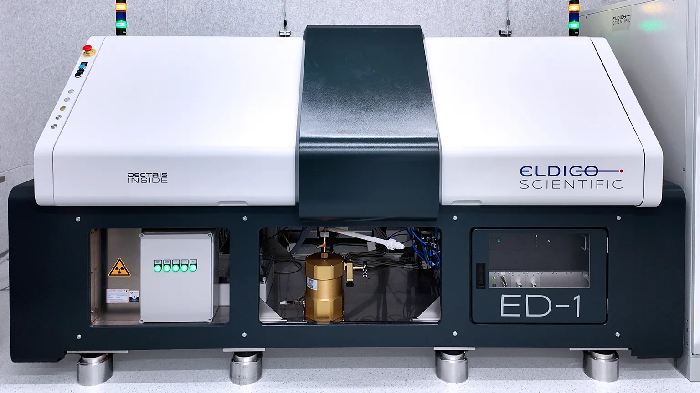
Crystal Pharmatech, a science-driven CRO/CDMO specializing in solid-state research, preformulation studies, and formulation development and manufacturing for small-molecule drugs, today announced that installation of the ELDICO ED-1 electron diffractometer at its Suzhou, China R&D center is complete. The instrument, the first ELDICO ED-1 installed in the Asia-Pacific region, is now operational, and MicroED services on the ED-1 are open to clients worldwide.
Eldico ED-1. Image Credit: ELDICO Scientific AG
Crystal Pharmatech launched MicroED services in 2021, using a cryo-electron microscope (cryo-EM) for data collection. The ED-1 now adds a dedicated, automated platform in the company’s own laboratory:
Built for diffraction. The ED-1 is designed specifically to collect electron diffraction data from small-molecule crystals, with a horizontal beam path, a 5-axis goniometer, and a DECTRIS QUADRO hybrid pixel detector
Automated. Automated calibration and data processing, and support for unattended operation, allow more crystals and more forms to be measured in less time
In-house. The instrument sits beside Crystal Pharmatech’s screening and crystallization teams, making MicroED a routine step in solid-form screening and selection
Working with an ELDICO Scientific AG team on site, Crystal Pharmatech had the instrument running and collecting its first diffraction data within three days of installation. The ED-1 is housed on the first floor of the company’s Crystal Building, in a room originally designed as a livestream studio. With MicroED inside, the sign at its entrance, “Crystal Live”, takes on a new meaning: bringing crystals to life by revealing their structures. Clients and partners visiting the Crystal Campus in Suzhou are welcome to see the instrument in operation.
Forms identified in a screen can now be taken directly to a crystal structure, without growing large single crystals. Clients can request:
Crystal structures and absolute configuration from sub-micron powders, from as little as 1 mg
Identification of hydrates, solvates, salts, and cocrystals, and of individual phases in mixtures
Structurally resolved polymorph landscapes to support form selection, patent and regulatory filings, and crystal structure prediction (CSP)
Standard results are delivered in one to two weeks. An expedited service delivers analysis and report in as little as 48 hours after samples and written approval are received. Projects are covered by Crystal Pharmatech’s No Structure, No Fee commitment under agreed terms.
“Five years after launching MicroED on a cryo-EM instrument, we now have a dedicated, automated electron diffractometer in our own laboratory,” said Dr. Alex Chen, Co-founder, Chairman and CEO of Crystal Pharmatech. “It was collecting data within three days of installation, and I can already see it becoming a workhorse for our solid-state research. Clients can now ask for the structure of each form a screen finds, quickly and on very little material.”
We’re pleased to see the ED-1 in service at Crystal Pharmatech. Their team brings extensive experience in solid form research, and the instrument’s automated operation makes it easier to include crystal structure determination in their everyday screening work. This is exactly how we intended the ED-1 to be used, helping scientists make informed decisions during pharmaceutical development.”
Dr. James Berwick, CEO, ELDICO Scientific AG
See MicroED in Boston on November 19
Scientists in the Boston area can see MicroED in practice at Crystal Pharmatech’s Boston Symposium & Executive Networking Reception, “First Time Right,” on Thursday, November 19, 2026, 12:00–7:00 pm, at the Boston Marriott Cambridge, Kendall Square. MicroED features in three parts of the program:
Talk: Gustavo Santiso-Quiñones, Ph.D., Co-founder of ELDICO Scientific AG, “Too Small for SCXRD, Too Complex for XRPD: 3D ED/MicroED for Sub-Micron Crystal Structure Determination”
Poster: Crystal Pharmatech and ELDICO Scientific AG, “What Is the Probability of Electron Diffraction Success on Routine Polymorph Screening Isolates? A Systematic Benchmark Across All Solid-Form Categories”
Poster: ELDICO Scientific AG, “(Automated) Electron Diffraction / MicroED: A New Tool for Pharmaceutical Solid-State Characterization”
The poster authors will be on hand during the networking break and throughout the reception.
Dr. Alex Chen, Co-founder, Chairman and CEO of Crystal Pharmatech, and Dr. James Berwick, CEO of ELDICO Scientific AG, will also attend and will be available to meet with interested attendees in person.
The program also includes talks on solid-form selection, crystal structure prediction, and formulation for challenging molecules, with speakers from Biosimulytics, Accent Therapeutics, and Arvinas, and a panel with experts from Novartis, Spolia Therapeutics, Ironwood Pharmaceuticals, and EyePoint. Attendance is free for qualified biotech and pharma R&D professionals, and places are limited.
Register for the Boston Symposium:
The ED-1 was announced in April 2026 as part of an expanded collaboration between Crystal Pharmatech and ELDICO Scientific AG:
1. This person found these crystals on their phone charger, which is a pretty sure sign that their phone battery might explode soon:
2. This person grabbed onto a Pitohui bird, which is one of the few birds in the world that can poison you with venom. Lucky!
3. These people decided to sled on a runaway truck ramp, on exactly the kind of day that a runaway truck ramp might be needed:
4. This person maybe let the stove get a little too hot:
Advertisement
Advertisement
Advertisement
Advertisement
Related: "29 Wild Bachelor Party Stories That Crossed Every Possible Line"
5. This person found some phosphorus, which was actively smoking, because — spoiler alert — it's intensely flammable:
6. This person's mirror nearly started a house fire just from the sun:
7. This person forgot that airbags are a thing and basically turned their steering wheel into a grenade:
8. This person's roommate left their Teflon pan on the burner for hours and superheated it, possibly releasing toxic gases into the air:
Advertisement
Advertisement
Advertisement
Advertisement
9. This person's parents left a concave mirror by the window, nearly starting a house fire:
10. This person rescued a "dog" that was actually very much a coyote (and could have had rabies):
Related: "These 37 Fails From Last Week Made Me Laugh So Hard I Think I Have Abs Now"
11. This guy soaked his nicotine pouches in raw deer blood, which is just begging for a prion disease:
12. This person picked up a blue-ringed octopus, one of the most venomous creatures on the planet:
Advertisement
Advertisement
Advertisement
Advertisement
13. This person's sister failed to empty her dryer's lint trap for...IDK, years? Which is fire-hazard central:
14. This person found a bunch of potatoes that had lived in the cellar for a year (which can be deadly if they start to rot because of the gases they give off):
15. This person thankfully didn't light their crystal with pyrite (fool's gold) in it because when you burn pyrite, it releases sulfur dioxide:
Related: "Are These People Actually The A-Hole Or Not?"
16. This person was — I hope and pray — just making a joke about keeping the trucks running:
Advertisement
Advertisement
Advertisement
Advertisement
17. This person found an old uranium water crock that you were supposed to drink out of (?!?!?!):
18. This person picked up what they thought was a rat snake (spoiler alert, it was a rat...tlesnake):
19. This person found their grandma's "cooking spoon":
This spoon is an example of vintage enamelware, which contained lead and cadmium before the 1970s. All of that lead coating ended up in grandma's food over the years.
20. This is just...not how stairs work:
Advertisement
Advertisement
Advertisement
Advertisement
21. This person found an American dagger moth caterpillar, whose hairs can cause hives and a burning sensation on the skin. So, while it might not kill you, it could definitely hurt:
22. This person found a tea for sale that we all hope is just named "Lily of the Valley." Because if it was actually tea made out of lily of the valley — you know, the severely poisonous plant — that would be bad:
Related: "13 "Unsolved" Mysteries Where Pretty Much Everyone Considers Solved"
23. This person found a "levitating" tree, which they hopefully got far, far away from as quickly as possible:
24. This person better not have plugged those in:
Advertisement
Advertisement
Advertisement
Advertisement
25. This person's landlord found a solution for a wet carpet, which was leaving this plugged in and running all day:
26. This person found themselves following a Final Destination truck that was even scarier than the truck in the actual movie:
27. And finally, this person was just holding a straight-up piece of raw uranium ore:
Your daily brain workout: You're One Of The Smartest People I Know If You Can Solve This Word Puzzle
Also in Internet Finds: "Ex-Cult Members Are Sharing The Moments They Realized Something Was Wrong"
Also in Internet Finds: "Crime Scene Investigators Are Sharing The "Most Horrific" Case They've Worked On"
Nearly 15 years worth of hard-won pollution reduction efforts are set to be undone in the United States, as a wave of data centers powered by gas plants enters construction.
That’s according to a new analysis by the Sierra Club, first reported by Bloomberg, which notes that the US energy grid is expected to belch out 2.1 billion metric tons of carbon dioxide by 2030, assuming the country’s currently-planned AI developments enter operation as scheduled.
That’s a massive rise compared to even 2025 — itself a near-record year for US carbon emissions. If the AI industry and its data center developers get their way, the analysis found, emissions will likely skyrocket by 42 percent over the five-year period, an expected increase of 618 million tons compared to 2025.
“The numbers continue to sort of boggle our minds,” the Sierra Club’s principal advisor for climate and energy Jeremy Fisher told Bloomberg.
Due to major bottlenecks in the electrical grid, many data center developers have opted for on- or near-site power plants, which are overwhelmingly fueled by noxious fossil fuels. Projects like Elon Musk’s 1.2 gigawatt data center near Memphis are already choking out residents with fleets of methane generators, which legal experts say flaunt all kinds of local permitting and federal environmental regulations.
Still, for anybody banking on having clean air to breathe, there is some hope. The number of data center projects at risk of cancellation is rising precipitously as time goes on — driven by grass roots organizing and increasing financial pressures.
So if you’re one of the many activists mounting opposition to data centers in your community, just know that the benefits of a cancelled hyperscale facility extend far beyond your backyard.
More on data centers: Thieves Are Making a Fortune Heisting AI Data Center Equipment
South Korean researchers have developed a software technology that blocks neighbors from peeking at a foldable phone screen by exploiting the reflection that appears between the two displays when the device is folded halfway like a laptop. Because it requires only software on commercially available foldable phones—no special films or extra components—observers say it could be commercialized as a smartphone security feature.
POSTECH announced on the 10th that Professor Hwang In-seok and master’s student Lee Kyu-sik of its Department of Computer Science and Engineering, working with Professor Han Joon of KAIST’s School of Computing, developed the privacy protection technology “Fold2Unfold,” which uses screen reflections. The results were presented at ACM UIST 2026, an international academic conference on user interfaces held in Detroit from November 2 to 5, and received a Best Demo Award. The honor is given to only six of the 127 demos accepted and presented at the main conference—one top prize and five awards of excellence.
So-called “shoulder-surfing attacks”—stealing passwords or personal information by peering over someone’s shoulder at their screen on public transit and in other public places—have recently emerged as a social problem. Privacy films sold on the market narrow the viewing angle of a screen, but they have a limitation: they cannot block the gaze of someone standing directly behind or pressed close to the side.
The research team focused on the fact that when a foldable phone is folded halfway like a laptop, light from one screen reflects off the opposite screen like a mirror. The core of the technology is turning this reflection—normally an annoyance—into a means of hiding information. Fold2Unfold splits a single number into two images and displays them on the two screens. Each image, viewed on its own, is a fragment that cannot be interpreted.
Only when the directly viewed image and the reflected image align precisely does the original number become readable to the user’s eyes. From any other angle, the two images fall out of alignment and appear as a jumbled pattern. The team corrected the problem of the reflected image appearing darker than the real one so that the two blend into a single, natural-looking screen. To keep the screen readable even when the user moves their head slightly, the smartphone’s front camera tracks the user’s eye position in real time and calculates the folding angle, adjusting the position and shape of the two images accordingly.
The performance gap was clear in experiments. With conventional protective films, most numbers could still be read even from 30 degrees to the side, but with Fold2Unfold, numbers became nearly unrecognizable just 7.5 degrees off the user’s line of sight. Assuming the phone is viewed from a distance of 35 centimeters, that corresponds to a difference of about 4.6 centimeters. In effect, the screen cannot be read unless someone is looking from within the user’s own face space. In an experiment recreating PIN entry, nearby observers could identify an average of only 0.65 of the 10 keypad digits.
Category
Conventional privacy film
Fold2Unfold
Angle at which screen is readable
Most numbers readable even at 30 degrees to the side
Unreadable when 7.5 degrees off the user’s line of sight
Deviation at 35cm viewing distance
About 20cm
About 4.6cm
Digits identified by bystanders during PIN entry
Most identified
Average of 0.65 out of 10
Additional hardware
Requires attaching film
None (software implementation)
Note: Angle and distance figures are based on the experimental conditions disclosed by the research team.
The technology could be useful when handling personal information, such as entering a mobile banking password or checking sensitive messages. In particular, because it is implemented purely in software without extra components, observers say foldable phone makers may adopt it as a default security feature. The growth of the foldable phone market—with larger exposed screen areas and more varied use cases in the folded state—is also cited as a backdrop for broadening the technology’s applications.
Lee Kyu-sik, a POSTECH master’s student and the paper’s first author, explained, “The goal was to let users read the screen normally while making it hard for people around them to make it out. We focused on keeping the screen looking natural even as eye position or folding angle changes.” Professor Hwang said, “It is meaningful that we turned the screen reflection, which was considered a nuisance, into a means of protecting user information. I hope this serves as a catalyst for more active privacy protection research that leverages the physical characteristics of devices.”
LOS ANGELES — Grand Theft Auto has never been much for following the rules.
Nearly three decades after a video game built around stealing cars, outrunning police and embracing criminal mayhem first arrived, the franchise has survived controversy, transformed open-world gaming and become one of the biggest sellers in entertainment.
Now, after a 13-year wait since its last main instalment, Grand Theft Auto VI is preparing for another big score. The latest chapter arrives Nov 19 with a return to the neon-soaked streets of Vice City with two protagonists.
For longtime fans, GTA VI is a highly anticipated return. For everyone else, here’s what to know about the blockbuster video game, its characters and the enormous business riding on its release.
Why is Grand Theft Auto such a big deal?
The franchise began in 1997 as a relatively simple, top-down game that allowed players to roam fictional cities, steal vehicles, evade police and commit crimes.
The release of Grand Theft Auto III in 2001 helped redefine open-world gaming. It gave players greater freedom to explore a sprawling three-dimensional city, pursue missions and interact with their surroundings.
Later installments expanded that freedom with larger environments, cinematic storytelling, social satire and detailed worlds. The influence reached far beyond games about stealing cars.
Ubisoft’s Assassin’s Creed series brought open-world exploration to historical settings, while Bethesda’s The Elder Scrolls games expanded their own longstanding tradition of open-ended fantasy role-playing.
Nintendo’s The Legend of Zelda: Breath of the Wild later emphasised experimentation and discovery, allowing players to use the environment itself to solve problems.
For Grand Theft Auto: San Andreas and Grand Theft Auto V, Rockstar Games recruited real-life gang members to help bring authenticity to background characters and dialogue.
Former writer and audio director Lazlow Jones has said some performers challenged scripted lines, prompting developers to let them use language drawn from their own experiences.
That attention to detail helped create the sense of a living world that became a hallmark of the franchise, even as the series drew criticism for its depictions of violence, crime and women.
But controversy did not stop the franchise’s commercial rise.
According to publisher Take-Two Interactive, the franchise has sold more than 470 million units worldwide. Grand Theft Auto V, released in 2013, accounts for more than 230 million of those units and reached US$1 billion (S$1.2 billion) in retail sales in just three days.
Its online multiplayer component, Grand Theft Auto Online, has helped keep players engaged through years of updates, new activities and in-game purchases.
A billboard for the video game “Grand Theft Auto VI” is pictured above Hollywood Blvd. on Nov 4, in Los Angeles. PHOTO: Associated Press
What’s the story behind Grand Theft Auto VI?
This time, the action returns to Vice City, Rockstar’s fictional version of Miami, and expands across the surrounding state of Leonida, a Florida-inspired setting filled with beaches, highways, nightlife and criminal enterprises.
At the centre are Lucia Caminos and Jason Duval, a couple trying to improve their circumstances through a life of crime. Lucia has recently been released from prison while Jason, a former soldier who became involved with drug runners in the Leonida Keys, is looking for a different path.
Their plans become more complicated when a seemingly straightforward criminal job goes wrong, drawing them into a conspiracy that stretches across Leonida.
The trailers suggest a story mixing romance, robberies, betrayals and the series’ familiar satirical take on American culture.
Rockstar has revealed several supporting characters, including bank robber Raul Bautista, aspiring music executive Dre’Quan Priest and nightclub owner Boobie Ike.
Who’s in the cast?
Rockstar has kept much of the voice cast under wraps, including the performers behind Lucia and Jason.
One familiar actor has confirmed his involvement: Stephen Root, known for his work in Office Space, King of the Hill and Barry. He told The Associated Press in September that he appears in the game, adding that fans had already recognised his distinctive voice in promotional footage.
Root has been identified in reports as the voice of Brian Heder, an aging drug runner operating out of the Leonida Keys. Rockstar has introduced the character but has not publicly confirmed Root’s casting in that specific role.
What makes this instalment different?
Beyond the return to Vice City, one of the biggest changes is the focus on two protagonists whose relationship drives the story.
Grand Theft Auto V featured three playable main characters. The new instalment centres on Lucia and Jason as partners navigating the criminal underworld together.
Rockstar has promoted a larger, more detailed setting that stretches beyond the city into the wider state of Leonida. The game also arrives in a vastly different technological landscape from its predecessor, with newer consoles capable of supporting more elaborate environments and character interactions.
But not every detail is known. Rockstar has offered trailers and promotional previews, while questions remain about the full range of activities, how the game’s systems will work and the future of its online multiplayer experience.
What about the music?
Music has long been part of Grand Theft Auto’s identity. It has included everything from fictional radio stations to the songs accompanying players as they cruise through the game’s cities.
Grand Theft Auto VI is expanding that tradition with an original score by Justice, the Grammy-winning French electronic duo of Gaspard Auge and Xavier de Rosnay.
Rockstar says the score adapts to players’ actions and experiences throughout the game, shifting with the environments and situations they encounter.
A 30-track score album is scheduled for Dec 11, featuring collaborations with artists including Tame Impala, SZA, King Gizzard & The Lizard Wizard and Gesaffelstein.
The game also features in-game radio stations and a separate collection of original songs, continuing the franchise’s connection to popular music.
Microsoft just filed a patent for an AI product that would be able to transform live video in real time to alter speakers’ words and faces.
The patent, as first flagged by patent-tracker Patentlyze, is described by its inventors as a “near real-time artificial intelligence (AI) enhancement of video or augmented reality (AR) presentations of live events.”
Using AI agents, the system would identify and alter or remove certain words, while editing a speaker’s face and mouth to match. The agents would rely on set parameters or user profiles to make the changes, and would also edit the video and audio just before and after a removed or replaced word to allow for “smooth transitions.”
In an era of media and the internet increasingly defined by AI-fueled deepfakes, disinformation, and information-muddling slop, the system described in this patent may represent a new world of filtering tools that subtly alter reality as it takes place, in this case on a highly-personalized level. Viewers, the patent suggests, could consume whatever live event they want to without hearing what they don’t want to hear.
The potential use cases floated in the patent vary. One possible application is real-time translation, with the system allowing for broadcasts and other live footage to be both heard and seen in a viewer’s preferred language.
The patent also posits that such a tool could be used to remove filler words like “um” or “ah” from live speech, or to erase stutters or speech impediments.
Other possible use cases, though, go much further. According to the patent, the system could be used to cut down on “personal words or phrases” like “coined terms,” as well as “colloquial terms” like the term “y’all” or the phrase “bite the bullet.” The patent also claims that the system could eliminate “mumbled words, mispronounced words, misused words, misspoken words, offensive words, insensitive words, or inappropriate words.” Replacement words, it adds, may come from an “internet search.”
In other words, live broadcasts may not be so live anymore after all.
Microsoft didn’t immediately respond to a request for comment.
Dubbing has existed for ages, and video footage is edited all the time, both for normal and for insidious reasons. Automatically editing live videos in this way with the help of AI agents, however, could change how audiences fundamentally engage with live footage. As it stands, if people don’t like what they hear, they can simply turn something off; the system outlined by Microsoft describes an environment where people can instead adjust someone else’s speech to their personal taste. Language translation aside, does using a tool that eliminates errors, or erases words and phrases associated with a speaker’s local dialect, move us further into personalized bubbles? What’s so bad about hearing someone from the South say “y’all?”
To that end, the patent does mention that an event’s original live video and audio may be recorded and stored for the sake of “ground truth,” nodding to potential misuse and confusion that could arise from such a tool.
The kinds of live footage that could be transformed by the system include lectures, presentations, a range of television productions — awards ceremonies, game and cooking shows — and live sports, among several others.
More on Big Tech patents:Meta Patents Technology to Detect Your Mood by Constantly Analyzing Your Tone of Voice
Test cricket approaches its 150th birthday, its near-century-and-a-half-long existential crisis still burbling and bubbling away, with a strange bill of health. The doctor’s notes, where legible, suggest it is dangerously ill, regenerating, thriving, clinging on the precipice, undiagnosable, and responding well to treatment.
Against the prevailing trend of modern cricket, there have already been three draws – there were only eight in the 120 Tests played over the previous six seasons, from 2023-24 to 2026. Zimbabwe and Afghanistan, in a match to place alongside some of the most bowler-unfriendly and result-averse ever played, became the first teams to play in a Test with three 500-plus scores (it has only happened twice in all first-class cricket, in more than 60,000 matches). For much of Test history, three draws in seven Tests would have been the norm. Nowadays it is joltingly unusual, but not, I both think and hope, a sign of a return to the days when many teams played Test matches as if trying to eradicate the concepts of hope and joy from the entire universe.
Anyone watching South Africa’s brilliant come-from-numerous-behinds series victory against Australia in October would think the five-day game was well set for another 150 years, particularly if they ignored the size of the crowds at the first two matches. It illustrated the capacity for narrative fascination and variety that has enabled Test cricket to endure for a century and a half, as a mutated but still discernibly direct descendant of Melbourne 1877.
This was a soul-stirring cocktail of modern and old-school Test cricket – strategic grind, T20-enhanced flamboyance, patience, recklessness, collapses, dogged resistance, high-grade skills, technical shortcomings, enrapturing brilliance and befuddling errors. And its fluctuating dramas churned out statistics that, should you find yourself attempting to persuade a friend, family member, passer-by, AI bot, blind date or boss that Test match cricket is in a dynamic state of evolution, would strongly support your argument.
Firstly, South Africa’s come-from-behind victory was the sixth in the 20 three-Test series that have begun this decade. There were also four such victories in the ten series of more than three Tests in the 2020s (plus England’s 3-1 win in South Africa in 2019-20, in which the first Test was played before New Year).
There were only six come-from-behind wins in 116 three-Test series in the 2000s and 2010s combined, and six out of 156 from the birth of Test cricket to the end of the second millennium. There was a flurry of three in fewer than 12 months, beginning with South Africa’s 2-1 win against New Zealand in 1994-95.
In all, one-third of all series of more than two Tests played this decade have had a come-from-behind win. Previously, just 8.2% of such series featured a come-from-behind win. When Ian Botham inspired England to recover from a 1-0 deficit in the 1981 Ashes, it was only the third time any team had won a series from behind since Jim Laker spun Australia to oblivion in 1956.
The near extinction of the drawn Test has helped drive the startling increase in the number of come-from-behind series wins.
Another important factor has been a significant improvement in the performance of away teams in the first matches of series. (Excluding draws, the win:loss ratio of 0.84 wins per defeat has risen considerably from 0.59 in the 2000-2019 period, and 0.47 from 1980 to 1999.)
Using the First Law Of Statistics, which states that you can prove whatever you want if you ask the numbers nicely, you could try to use these figures to prove that the best preparation for touring teams is not to prepare at all. It is perhaps the case that the modern global cricket calendar means that home sides’ players are often equally underprepared, and sometimes even more unready, than tourists. Importantly, when schedulers allow their teams to play more than two matches, Test cricket’s series narratives are more dynamic and less predictable than ever.
(Incidentally, the survival of Test cricket through the 1960s, when nearly half of all Tests were drawn, many of them amidst a level of turgidity and strategic caution that could have been used as a general anaesthetic in all but the most serious medical operations, is one of the game’s more remarkable stories. Were it not for West Indies – the only team to draw under 40% of its Tests in a decade when the world in general was embracing sex, drugs and rock’n’roll – and the belated advent of professional one-day cricket, the sport could quite feasibly have toddled off into well-deserved oblivion whilst a weeping scoreboard displaying 340 for 4 off 150 overs hurled itself into an erupting volcano.)
The third Test, in Cape Town last month, contained 11 ducks (equalling the Test record) and 11 scores of 50-plus. There had never previously been a Test with ten or more of both. This record-splattering stat highlights how the game swung, clatters of wickets interrupting periods of seemingly easy batting, and how Australia, from 370 for 4, contrived to lose by 176 runs, the third heaviest defeat ever suffered by a team that has been 40 runs ahead batting second with six or more wickets left.
The first and third Tests were also unusually long by the wicket-festooned standards of the modern game. At 360.1 overs and 399.3 overs respectively, they were the longest Tests in South Africa since January 2020, and the second and third longest in the last ten years.
In the 1960s, were it not for West Indies – the only team to draw under 40% of its Tests – and the belated advent of professional one-day cricket, the sport could quite feasibly have toddled off into well-deserved oblivion
That Test matches lasting 360 overs feel like relative epics is notable in itself. Since 2023, only 16% of Tests have exceeded 360 overs, so to have two in a series is wildly exciting for any cricket lovers who (a) want their sport to distract them from the reality of the real world for as long as possible, and (b) find that the drama and novelty of rapid-action bad-pitch shootouts has decreased with increasing familiarity. (Since 2024, 12 out of 117 Tests have been completed in fewer than 180 overs. There were none whatsoever in the 645 Tests played from 1951 to 1983.)
South Africa’s victory was driven by their proven stars performing on the biggest stage, as well as by players without bulging Test CVs making big impacts at critical moments. Before their series-defining second-innings centuries in Cape Town, Ryan Rickelton and Wiaan Mulder had batted a combined total of 28 times in Tests against other teams in the current top five in the world rankings (India, Australia, England, New Zealand), and failed to make a half-century.
They helped South Africa add to their phenomenal record in final Tests that began with the teams level in the series. This was South Africa’s 11th such game since 2000 (counting only series of at least three matches). They have won seven, drawn two, lost two, comfortably the best record of any team in deciding final Tests this millennium. Australia lie bottom of that particular league table, their equivalent record now standing at played ten, won two, drawn two, lost six. Discuss, with reference to assumed national cricketing stereotypes.
This was a gripping and encouraging series, a shot in the arm for five-day cricket, and a brilliant win for South Africa, whose recovery as a Test force has been one of the great stories in the sport over the last few years, and, I think, a loudly honking endorsement for the flawed but vital World Test Championship.
Andy Zaltzman is a stand-up comedian, a regular on BBC Radio 4, and a writer
In 2025, China accounted for 45% of cases in the eight major markets.
Diagnosed glioblastoma (GBM) cases in the eight major markets (8MM) are set to increase at an annual growth rate (AGR) of 0.81% to over 66,000 in 2035 from over 61,000 in 2025.
These countries include the United States, France, Germany, Italy, Spain, the United Kingdom, Japan, and China.
According to GlobalData, China will have the highest number of cases, with 29,000, whereas Japan will have the fewest diagnosed cases, with 1,800.
In 2025, China accounted for 45% of all diagnosed GBM in the 8MM due to its large population.
“Further research into targeted chemotherapy and increased focus on screening may increase 5-year survival,” Casey Freimuth, senior epidemiologist at GlobalData, said.