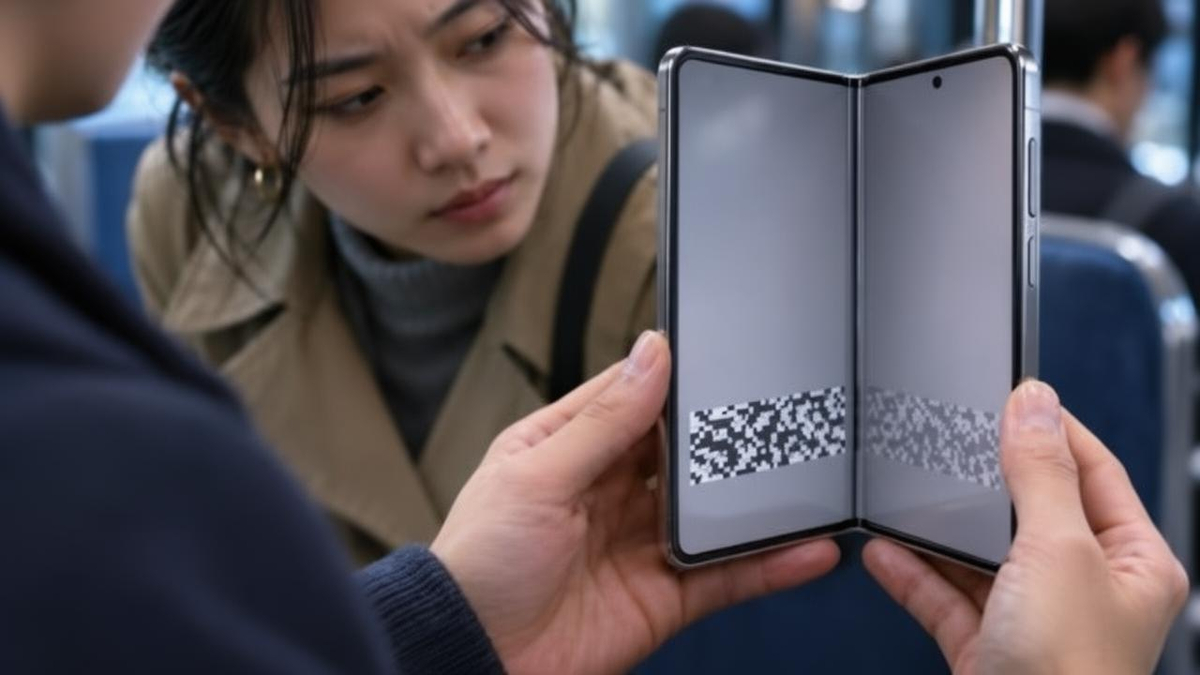
South Korean researchers have developed a software technology that blocks neighbors from peeking at a foldable phone screen by exploiting the reflection that appears between the two displays when the device is folded halfway like a laptop. Because it requires only software on commercially available foldable phones—no special films or extra components—observers say it could be commercialized as a smartphone security feature.
POSTECH announced on the 10th that Professor Hwang In-seok and master’s student Lee Kyu-sik of its Department of Computer Science and Engineering, working with Professor Han Joon of KAIST’s School of Computing, developed the privacy protection technology “Fold2Unfold,” which uses screen reflections. The results were presented at ACM UIST 2026, an international academic conference on user interfaces held in Detroit from November 2 to 5, and received a Best Demo Award. The honor is given to only six of the 127 demos accepted and presented at the main conference—one top prize and five awards of excellence.
So-called “shoulder-surfing attacks”—stealing passwords or personal information by peering over someone’s shoulder at their screen on public transit and in other public places—have recently emerged as a social problem. Privacy films sold on the market narrow the viewing angle of a screen, but they have a limitation: they cannot block the gaze of someone standing directly behind or pressed close to the side.
The research team focused on the fact that when a foldable phone is folded halfway like a laptop, light from one screen reflects off the opposite screen like a mirror. The core of the technology is turning this reflection—normally an annoyance—into a means of hiding information. Fold2Unfold splits a single number into two images and displays them on the two screens. Each image, viewed on its own, is a fragment that cannot be interpreted.
Only when the directly viewed image and the reflected image align precisely does the original number become readable to the user’s eyes. From any other angle, the two images fall out of alignment and appear as a jumbled pattern. The team corrected the problem of the reflected image appearing darker than the real one so that the two blend into a single, natural-looking screen. To keep the screen readable even when the user moves their head slightly, the smartphone’s front camera tracks the user’s eye position in real time and calculates the folding angle, adjusting the position and shape of the two images accordingly.
The performance gap was clear in experiments. With conventional protective films, most numbers could still be read even from 30 degrees to the side, but with Fold2Unfold, numbers became nearly unrecognizable just 7.5 degrees off the user’s line of sight. Assuming the phone is viewed from a distance of 35 centimeters, that corresponds to a difference of about 4.6 centimeters. In effect, the screen cannot be read unless someone is looking from within the user’s own face space. In an experiment recreating PIN entry, nearby observers could identify an average of only 0.65 of the 10 keypad digits.
| Category | Conventional privacy film | Fold2Unfold |
|---|---|---|
| Angle at which screen is readable | Most numbers readable even at 30 degrees to the side | Unreadable when 7.5 degrees off the user’s line of sight |
| Deviation at 35cm viewing distance | About 20cm | About 4.6cm |
| Digits identified by bystanders during PIN entry | Most identified | Average of 0.65 out of 10 |
| Additional hardware | Requires attaching film | None (software implementation) |
Note: Angle and distance figures are based on the experimental conditions disclosed by the research team.
The technology could be useful when handling personal information, such as entering a mobile banking password or checking sensitive messages. In particular, because it is implemented purely in software without extra components, observers say foldable phone makers may adopt it as a default security feature. The growth of the foldable phone market—with larger exposed screen areas and more varied use cases in the folded state—is also cited as a backdrop for broadening the technology’s applications.
Lee Kyu-sik, a POSTECH master’s student and the paper’s first author, explained, “The goal was to let users read the screen normally while making it hard for people around them to make it out. We focused on keeping the screen looking natural even as eye position or folding angle changes.” Professor Hwang said, “It is meaningful that we turned the screen reflection, which was considered a nuisance, into a means of protecting user information. I hope this serves as a catalyst for more active privacy protection research that leverages the physical characteristics of devices.”