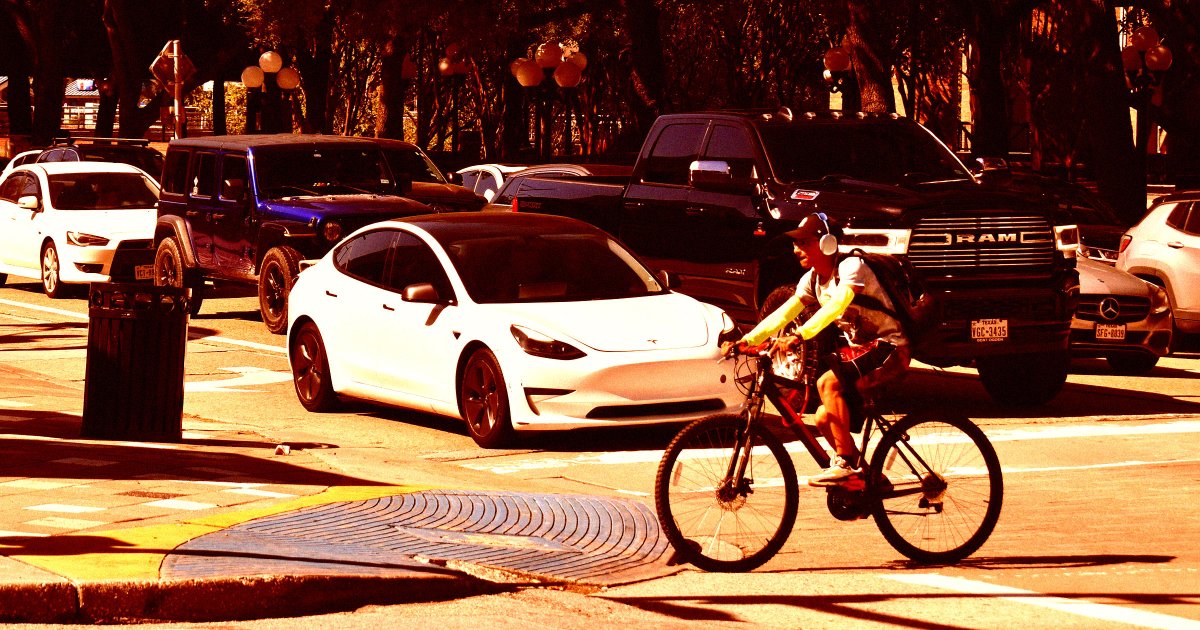
As if cyclists didn’t have reason enough to fear cars on the road, it turns out that Tesla’s self-driving cars hate them as much as human motorists.
In tests of the Elon Musk automaker’s Full Self-Driving software, a team of researchers at the pedestrian and road safety organization Johanna.be found that it frequently made a mockery of traffic laws. The cars blazed through neighborhoods and residential roads well above the speed limit, according to findings spotlighted by Momentum Mag, and kept trying to overtake cyclists, despite it being illegal in Belgium, where the tests were conducted.
In 55 percent of the 30 kilometer per hour zones tested, FSD traveled at an average speed of 44 kilometers per hour. Its system displayed the wrong speed limit to the driver in 90 percent of the zones, cruising through at 50 kilometers per hour despite correctly identifying a sign with the posted limit of 30 kilometers per hour moments earlier.
Its behavior was even worse on cycle streets, which are shared roadways in Belgium designed to give preference to bicycles.
On top of repeatedly trying to overtake the cyclists, “in none of the six tested cycle streets did FSD correctly indicate the applicable 30 km/h speed limit,” the researchers wrote in the report. On several occasions, the supervising driver had to manually abort an overtaking maneuver.
“This evidence suggests that FSD neither recognizes nor appropriately responds to the operational requirements of Belgian cycle streets,” they added.
Strangely, this is despite FSD otherwise driving fairly courteously around pedestrian cyclists, often yielding to them proactively. But this doesn’t “offset the documented failures to comply with speed limits and cycle-street regulations.” The cars, at the end of the day, are careening down low-speed roads that are explicity designed to be more comfortable and safe for pedestrians.
The findings highlight a key tension in the tech’s capabilites, according to the European Cyclists’ Federation.
“Systems like this sit in an uneasy middle ground of driver and vehicle responsibility,” the organization wrote, as quoted by Momentum Mag. “They seem capable and often interact courteously enough, and they are certainly marketed confidently enough that drivers believe they are fully autonomous cars.”
Tesla’s Full Self-Driving software, despite its name, isn’t capable of fully driving itself. It requires constant supervision and demands that a driver be ready to take over at a moment’s notice. The automaker faces a steady barrage of scrutiny and government investigations over the safety of its system, which has been involved in several deadly collisions.
The findings come as Tesla looks to deploy its tech across Europe, where it’s more common for roads to be shared with pedestrians and cyclists than in the US. The continent has long been hesitant to greenlight Tesla’s self-driving tech, but around a dozen countries have recently granted provisional approval, including Slovakia, Belgium, and Finland.
Tesla received a boost after German transport minister Steffen Bilger announced last month that he would back approval of FSD across the European Union, and it soon tellingly agreed to rename its tech “Tesla Assisted Driving” in Europe. If these latest findings are any indication, though, its software still hasn’t been fine-tuned to adhere to European traffic laws.
More on Tesla: Tesla Running FSD Slams Into Police Cruiser After Driver Falls Asleep Behind the Wheel, Hospitalizing Two Officers With Serious Injuries