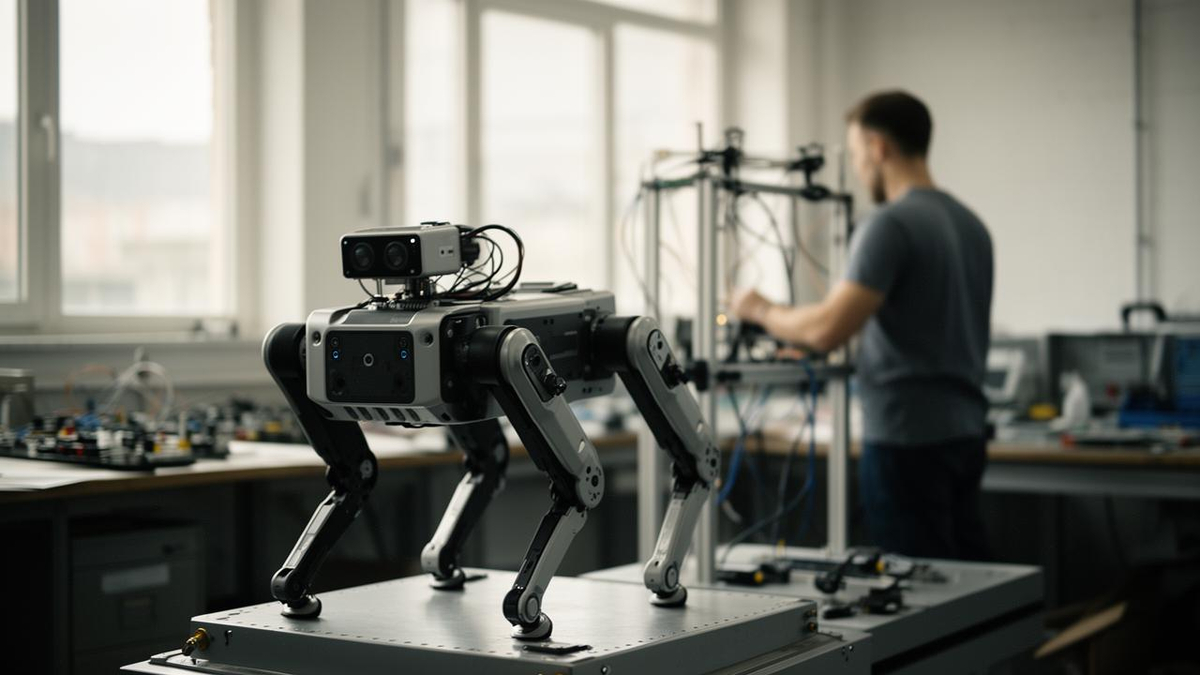
The robotics industry has jumped into a race to transplant generative AI’s success formula onto physical AI, but critics are warning that simply scaling up large models and data will not be enough to achieve general-purpose robot autonomy. Marco Hutter, a professor at ETH Zurich and one of Switzerland’s leading roboticists, predicted that physical AI will advance far more slowly than generative AI.
In an interview held on the occasion of Swiss Robotics Day 2026 in Zurich on the 13th (local time), Hutter said, “The expectation that scaling up a single large vision-language model (VLM) will give robots the general-purpose autonomy to perform a wide range of tasks on their own is overblown.” His point is that robot performance will not improve at the same pace as generative AI simply by increasing model and data scale.
Hutter heads the ETH Robotics Center and the Robotic Systems Lab (RSL), and has co-founded several robotics startups spun out of ETH, including ANYbotics, which commercialized the quadrupedal walking robot ANYmal, as well as RIVR, Flexion, and Gravis Robotics. His research has covered rough-terrain walking robots, mobile manipulators that combine functional robotic arms with mobile platforms, and autonomous excavators.
The industry’s recent buzzword is applying the way generative AI develops to robots. A prime example is the development of robot foundation models, including vision-language-action (VLA) models that extend VLMs—which understand images and language together—to actual robot behavior. The goal is to boost generality by applying a single model across diverse tasks and robots.
Google DeepMind unveiled its latest VLA model, Gemini Robotics 2.5, on the 10th, while Nvidia is building the Isaac GR00T 1.7 VLA model for humanoids along with a development platform that connects data collection, simulation, training, and deployment.
Hutter sees the advancement of foundation models, including VLA, as an important pillar that will drive robotics technology next year. But he drew a line at the expectation that general-purpose autonomy will be achieved simply by extending a VLM’s visual and language understanding into action and scaling up model size.
He also voiced skepticism about the race to secure training data. Across the industry, a method is spreading in which action data is collected by filming people performing tasks or by teleoperating robots, and then fed into AI models for training. The underlying expectation is that feeding in more action data and computing resources will bring robots closer to general-purpose capability.
However, Hutter believes that expanding models and data alone will not solve the reliability and commercialization challenges facing robots. “We are still in the early stages of robotics, and progress is needed across the entire field,” he stressed. “Reliable deployment still requires advances in hardware and safety.”
The decisive difference between generative AI and physical AI is that the judgments produced by AI must translate into movement in the real world. Robots must actually move their motors and joints to make contact with objects, and the movements required vary with an object’s weight and shape, as well as with friction and contact conditions. Unlike generating results in a digital environment, this demands not only AI models but also the reliability of control, sensors, and hardware working together.
For this reason, Hutter judges that the scaling laws that drove generative AI’s progress are hard to apply directly to robots. “Physical AI is advancing too, but I expect the process to be far slower than generative AI,” he said. “Large language models (LLMs) have rapidly improved performance by increasing model size, training data, and compute, but I don’t think the scaling laws of physical systems are the same as those of the purely digital world.”
So where will the next driver of progress come from? Rather than making a single model bigger, Hutter focused on combining AI models with physical learning techniques. He forecasts that the biggest progress next year will come from combining robot foundation models with reinforcement learning and large-scale simulation. Reinforcement learning is a method of learning behaviors that maximize rewards through repeated trial and error.
“Learning physical skills through simulation and reinforcement learning is still undervalued, and so are force and tactile sensing,” he explained. “These techniques address the difficult contact and control problems needed to achieve reliable interaction.”
He also cited agentic behavior—in which robots plan complex tasks on their own, monitor progress, and respond when problems arise—as a major direction for development. “Agentic behavior will help robots plan complex, long-duration tasks, monitor progress, and adapt when problems arise,” he said. “Tactile sensing and sophisticated manipulation skills will help turn these capabilities into reliable physical work.”
He pushed back on the view that as AI advances, differences between robot hardware will shrink and the same intelligence can be applied to various robot bodies. “I want to challenge the assumption that better AI will make robot hardware interchangeable,” he said. “A robot’s physical design determines what it senses, what it learns, and what it can do. Machines must be designed around the tasks they are meant to perform.” He added, “The most powerful products will come from developing hardware and intelligence together.”
His remarks put the brakes on an industry trend in which capital and talent are pouring into robot foundation models and large-scale action data collection. As the VLA model race accelerates, it may highlight that scaling up model size alone makes it hard to secure the reliability and safety that are the gateway to commercialization. The implication is that companies that advance task-centric hardware together with control and sensing technology, rather than separating hardware design from intelligence, may gain an edge in the real-world deployment race.