World of Warcraft Forever is all about taking your time and exploring the world, rather than rushing to the endgame. But, despite the Forever team’s insistence on taking your time and making friends, a WoW Forever player has already hit level 60.
Team JokerD, led by the eponymous streamer was the first team of characters to hit level 60, and the team was made up entirely of Undead characters and one Troll. The Undead race was important there, because Blizzard changed the Cannibalize ability to help you regenerate mana, which meant there was little to no downtime between massive pulls. I spent some time watching the streams of these speedrunners, and they’d gather entire groups of mobs to nuke them down with AoE abilities.
JokerD’s claim to fame was being the world’s first level 60 when World of Warcraft Classic launched back in 2019, so it’s not super suprising that his team was the first to hit max level in Forever. There was plenty of competition this time around, but JokerD’s team was pretty far ahead of the fray throughout the entire race. Even at the time of writing, the second place character who’s not part of JokerD’s team is Ksuper Worldfirst, who is still level 53.
World of Warcraft: Forever Screenshots
However, while it’s cool that these players have been able to hit max level already, there’s not much of a reason to rush to endgame right now. The first raids, Barrow Deeps, Hyjal Summit and Onyxia’s Lair, don’t open until December 9, so players hitting level cap this weekend might find it hard to find what they should do next.
When I interviewed WoW Forever principal game designer Kris Zierhut, he made it pretty clear that Blizzard intends players to level multiple characters, and reinforced that leveling is a major part of the game. So, if you do manage to make it to level 60 super early and you run out of content before raids open, it might be worth it to start another character and take a different path to max level.
WoW Forever also had an extremely smooth launch, and was largely free of any major server problems. But, then again, Blizzard later came out and bragged that the game was running on more than 200TB of RAM, so it’d be a little concerning if the servers still buckled under the weight of players trying to log in.
A green warp pipe, a stack of gold coins and a familiar red cap are enough to make a place feel like a level from a Mario game. You do not need to know every Nintendo title to understand the invitation: walk around, look for recognizable details and discover what is around the next corner. That simple sense of play is about to become part of a Christmas shopping trip in Singapore.
At VivoCity, a new collaboration with Nintendo will turn the mall’s outdoor spaces and indoor retail areas into a Super Mario holiday setting. In a November 6 announcement, Nintendo outlined six festive zones and a giant Mario centerpiece, alongside game demos, a merchandise store and character appearances planned between November 13 and December 27, 2026. It is an advance campaign announcement, not a report of the event already taking place.
Table of contents
Jump to each section:
Mario’s visual language is unusually easy to translate into a place people can walk through. Oversized warp pipes, question-mark blocks and coins work as recognizable gaming references, but they also make sense as holiday decorations for shoppers who may have never picked up a controller. A family can stop for a photo while a longtime player can recognize the details from the games.
That matters because an entertainment collaboration at a shopping mall has to serve more than one audience. Existing fans need something more distinctive than a character image printed on a banner. Casual visitors need to understand what they can actually do. Here, the physical world and the game world meet at the same point: a destination worth exploring.
The timing helps the concept. A festive shopping trip already involves wandering between stores, discovering gift ideas and finding a place to spend time with friends or family. VivoCity is placing a familiar adventure structure around that routine rather than asking people to learn a new one. Whether shoppers arrive for Nintendo or simply encounter the display, the activation gives the mall a shared visual theme.
MINISO turns Zootopia 2 into a global pop-up playground for fans and Gen Z shoppers
MINISO turns Zootopia 2 into a traveling fan experience across Asia and North America. Here’s what it reveals about experiential marketing.
ContentGrip
Six holiday zones turn game cues into photo moments
The planned centerpiece is a 10-metre-tall Mario inflatable emerging from a large green warp pipe at the Outdoor Plaza. Around it, six discovery zones are expected to use oversized pipes, character displays, illuminated installations and other motifs from Super Mario.
10 metres tall is the announced height of the Mario centerpiece, with six themed zones planned for the event, according to Nintendo.
The displays are scheduled to open in phases from November 13. Snowfall sessions are also planned on Tuesdays through Sundays, at 7:30 p.m. and 8:30 p.m. Together, the zones and timed effects give visitors several reasons to pause rather than treating the decorations as a single backdrop.
Official Nintendo preview of the upcoming VivoCity holiday installation. The event had not opened when this article was written.
The crucial distinction is between a display people glance at and a space they can explore. A large centerpiece may create the first impression. The smaller discoveries, scheduled activities and places to photograph are what can extend a visit. That is a design proposition, not evidence that shoppers will spend more or that the event has already attracted crowds.
Play, collectibles and purchase rewards share one itinerary
Nintendo’s presence will continue indoors. A pop-up store is planned for VivoCity’s Central Court from December 1 to 27, stocking merchandise from Japan, Singapore-exclusive T-shirt designs and festive Mario-themed plush toys. The store provides a direct route from the familiar characters in the decorations to merchandise visitors can take home.
There is also a way to participate without buying an item. Nintendo Switch 2 demos are scheduled from November 20 to December 27, and Mario Kart World Challenge sessions are planned for December 5, 6, 19 and 20. Nintendo says admission to those gaming sessions will be free. For someone curious about a game or a parent accompanying a child, that makes the collaboration more than a shopping promotion.
Nintendo’s advance visual for the pop-up store, scheduled to open December 1.
Mario and Luigi meet-and-greet sessions are planned across three December weekends. Passes will be tied to qualifying same-day receipts, while other rewards include a Super Mario eco bag set and an additional voucher for eligible VivoRewards Gold members. Complimentary gift-tag stamping will offer another small, themed activity.
These activities address different reasons for visiting. A fan might want merchandise; a family might want a character photo; a curious player might stop for a game demo. Putting them in one mall campaign creates multiple entry points into the same holiday world. The commercial test will be whether those experiences ultimately benefit retailers, something the announcement does not yet measure.
VivoCity keeps building entertainment worlds
This is not VivoCity’s first attempt to make entertainment part of a trip to the mall. Earlier in 2026, it worked with Disney and Pixar’s Toy Story 5 on an outdoor-plaza experience featuring oversized character installations and themed activities. The Nintendo collaboration shifts the reference from a film franchise to a game world, but both use recognizable intellectual property as a reason to explore a physical retail destination.
The new campaign also falls in VivoCity’s twentieth anniversary year. The mall’s anniversary programme already involves special collaborations, deals and themed activities. A major festive installation fits that ongoing pattern instead of standing alone as an isolated decoration.
Gwen Au, vice president of marketing communications at MPACT Property Management, said the collaboration was intended to “give everyone more reasons to celebrate together.” That is an ambition, not a proven result. Its significance lies in the mix of shared entertainment, retail rewards and playable experiences that the partners have chosen.
The approach also resembles how character-led pop-ups have become a retail format in their own right. MINISO, for instance, has used Zootopia 2 merchandise and themed spaces to move a film franchise into stores. VivoCity’s version is different because the mall brings together multiple merchants and visitor activities, not just one retailer’s own merchandise.
What marketers can learn from the holiday power-up
The interesting part of this campaign is not simply that a big Nintendo character will appear in a shopping mall. It is the attempt to turn a known game world into a series of reasons to visit, linger and return, while connecting those experiences to ordinary holiday shopping.
Make a character useful beyond recognition. A photo centerpiece creates a familiar first impression, but demos, meet-and-greets and hands-on activities can give people a way to engage with the world behind the character. The best design question is what visitors can do, not only what they can see.
Give different fans different ways in. Someone looking for a collectible does not have the same motivation as someone trying a console game or taking children to an event. Separating these experiences across dates and formats lets the campaign serve several visitor groups without pretending they all behave alike.
Keep shopping incentives visible but secondary to the experience. Receipt-linked rewards make the commercial purpose clear. By also offering demos and free gift-tag activities, the programme avoids making every interaction depend on an immediate purchase. Marketers should measure visitor activity and retailer results separately rather than treating the presence of a crowd as proof of sales.
Build continuity across campaigns. The earlier Toy Story activation and the new Nintendo takeover point to a repeatable pattern for the venue. If audiences come to expect new entertainment worlds at different moments of the year, the mall has a potential programming advantage. That expectation still needs evidence from future visits and retention data.
There is a useful cultural lesson here. Games often turn exploration into its own reward. The holiday campaign borrows that feeling for a place where people already wander, shop and meet others, using physical references that make sense to fans and newcomers alike.
Whether the 10-metre centerpiece attracts crowds or the pop-up drives retail spending remains to be seen after the launch. For now, the campaign offers a concrete example of how entertainment IP can shape an entire visit rather than sit on top of a seasonal promotion.
This article is produced by ContentGrow. We’re building branded media outlets for B2B companies. Interested in learning more? Learn more.
After his party suffered a historic defeat in this week’s midterm elections, president Donald Trump’s Truth Social is following suit.
Shares of the social media platform’s parent company, Trump Media & Technology Group (TMTG), hit an all-time low after Trump’s candidate picks were roundly rejected by American voters. As it turned out, investors weren’t finished. Shares plummeted another ten percent on Thursday, compounding major losses. The stock temporarily even dropped below the $4 mark, a dismal abyss after the $80 share price the company recorded in March 2024 shortly after merging with a blank check acquisition company to go public.
Given the company’s catastrophic financials — TMTG reported a staggering $238 million loss while making less than $2 million — it’s perhaps the clearest sign yet that the venture is more an indicator of Trump’s popularity than a viable business.
Now that the president’s approval rating is at a record low, hovering at just 33 percent as his party gets shellacked nationally, it’s no wonder his social media play isn’t faring much better.
As it became clear that it wasn’t picking up much actual market share as a Twitter clone, the company made various efforts to pivot to everything from prediction markets to a war chest of rapidly depreciating Bitcoins. It even merged with a nuclear fusion company this year. But none of those efforts have gained any visible ground.
Worse yet, some of the president’s most loyal supporters — who agreed to lend his firm money despite it incurring massive losses — feel disillusioned. Investor and oil and gas engineer Chad Nedohin told the New York Times that he feels betrayed, claiming that TMTG strayed too far from its purported mission of promoting free speech.
He’s since sold most of his shares.
“The early shareholders did the right thing for the right reason, but it is devastating that Trump is not the person we thought,” he told the newspaper.
More on Trump Media:Truth Social Stock Crashes to All-Time Low After MAGA’s Massive Defeat
The post Truth Social’s Stock Price Can’t Seem to Stop Falling After Trump’s Brutal Defeat in the Midterms appeared first on Futurism.
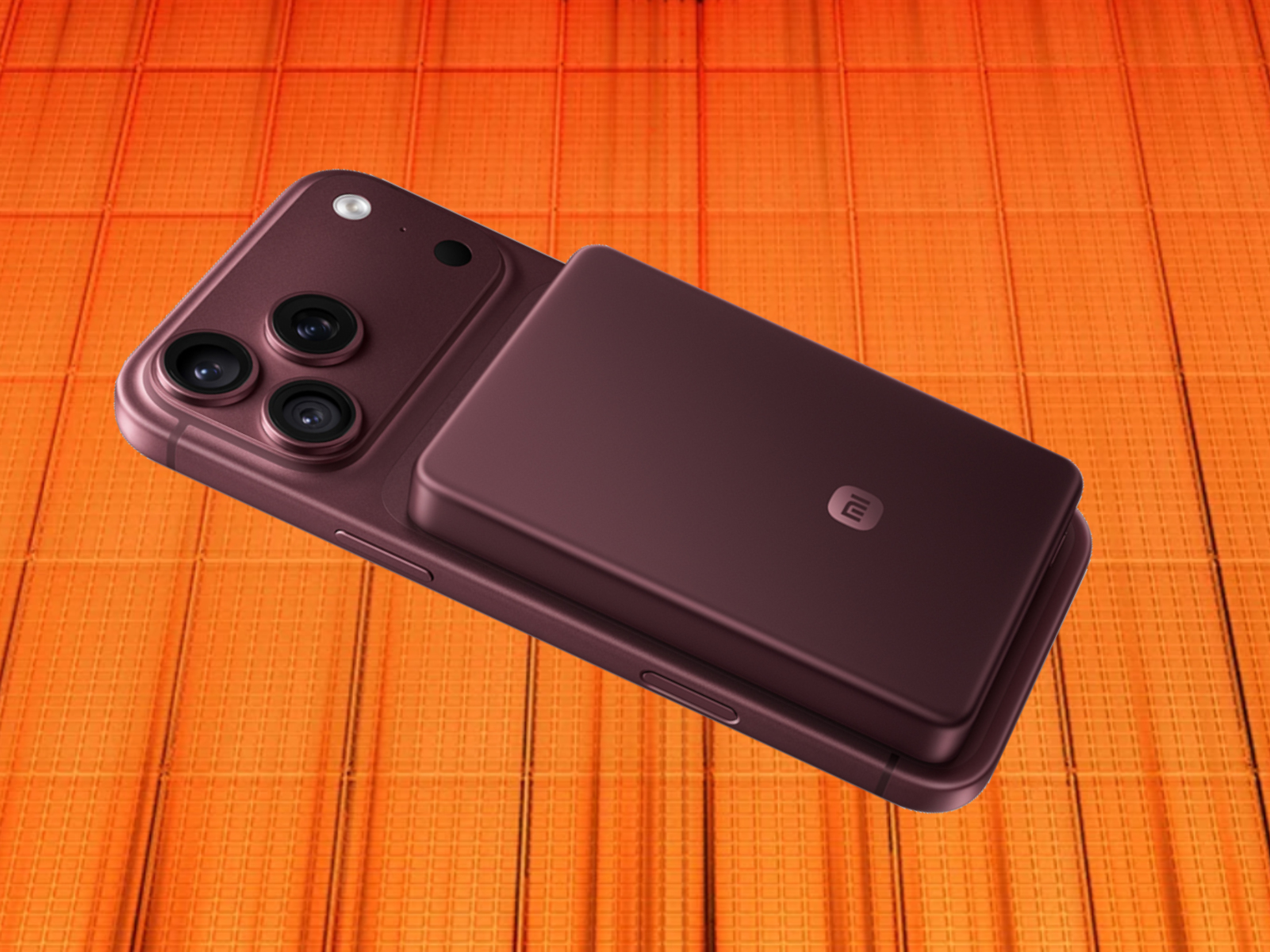
The UltraThin Magnetic Power Bank 10000 25W recharges at 30 W and is suitable for air travel thanks to extensive safety features. Also, one can monitor the power bank’s status via a web portal after connecting it directly to a laptop. For reference, Xiaomi packs this hardware into a 102 x 70.5 x 13.2 mm housing that weighs approximately 186 g.
Currently, Xiaomi has priced the UltraThin Magnetic Power Bank 10000 25W at THB 3,499 (~$105) in Thailand, discounted from a THB 3,999 (~$119) MSRP. Incidentally, the new power bank appeared across Europe on Amazon, indicating that a broader release could be coming soon. Pricing outside of Singapore and Thailand remains unknown for now, though.
Actor Blythe Melin is now the voice of the male protagonist and his brother, J, in The Expanse: Osiris Reborn. This comes after fan reaction to the beta, which accused the voice work of being “flat” and “boring.”
“While the voice actor for the male protagonist and J put in a lot of good work, they felt less expressive than we wanted,” said the developer in a blog post earlier this year, before a replacement was announced. “Because of this, we are changing the voices of the male protagonist and J.”
Melin is best known for his roles in animation, particularly in the DC comics universe, but the U.S.-based actor has also worked in video games doing mostly background NPC voices. As far as I can tell, developer Owlcat never announced who the previous actor was.
The Expanse: Osiris Reborn Updated Male Protagonist Face Screenshots
Funnily enough, this isn’t the only game inspired by Mass Effect to change the look of its protagonist based on fan feedback. Upcoming sci-fi RPG Exodus also did a redesign of its male protagonist the other week.
For me, The Expanse: Osiris Reborn’s new protagonist looks like Marco Inaros, the terrorist leader and commander of the Free Navy in The Expanse TV show. He liked flinging asteroids at Earth but was pretty chill about it. Anyway, the new face looks a lot like him — maybe it’s the hair in the example images.
That hair is up to you, of course. You’re able to customize how your protagonist looks, whether you choose the male or female version of the character. But like Commander Shepard has a canon look, so will this pair. Details on who voices the female protagonist and other cast members are coming at a later date.
“Voicing both the Captain and J has been an incredible joy and a unique challenge compared to the rest of my work voicing in video games over the years,” Blythe Melin said. “TWO, biologically related characters! It presented a difficult task in itself, because I find it very important to make sure neither character felt one-note-ey or too similar to the other.
“The more a character talks, especially in a multi-path dialogue route like for this game, the harder the task of making characters feel fleshed out while still having their own flavors and mannerisms. Playing twins has definitely been tricky, but there is somewhat of an easy divide that can be made between the Captain and J, in that one is an avatar for the player themselves, and the other is a pre-established co-character within the context of The Expanse. This allowed us to give J more of a solidified personality to work off of, with a lot of credit going to the writers and directors.”
The Expanse: Osiris Reborn launches on PC, Xbox Series X|S and PlayStation 5 in spring 2027.
Kirk McKeand is a Contributor on IGN News. Find him on Twitter @MckKirk
A journalist is being raked over the coals after she was caught using AI to edit a photo of an election night party of Michigan Democrats.
The journalist, Olivia Reingold, is a staff writer for The Free Press, a conservative, billionaire-aligning media outlet best known for ragging about perceived instances of “wokeness” in culture and attacking critics of Israel.
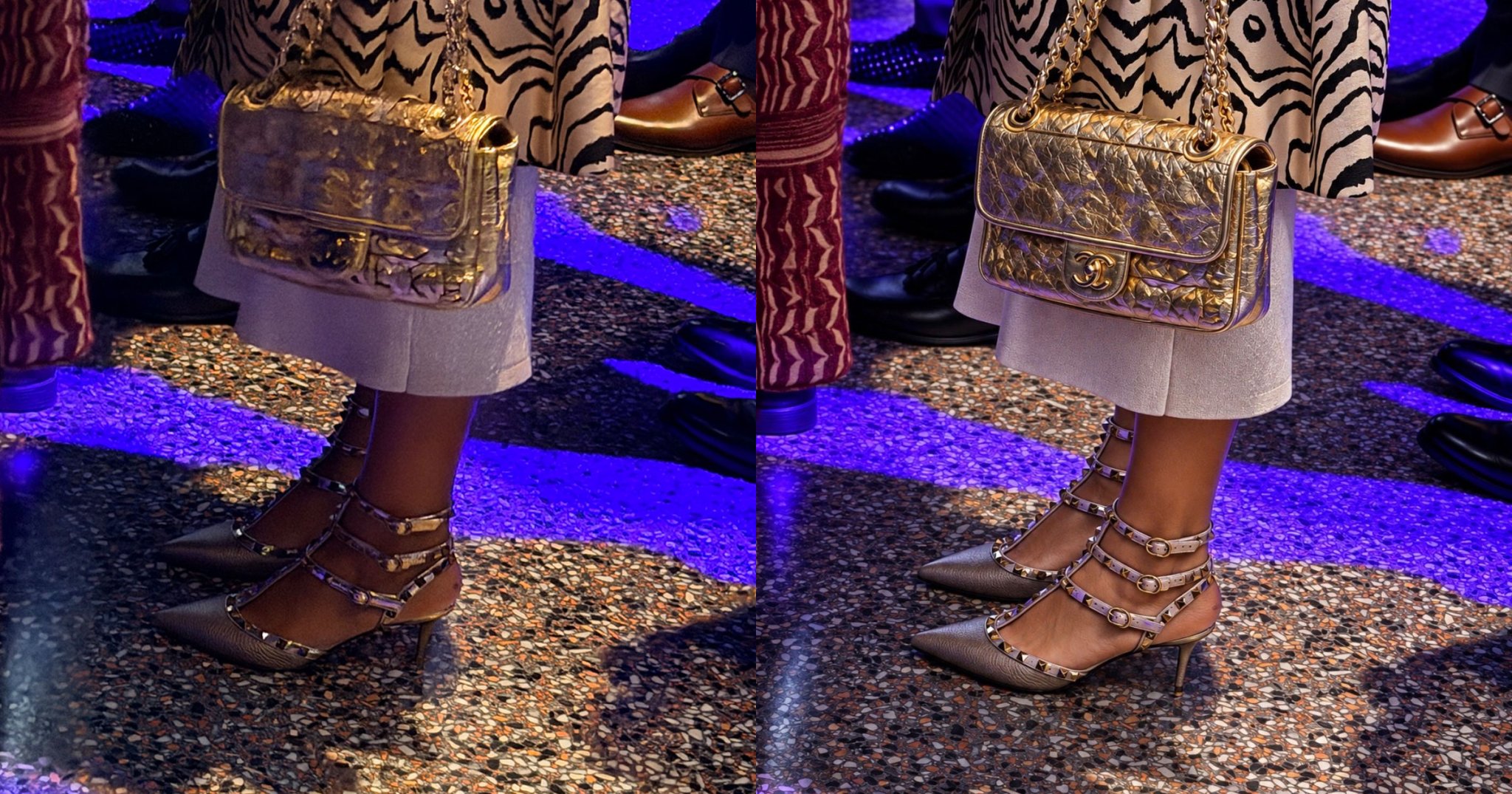
As part of her coverage, Reingold posted a photo on X singling out a woman in a gaudy outfit, seemingly to make a point: that Michigan Democrats are rich and opulent, disconnected from the American working class.
“So far at Abdul El-Sayed’s election night event I’ve spotted, Valentino heels, a Chanel bag, a Moncler jacket, Rolex watches, and a YSL bag among other designer items,” she wrote, referring to the Democratic candidate who prevailed in the Michigan senate race, much to the chagrin of Islamophobes.
Initially, the post was mocked for being frivolous, out of touch, and a poorly conceived hit piece. But soon, observers noticed that the image had a suspiciously glossy sheen characteristic of AI-image generation. Some ran it through image detectors which flagged it as either AI-generated or edited, containing watermark data from an OpenAI model. Others pointed out incongruities in the clothing details. The fashionistas at Vanity Fair noted that “the style and make of the Chanel Flap bag is inconsistent with others the brand has sold, and the Valentino shoes in question appear askew in proportion; their straps have several punched holes that the authentic Valentino style does not.”
So far at Abdul El-Sayed’s election night event I’ve spotted, Valentino heels, a Chanel bag, a Moncler jacket, Rolex watches, and a YSL bag among other designer items. pic.twitter.com/ZfV9uIoC8R
— Olivia Reingold (@Olivia_Reingold) November 4, 2026
As speculation mounted, Reingold finally came clean.
“Hello my name is Olivia Reingold and I used ChatGPT to brighten and sharpen an image of a woman in Valentino shoes and a Chanel bag,” she wrote in a followup post on X, attaching a copy of what she claimed to be the original unaltered photo.
“After processing, it still shows these same things: a woman wearing Valentino shoes and a Chanel bag,” she continued. “She is a real (and chic!) woman, really wearing those items. The observation holds.”
It’s an admission that raises a fair few questions. Why ask a chatbot to do the most basic photo touch up job possible, one that can be accomplished on most smartphones in a matter of seconds? And better yet, is this kind of alteration acceptable for a journalist?
While basic touch ups and exposure adjustments are entirely above board from a photojournalistic perspective, many users argued she went too far by using ChatGPT to “sharpen” the image. The process introduces information that wasn’t originally in the photo, adding another layer of remove from reality to a photo that is already being presented in an arguably disingenuous context.
The texture of the bag in the edited photo, for one, is completely different from the supposed original. The AI edit also seems to have drastically altered the lighting of the image. In the supposed original, the subject is cast in shadow, appearing one with the crowd. In the ChatGPT-doctored one, she appears gleaming and opulent, larger than life.
Max Spero, the CEO of the image detector Pangram, chimed into the drama and wrote in a post that “there is no such thing as a faithful AI upscale.”
“AI will hallucinate details that do not reflect reality,” he added, “and it will put your integrity at risk to present an AI image as reality.”
Bruce Arthur, a columnist, was more scathing. “Actual journalists don’t do this,” he wrote. “Actual journalists should never do this.”
More on AI:Voters Supported Every Single Anti-Data Center Proposal in America, Except One
The post Journalist Admits She Used AI to Edit Photo Smearing Democrat Voters appeared first on Futurism.
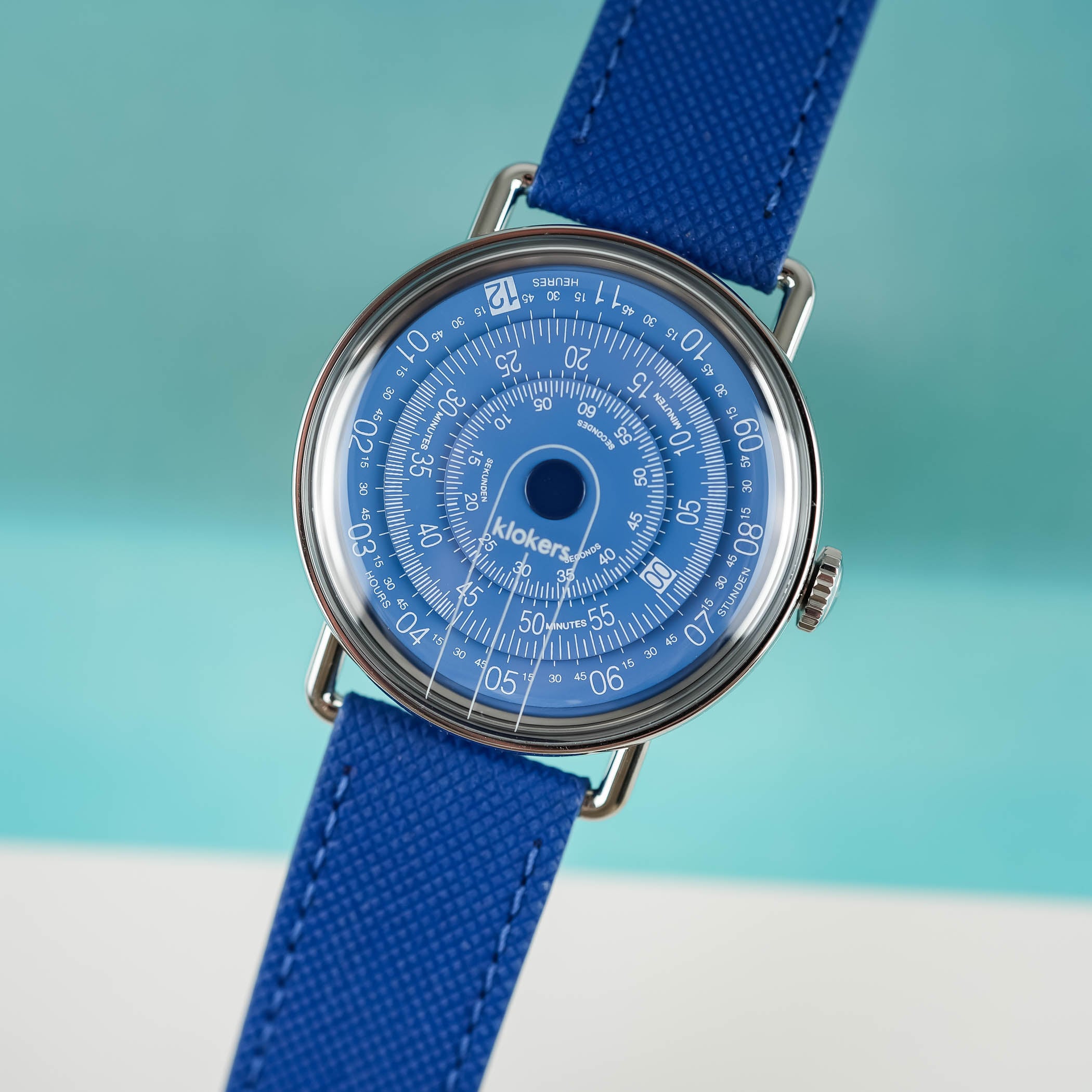
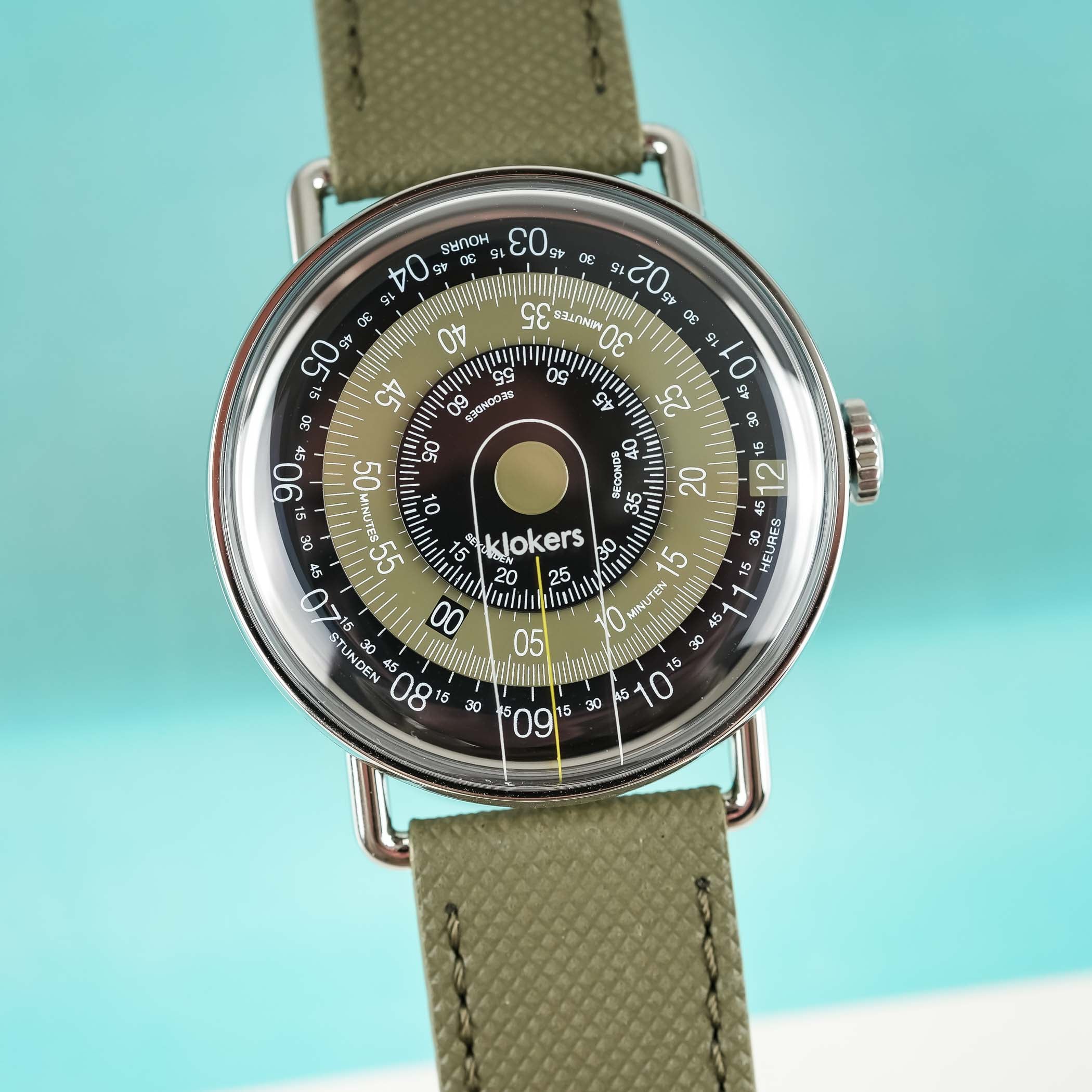
Come to think of it, there aren’t many watches that are read like a Klokers. The brand has replaced hands with stacked discs and a single line of reading. A slide-ruler-inspired take on time display that was accessibly priced (every Klokers made between 2015 and 2025 ran on quartz) and earned a loyal following, but also struggled at some points in its history. The new KLOK03 is the brand’s first mechanical watch: it keeps the signature time display, changes plenty around it, and still sells for under EUR 900.
Founded in 2015, Klokers joined several brands that wanted to offer another way to read time, without conventional hands. Two Kickstarter campaigns raised more than one million euros from 2,600 backers, and the first models, the KLOK01 and KLOK08, used flat discs that turned counter-clockwise. A patented system let owners detach the watch head and move it between straps and accessories. The ambitious system proved difficult to make reliable. Loyal following or not, the brand filed for bankruptcy twice: in 2020 and again in 2023, when Christian-Louis Col, also owner of Ikepod, came to save it. The earlier KLOK01 and KLOK08 remain available, and after-sales service is assured, but the KLOK03 is not meant as their evolution. It is a watch built differently.
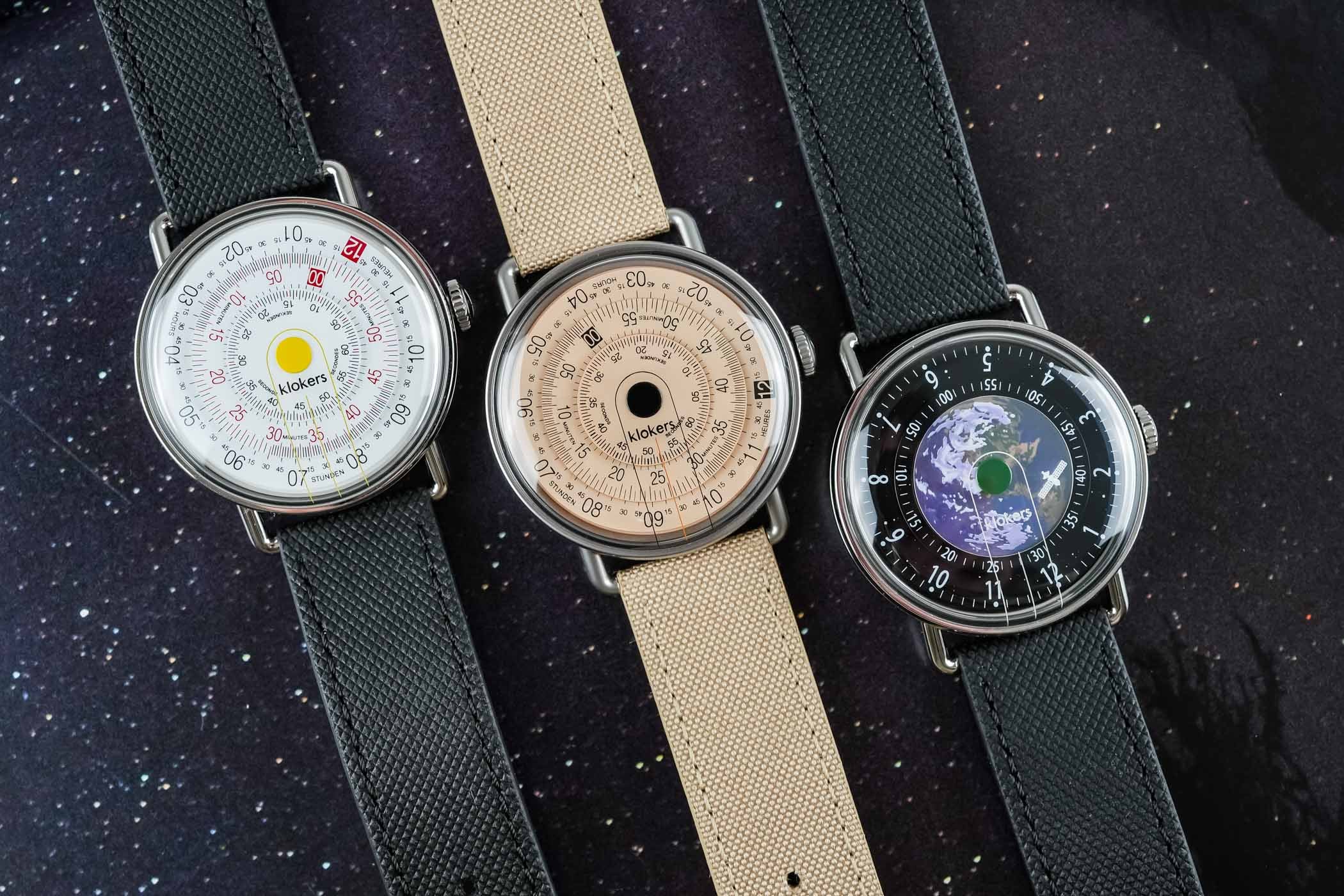
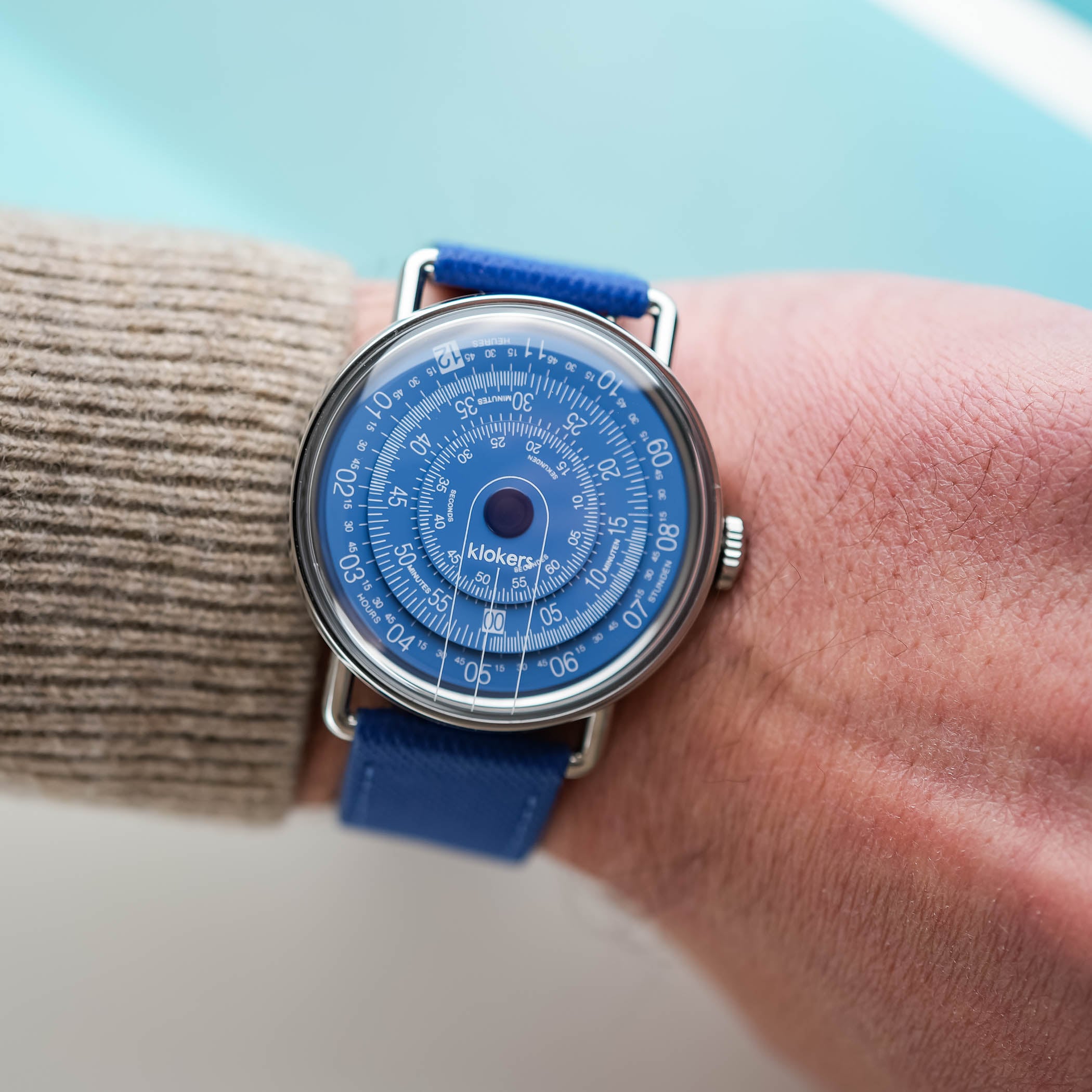
For this new chapter, Klokers invited Fabrice Gonet, watch designer and co-founder of Edge Design studio, who designed the latest Seaslug by Ikepod, but also worked for MB&F, DeBethune, and Louis Moinet: check him out; it’s worth the time. Visually, the biggest change is the composition: the three discs are now stacked in tiers, creating a sense of depth the earlier flat discs couldn’t offer, and they turn clockwise, so more conventionally.
Time is still read vertically, through a magnifier at 6 o’clock. The lower disc displays the hours, the middle one shows the minutes, and the central disc is for the seconds; all are aligned along a single line. Technical and instrument-like in appearance, the reading stays simple: three discs, three pieces of information, one line. As with all watches with an unusual display, it takes a bit of time to get used to it, but the result is fairly intuitive.
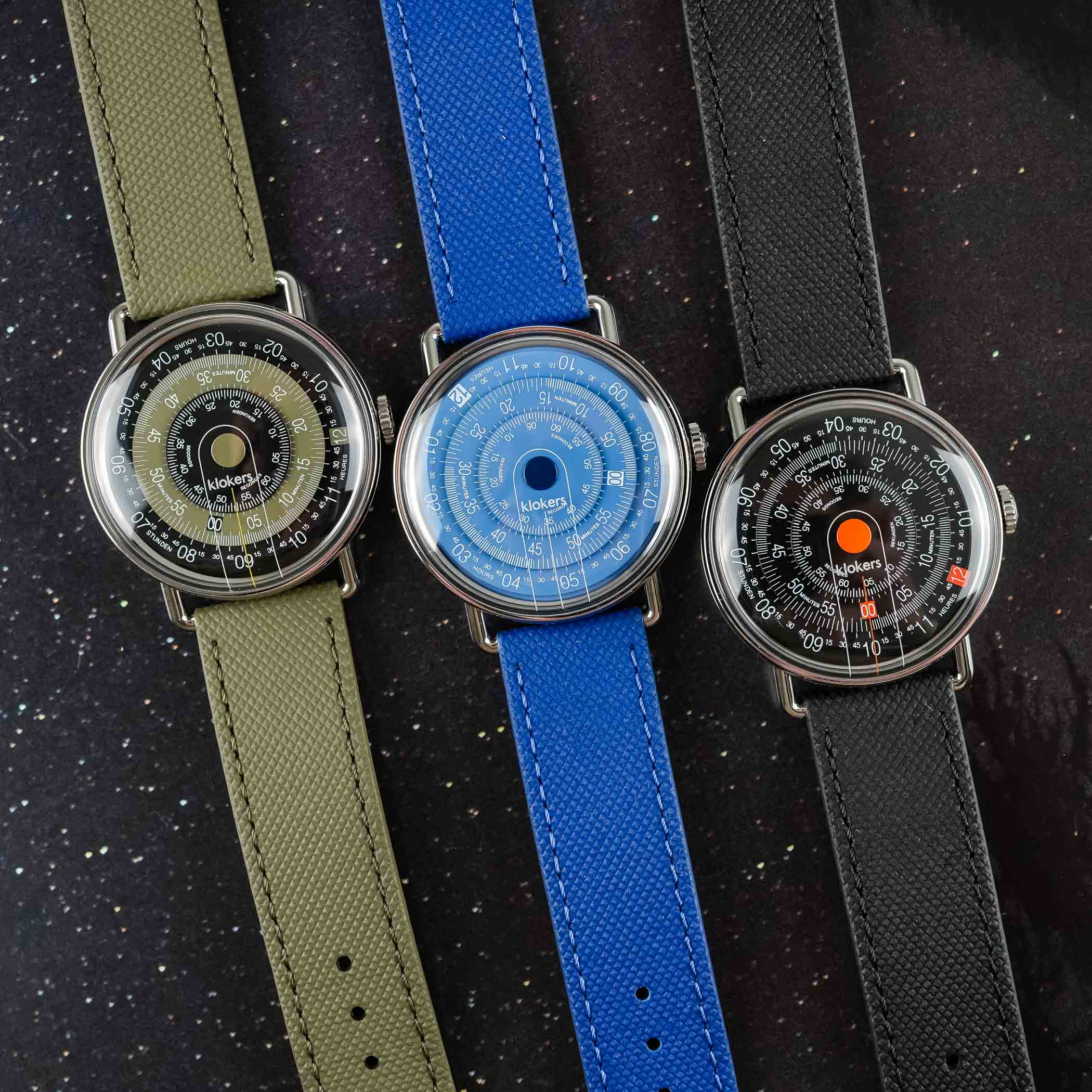
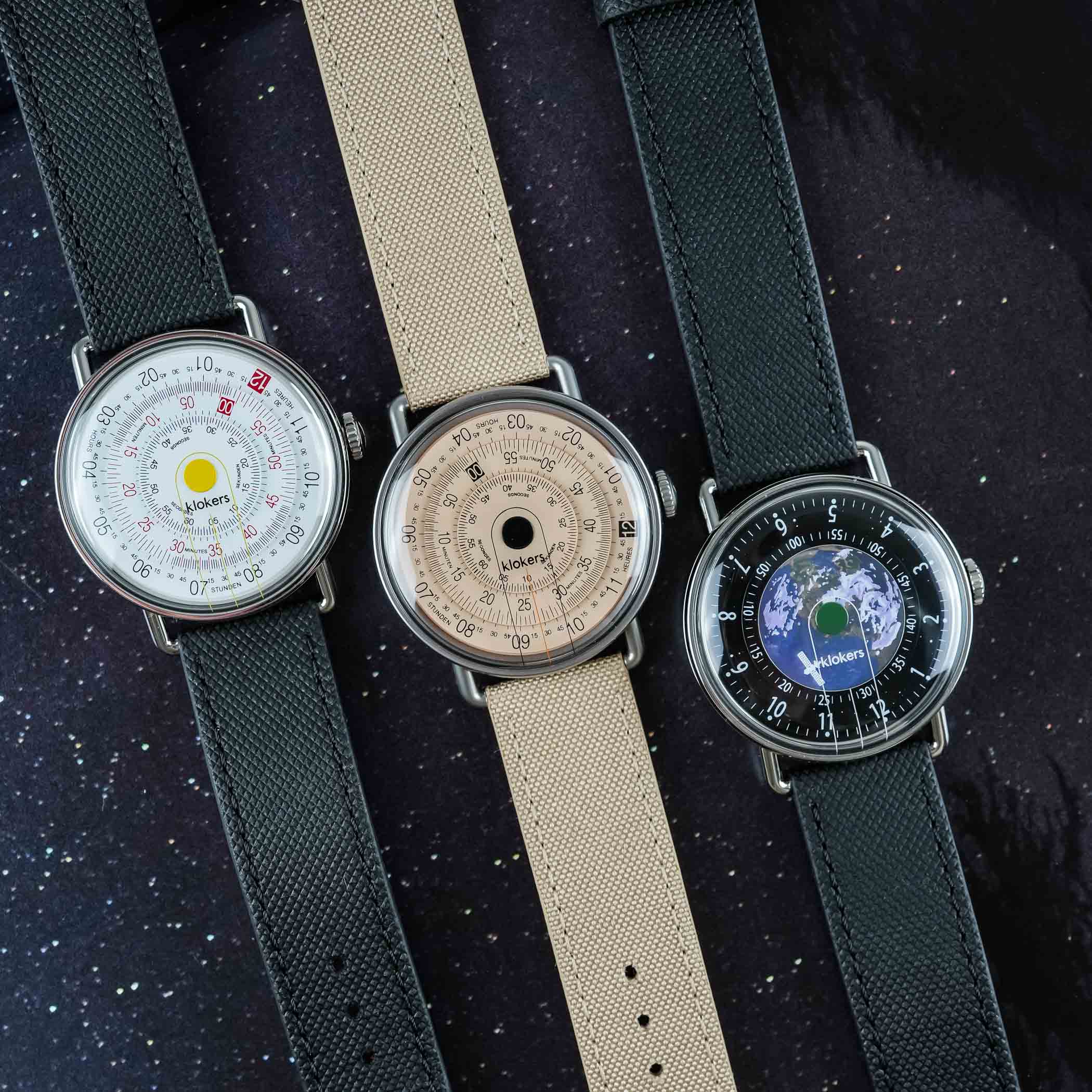
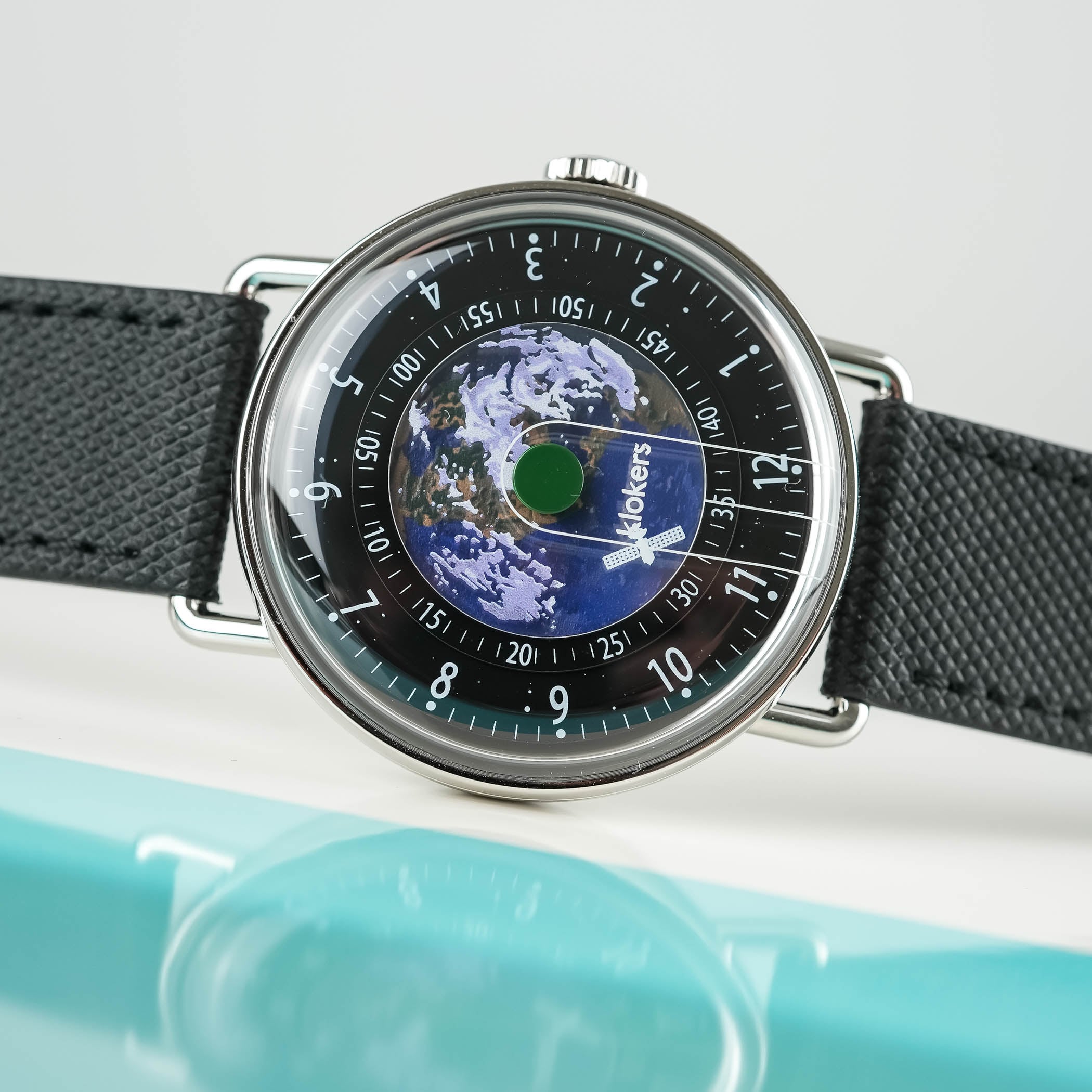
The KLOK03 comes in six versions: Yellow Dot, Blue Note, Yuri, Desert Storm, Orange Dot and Kaki K. The white Yellow Dot and the blue Blue Note revisit two colourways that were very successful in earlier Klokers collections, while the other four introduce new combinations. Yuri pairs a blue dial with a green dot and a rotating world map, Desert Storm goes for sand beige and a matte case, Orange Dot sets an orange dot against black, and Kaki K is, well, khaki.
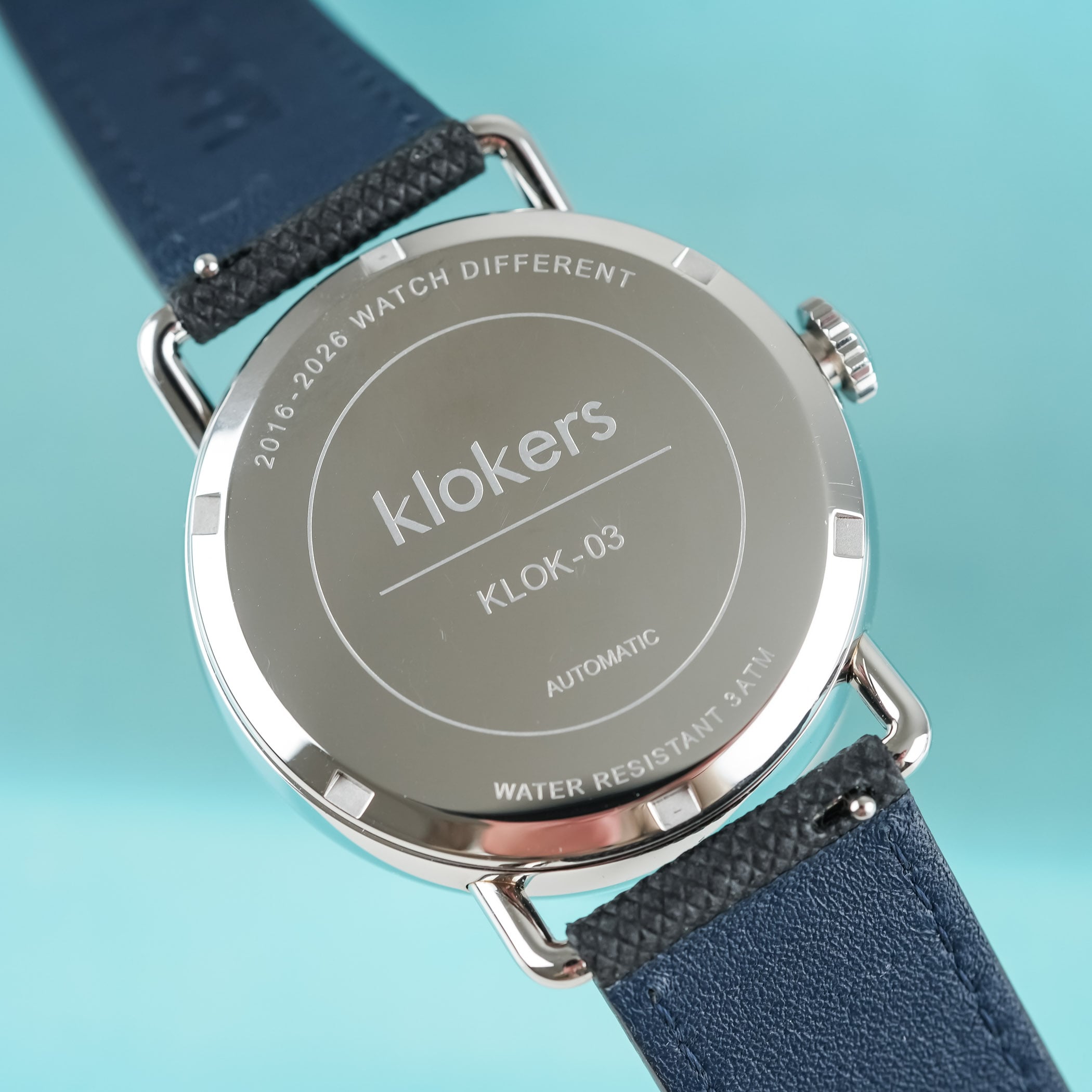
The case is made from 316L stainless steel and measures 40mm in diameter and 13.9mm thick, with a 45mm lug-to-lug. A sapphire crystal with the Klokers logo protects the display, and the caseback is solid. Water resistance is 30m, which is OK for a design-led watch meant for daily wear. As mentioned, every previous Klokers was powered by quartz, the KLOK03 uses a classic Miyota 82S0 automatic movement, operating at 21,600 vibrations/hour with 42 hours of power reserve.
The Klokers strap-change system gives way to the more conventional quick-release spring-bar mechanism. Straps from other brands can be fitted, although those of the KLOK01 and KLOK08 cannot; the KLOK03 is now conceived as a complete watch instead of a detachable head.
The Klokers KLOK03 is now available from the brand’s website, with delivery within one week. The brand proudly states that the watch is made in Hong Kong and offers a two-year warranty. The price is EUR 890 including VAT, with a launch price of EUR 790 until 20 December. More information at klokers.com.
With Mastering SAP Collaborate, an SAP TechEd on Tour event, arriving in mid-November 2026, we have been speaking with event sponsors about what makes the Australian SAP market distinct. In a recent conversation, Onno Coenen, Managing Director APAC and VP Global Alliances at SecurityBridge, offered a perspective shaped by years working with SAP customers in Europe and the US, including being based in Singapore for the last eight.
His message is direct. Australian organizations are consolidating on SAP Cloud ERP faster than most, and their cybersecurity teams are waking up to the SAP application layer as a blind spot. But the business case, the buying center, and the obstacles look different from those in the Americas and EMEA.
What Makes the Australian Market Unique
The first difference is scale. In Europe, Coenen notes, many long-standing SAP customers, particularly large German manufacturers, run dozens or even hundreds of SAP landscapes. That is rarely the case in APAC, even in a mature SAP market like Australia. Coenen said that most of the organizations SecurityBridge speaks with are already using RISE with SAP or planning the move, and their landscapes are consolidating into a single SAP S/4HANA system, a few SAP Business AI Platform accounts, and some additional cloud solutions.
That changes the conversation. “Patching is a significant task for one system, let alone for hundreds of systems,” Coenen says. When a customer runs hundreds of systems, automating a painful process makes the business case on its own. With a consolidated SAP Cloud ERP landscape, the case must be made differently.
RISE with SAP also brings what Coenen calls the biggest misconception in the region: the assumption that SAP is taking care of application security. “That’s the number one mistake,” he says, and it remains the most common discussion SecurityBridge has with prospects and customers. SAP manages much of the underlying infrastructure under SAP S/4HANA Cloud Private Edition, but users, configuration, custom code, and activity inside the application remain the customer’s responsibility.
The second difference is who is driving the decision. In Australia, CISOs, SOCs, and broader cyber teams are realizing that SAP is often missing from their SIEM. Recent SecurityBridge engagements in Australia were led by cyber teams, often while already-overloaded SAP teams resisted taking on another project. “The responsibility and mandate is shifting from the SAP teams to the cyber teams,” Coenen says.
He sees Australia as a front-runner in APAC, likely because organizations there take regulation and frameworks such as NIST more seriously. Singapore and Japan also treat SAP security as a priority. Across much of developing Asia, however, cost remains the main reason for inaction, and some organizations still believe the problem can be solved with manual effort. With only a limited number of SAP security vendors operating in the region, the first job is often building awareness rather than winning a product comparison.
Australia has its own remediation hurdle too. ABAP development is often handled by contractors or service providers rather than employees. By the time a first scan surfaces thousands of custom code vulnerabilities, the people who wrote that code have frequently moved on, and the findings can feel too overwhelming to tackle.
How SecurityBridge Is Helping Customers Respond
SecurityBridge runs on any ABAP stack, including SAP S/4HANA within RISE with SAP, where Solution Manager is no longer part of the picture. Coenen sees customers arrive through two doors, split roughly evenly.
The first is vulnerability management. An Australian energy provider had a company-wide vulnerability management program in which SAP was one subprogram. Its SAP team needed a solution specific to SAP and started with SecurityBridge’s security compliance and patch management capabilities. Over time they plan to extend into threat detection and other capabilities.
The second door, and the faster-growing one, is real-time visibility. Cyber teams want SAP application-layer activity flowing into their monitoring capabilities so that the systems running the business are no longer a black box to the SOC.
Hard deadlines are accelerating both. Coenen gave an example of one of Australia’s largest banks where management issued a directive requiring the SAP team to patch within seven days. With criminals using AI to exploit vulnerabilities soon after SAP’s Patch Tuesday, teams can no longer wait a month or more. Meeting that kind of target, he says, “can only be done with an advanced tool.”
SAP’s own field teams are also shaping demand. As SAP sales teams position offerings such as SAP Enterprise Threat Detection and Code Vulnerability Analyzer to RISE customers, awareness grows, and customers who find those options too complex or too costly look for alternatives. Since SecurityBridge is available through SAP Store, this gives SAP sales teams another option to put in front of customers.
Coenen’s core message is that the SAP application layer holds the crown jewels, not the network or the operating system. Protecting SAP only at the perimeter is like securing a building with just a fence and a front door. An attacker who has already gained network access, or an employee representing an insider threat, can “just walk straight through your application.” With AI and geopolitical tensions raising the stakes, he says, “companies cannot afford to wait.”
What This Means for SAPinsiders
Clarify who owns application security under the RISE with SAP model. Review your SAP Cloud ERP contract and particularly the shared responsibility model with SAP. Assume that user access, configuration, custom code, and application-layer monitoring are yours to secure, and make sure someone is accountable for each.
Bring your SAP and cyber teams together around measurable targets. Get SAP activity into your SIEM and SOC, and set a time-to-patch target, for example a seven-day window. Then test honestly whether manual processes can meet it and prioritize custom code findings by risk so remediation stays manageable when original developers are gone.
Connect with SecurityBridge at Mastering SAP Collaborate. Visit the SecurityBridge team at ICC Sydney on 18–19 November. Bring your questions on RISE with SAP security responsibilities, SIEM integration, and accelerating patch timelines, and pair those conversations with sessions in the event’s Security & Risk track.
If you’re one of the nearly one million of investors who bought into Donald Trump’s pet crypto coin, the best time to sell was January of 2025, before the whales cashed out and sent prices tumbling. The second best time was yesterday.
Trump’s memecoin has suffered a massive fall-off in the wake of the US midterm elections, tumbling to an all-time-low of $1.12, down from an already paltry $1.70 just prior to the all-important round of voting. Even a month ago, holders of the crypto currency could have gotten out at roughly $2.00 a pop.
Obviously, anybody short-sighted enough to approach Trump coin as an investment is getting pummeled. But with a current market cap of around $340 million, there are clearly more than a few people hoping against hope for a turnaround.
It’s a fitting end for a crypto venture that many had pegged as a grift from the very start. Unfortunately, many more fell for the scam, pumping the coin up to a market cap of $72 billion at its peak.
One analysis found that some 21 well-timed whales pulled the rug on coin holders early into the currency’s launch, getting out with some $214 million and sending the value plummeting.
Predictably, many of the president’s victims count themselves among his biggest fans. In July, the BBC reported that Trump had raked in over $1 billion from all of his crypto dealings combined since returning to the Oval Office in 2025 — money ripped from the hands of the MAGA movement’s most devoted followers.
More on crypto: Former Crypto Regulator Insists That Gambling on the Weather Is Inherently a Good Thing and “Human Nature”
The post Investors in Trump’s Crypto Coin Are Now Screwed Beyond Belief appeared first on Futurism.
Developer KAFI has announced its next game, titled Snow Panic, which is an eight-player arcadey online skiing game that one of its developers describes as being like “SSX meets Mario Kart.” It’s in development for PC.
It’s a downhill skiing game that will always feature competition; bots will fill in if you don’t have enough human players in the match. And in that downhill race, the only rule is that the first one to reach the bottom wins. Bullets, rockets, and “suspiciously aggressive wildlife” will be amongst the obstacles you have to overcome as you ski towards the bottom. The developers mention airstrikes, mines, and a literal exploding goat as other hazards. Check out the announcement trailer below.
A clean run sounds like it’s virtually impossible, by design. “Every hit is a full ragdoll crash, and every crash is somebody’s favorite clip,” KAFI said. Expect six mountains to race on at launch, with more promised in post-release updates. Snow Panic also features proximity voice chat, because, as the team notes, “What’s the point of blowing up your friends if you can’t hear them scream as they fall into a ravine?”
There are 14 total weapons and items available at launch, and you’ll be able to customize your skier’s hair, outfits, and skis. You can wishlist Snow Panic on Steam if you’re interested.
Ryan McCaffrey is IGN’s executive editor of previews and host of IGN’s weekly Xbox show, Podcast Unlocked, and a co-host of Next-Gen Console Watch. He’s a North Jersey guy, so it’s “Taylor ham,” not “pork roll.” Debate it with him on Twitter at @DMC_Ryan.