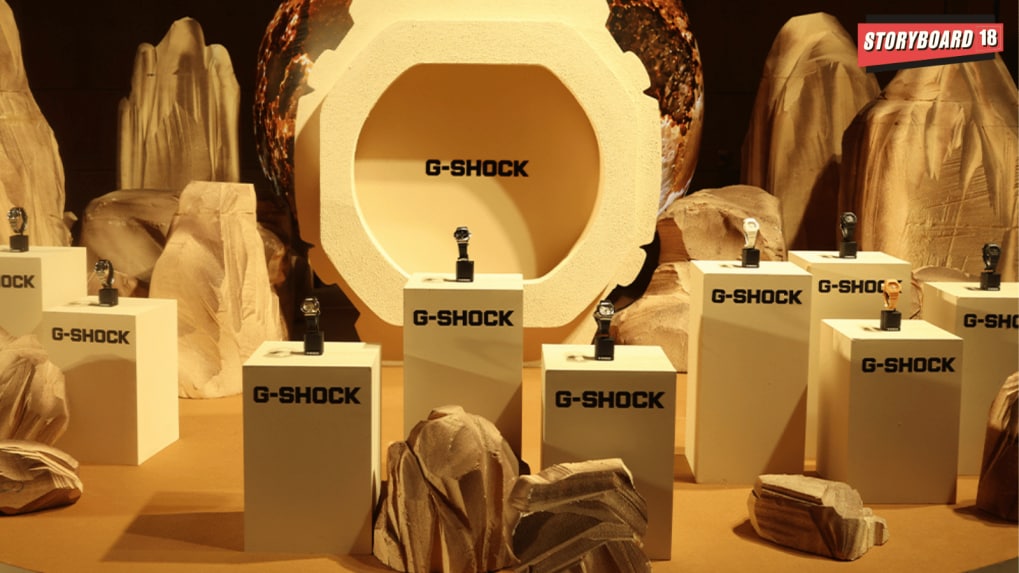
Casio India is looking to significantly expand its retail presence in the country, with an ambition to at least double its network of 85 brand stores, as the Japanese watchmaker steps up its focus on the Indian market with the launch of the G-Shock 2500 Series.
Speaking to Storyboard18, Takuto Kimura, Managing Director, Casio India, said brand stores have become an important part of the company’s strategy, allowing consumers to experience its products and brand philosophy firsthand.
“The brand store is now one of the key important channels to create the opportunity for local consumers to experience our brand philosophy and also the product. So, we focus to expand our key brand stores,” Kimura said.
While he did not share a specific timeline for the expansion, Kimura said his ambition was to at least double the existing network. Casio currently has 85 brand stores across India.
The expansion comes as the company sees demand for its watches across different parts of the country. Kimura said G-Shock continues to be well accepted in Tier 1 markets, while Tier 2 cities are emerging as an important growth opportunity. Casio’s Vintage collection, meanwhile, has found acceptance even in Tier 3 markets.
“India is technically one of the most important markets for Casio globally. India has a huge population, and the proportion of the young generation is really huge. The economic growth is also at an amazing speed. So, for G-Shock, India is really the most important market,” he said.
G-Shock 2500 Series targets consumers seeking analog watches
The expansion push coincides with the launch of the G-Shock 2500 Series in India. Inspired by the original DW-5000C, the collection combines the brand’s signature shock resistance with a more refined analog design.
The series comprises two variants: the resin GAC-2500 and the metal-clad GMC-2500. Both feature 20-bar water resistance, a new Multi-Mission Date function and a distinctive two-eye dial layout. The watches are priced between ₹9,995 and ₹26,995.
Kimura said the new collection is intended to attract a wider set of consumers, particularly those who prefer analog watches but are drawn to G-Shock’s toughness.
“We have a variety of G-Shock products already. However, this new G-Shock definitely opens up the brand to broader consumers who like analog watches but love G-Shock. I think there is huge potential for this new product,” he said.
E-commerce and brand stores drive distribution strategy
While Casio is seeing growth across both online and offline channels, Kimura said e-commerce remains an important sales channel. He also highlighted the role of physical brand stores in building consumer engagement.
“Online and offline channels are both growing rapidly. I cannot reveal too many details, but I can say it is e-commerce. Our offline channel, especially our brand stores, is really well accepted by local consumers in terms of sales and branding,” he said.
On the marketing front, the company follows a product- and audience-specific approach, with ambassador-led campaigns forming a core part of its strategy. Traditional media and collaborations also remain part of its communication mix.
Kimura did not disclose the company’s advertising expenditure or the split between traditional and digital platforms.
G-Shock and Vintage appeal to different consumer segments
Kimura said G-Shock and Casio Vintage are among the company’s best-accepted product lines in India, with both primarily targeting younger consumers.
He also sees the two categories benefiting from different market dynamics, with G-Shock finding traction in Tier 1 and increasingly Tier 2 markets, while Vintage has a wider reach in smaller cities.
Addressing the competition from smartwatches, Kimura said the two product categories serve different consumer needs.
“Smartwatches are more function-oriented, but our watches attract people who see the product value and brand value, and people who want to have them for years to come,” he said.
He added that G-Shock also appeals to watch collectors and younger consumers who view watches as an extension of their personality and style rather than just devices for timekeeping.
“The G-Shock is always at the centre of culture,” Kimura said.
Premiumisation and 1990s designs shape global watch trends
On broader trends in the global watch market, Kimura pointed to a renewed interest in designs from the 1990s, alongside accelerating premiumisation.
For India, he said the challenge lies in catering to diverse consumer preferences across regions while expanding distribution and product availability.
The company is also looking to strengthen its India-specific portfolio through its Make in India collections. Kimura said Casio works with manufacturing partners in the country and is gradually developing this range.
For the festive season, the company has been creating region-specific campaigns around these collections, including customised key visuals and films.
Looking ahead, Kimura said Casio’s focus would remain on offering models that appeal to Indian consumers at accessible price points, while expanding its retail touchpoints and product portfolio.
Also Read – Why Fossil is doubling down on premium watches in India
First Published on