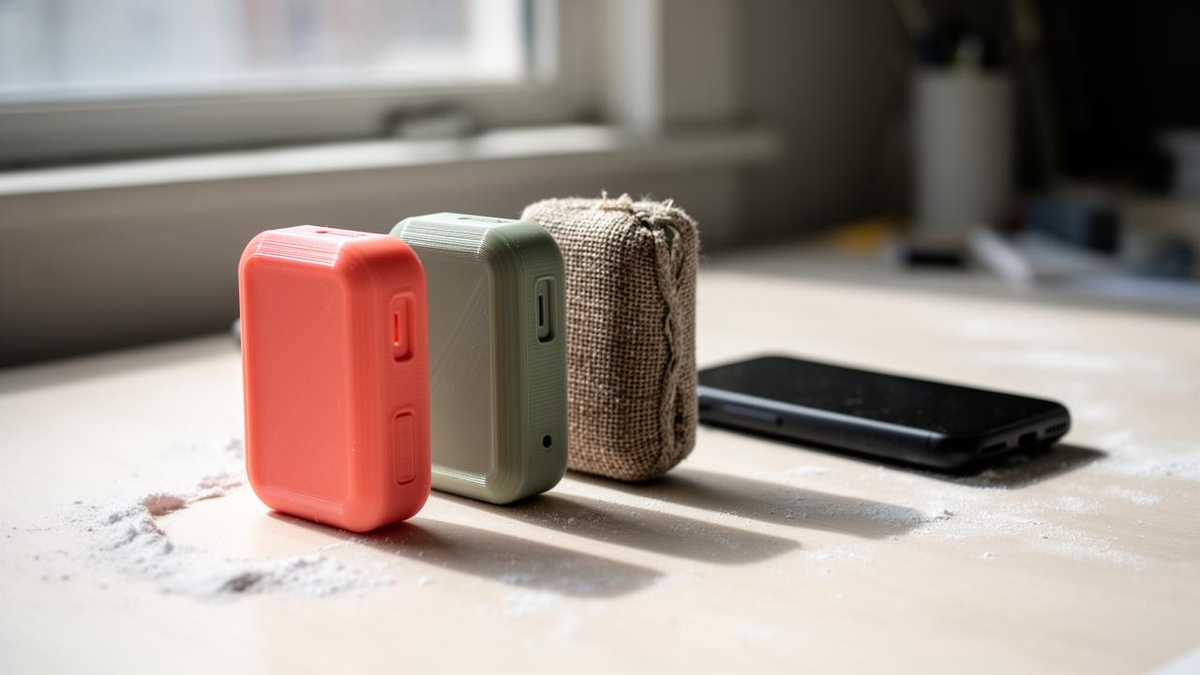
Walk into any coffee shop and ask how many people are holding the same phone. Roughly nine in ten hands will go up — a level of uniformity in personal computing that hasn’t existed since the 1970s, according to design historian Elizabeth Dorman. She thinks that’s the anomaly, not the endpoint.
“We’re going to see thousands,” Dorman said on the MTS podcast, describing where computing goes next. “The same way that we don’t all wear the same fashion sense, but there’s thousands of fashion designers. And I believe that over the next 50 years we’re going to see this happen in computing.”
Dorman isn’t a pundit speculating from the sidelines. She worked on Apple Vision Pro, then on the design team at Humane — the AI pin company acquired by HP — and co-founded Era in 2025. Her argument is that the iPhone era produced a Cambrian explosion in the wrong layer: software applications multiplied while the physical objects we carry collapsed into one black rectangle. The social signal shifted from “look at this cool cassette player I got” to “look at this cool app I downloaded” — and by now, she notes, everyone uses the same five apps anyway.
The phone monopoly is younger than you think
Dorman’s historical claim is that personal computing has always cycled between convergence and divergence, and the current moment is the first hard convergence since the 1970s. She grounds it in two cases where broken monopolies and unprotectable technology produced an explosion of design.
| Case | Before the shock | What broke it open | What followed |
|---|---|---|---|
| Bell Telephone | Through the 1970s, Americans could only rent a phone from Bell — a total monopoly | Bell broken up as a monopoly in 1983, as plastics manufacturing scaled in South Korea and Hong Kong | A wave of novelty phones (Mickey Mouse, hamburger, Garfield shapes) plus Bell’s own late-70s “Design Line” of ten models |
| Sony Walkman | Sony shipped three iterations before settling on the canonical Walkman | Philips and others entered; cassettes weren’t patentable, so no walled garden protected the category | Sony told its designers to build a Walkman for every subculture — baby models, yellow sports versions, translucent “Freak” models for skateboarders, jelly-bean and purse-shaped variants |
The Bell detail Dorman prizes most: the monopoly itself recognized how boring its product was and released Design Line phones in the late 1970s, including a centennial edition styled after an Alexander Graham Bell phone with an American flag. “One of the prizes in my collection,” she said. She owns roughly 150 vintage devices.
The Walkman lesson is the analytical one. Because nothing was patentable, competition had to happen on differentiation — and differentiation happened on aesthetics. That’s the mechanism she believes is missing today.

The designer phone didn’t fail. The iPhone just became the hotter accessory.
The obvious pushback: fashion is a booming industry, so why did Siemens’ Zolibri line — designer phones released on a fall/winter and spring/summer runway cadence in 2004, eight phones total — die?
“Because an even hotter phone came out and that was the iPhone,” Dorman said flatly.
She stresses that nobody in 2007 could picture the world of 15 years later. The iPhone launched without an App Store and was, at the time, simply a better and more intuitive phone. She cites a business-school anecdote relayed to her the previous day: the entering class of 2006 all had BlackBerrys; the entering class of 2007 all had iPhones. “It was a change of fashion.”
The Zolibri founder’s thesis, as she describes it, was explicitly pluralist — people would own many phones because phones are lightweight communication peripherals, and you shouldn’t carry the same phone to the gym as to a cocktail party. Correct in spirit, premature in market. And a correction to conventional history: the first smartphone wasn’t the iPhone, she notes, but the LG Prada phone. The precedent list runs long — Swarovski with Misfit on wearables, Fitbit with Tory Burch, Dolce & Gabbana with Motorola — with Balenciaga’s couture speaker built into a custom Game Boy and Pharrell’s gilded BlackBerry as examples of personalization as status.
Dorman’s diagnosis of Apple is structural rather than personal. She wonders aloud what Steve Jobs would make of the modern company — “I actually would think that I think he would say that Apple hasn’t reinvented itself nearly enough as it should” — but her sharper claim is about incentives: Apple and its peers are “incentivized to keep that ecosystem closed,” which is why the convergence has persisted.
Manufacturing isn’t the bottleneck anymore. Imagination is.
Why is everything black or white? Dorman’s answer isn’t technical. Injection molding, CAD and contract manufacturers make hardware accessible within six to eight months, she says. The constraint is who chooses to make technology and what they’re willing to risk.
She names two causes: a design culture that treats Teenage Engineering and Dieter Rams as the only references, and a demographic narrowness — “we don’t have enough women designing consumer electronics. We don’t have enough young people designing consumer electronics.”
Then there’s the economics. A colorful, unconventional device requires committing to a minimum order of 10,000-plus units. A black-and-white device feels safe because that’s what everyone around you owns. She calls this “a lack of imagination in hardware, which is the opposite of what we have in software, especially in the world of vibe coding.”
Her prediction: additive manufacturing closes the gap over five to ten years, with certification and battery safety the unresolved problems.
“Very soon in my expect my prediction is 5 to 10 years from now, you should be able to wake up and be like, oh, I’m wearing this outfit today. I want a device that matches my style. And it just gets printed for you within the span of 2 hours.”
The leading indicator she points to is a family friend in high school who “is vibe coding Barbie colored websites and to-do lists for herself.”

“Couture computing” is a category, not a slogan
Dorman defines the term precisely: “Couture computing is pretty much the intersection of manufacturing becoming much more approachable where you do not need to be like Apple and have, you know, thousands and thousands of [units].”
She expects the market to mirror fashion’s tiered structure — hand-sewn at one end, haute couture in the middle, mass production at the other — with thousands of differentiated device makers rather than one vertically integrated giant. The single-aesthetic, single-device model, the Humane approach included, is what she thinks gets replaced.
“We’re not going to have phones,” she said. “It’s going to be a bring your own screen and bring your own device future.”
Era is betting on the layer underneath, not the next gadget
Era’s business is deliberately not another device company. It’s building the substrate thousands of such companies would run on: device and fleet management, identity, orchestration, connection to a user’s preferred memory system, connection to agents, and device-to-device connection. The analogy Dorman reaches for is architecture — material suppliers and structural engineering firms make buildings possible, but architects keep design freedom.
Her critique of both Apple and Humane is that they built in silos, “with ego,” from a position of knowing what’s best for humanity. She’s explicit that both were directionally right about where computing goes — AR/VR devices, ambient intelligent devices, even laser-based computing — and that the failure was in how they sold it to people who feel unheard and want authorship. Era has a hardware product coming, described as highly customizable and “bedazzlable,” with detail promised early next year.
That choice argument is the emotional core of the episode. Dorman frames the “rebel alliance” in tech not as rebels against a galactic empire but as a response to young people feeling unseen because they have no choice in where they store memory, which devices they use, or how they communicate — “are you a green bubble or are you a blue bubble?” Her diagnosis of contemporary Luddism follows: the only options on offer are devices that spy on you and harvest attention, or no technology at all.
“When we go back to binaries, right? Zeros and ones, it’s like we’re on two extremes,” she said. “We only have these two options. And I think so much of the work ahead of us as young technologists is how do we create the spectrum.”
The lever against walled gardens is portable memory
Dorman’s forward bet is that AI plus open protocols pushes computing out of the App Store model toward something closer to HTML and browsers, where users pick their own interface. She cites MCP and similar protocols as the mechanism, and notes that large AI models can now generate custom circuit board designs — compressing months of work into about two days, with fabrication and delivery in roughly a week. Combined with open-source hardware boards and Shenzhen manufacturing, that expands the physical vocabulary of what a device can look like.
She names Mozilla as an Era investor and points to Mozilla AI’s work on portable memory as the standard she most wants to succeed, because it would let users take their memory across devices and providers. She extends the logic to agents: just as travelers choose among trip.com and booking.com, users should choose among dozens of competing agents.
Her warning is about incentives. Meta Ray-Bans are her example of a device whose value proposition is undermined by distrust of the parent company’s motives — which is why she argues incentives must be aligned at the start rather than retrofitted.
The host’s framing of the stakes: users have agency, and if a tool doesn’t serve them they should replace it — but in five to ten years they’ll also have the power to make their own software and then their own tools. Dorman’s endpoint is a world of “vernacular devices,” the hardware equivalent of regional architecture, and tech runways where creative technologists become “the next Louis Vuitton, the next Balenciaga, the next Gucci.”
“A meaningful life is one that we feel agency over,” she said. “And in a world of agents, we have no agency today.”
What deserved to die, and what Apple still gets right
Asked which lost features she mourns, Dorman declines the premise: “I think what was meant to die died. What was meant to stick around stuck around.” She evaluates technology by the value system that produced it rather than by its buttons, and she keeps a couple of Humane pins in the hope the company’s values carry forward.
She’s equally clear that Apple’s values aren’t the problem — she trusts an iPhone not to spy on her — and that the fault lies in walled gardens and misaligned incentives baked in from the start. Her advice to a young designer is unglamorous: start building, visit the Teat gallery in San Francisco, where Era supported a month-long “everything computer” exhibit featuring 45 artists, from Cornell and Media Lab HCI researchers to Game Boy hackers, befriend people building cyberdecks, and watch what Era ships.
At this point, the investor’s real question is whether any of this dents Apple. The near-term numbers say no: iPhone revenue rose 17% to $57.6 billion in the fiscal fourth quarter ended Sept. 26, and phone sales hit roughly $254 billion for the full year, 53% of total revenue. Apple carries a premium multiple — around 36 times expected fiscal 2027 earnings — even as memory costs squeeze holiday-quarter gross margin guidance to 45%–46% from 50.1%. And the company is hardening the privacy architecture underneath ambient computing, disclosing Secure Enclave-based controls that separate what a device senses from what it captures, exactly the trust gap Dorman points to in Meta Ray-Bans.
But look at the rest of the supply chain. Qualcomm’s handset chip revenue fell 26% year over year to about $5.1 billion as phone makers cut production. Arm’s royalty revenue slipped sequentially to $670 million. Corning’s glass innovations segment fell 3% to about $1.5 billion. If devices do fragment into thousands of small makers, volume economics shift away from the handful of component giants that ride one flagship cycle — and the moat that matters becomes the software and memory layer, not the hardware.
The tension worth tracking is that Dorman wants a spectrum of choice, but the manufacturing path she describes still runs through minimum order quantities, certification regimes and battery safety — the same constraints that produced the black-and-white consensus. Whether Era’s infrastructure layer lowers those barriers or merely shifts them one level up the stack is the question its early-2027 hardware will begin to answer. And the Mozilla-backed portable-memory standard is the one to watch: if memory becomes portable, the switching costs that hold the current ecosystem together weaken, and the divergence she predicts becomes materially possible rather than merely desirable. Apple’s repair crisis on the iPhone Duo — parts shortages, suspended next-day replacements, a $999 screen bill — is a reminder that even a company with a 36-times multiple can only stretch a single closed hardware line so far.