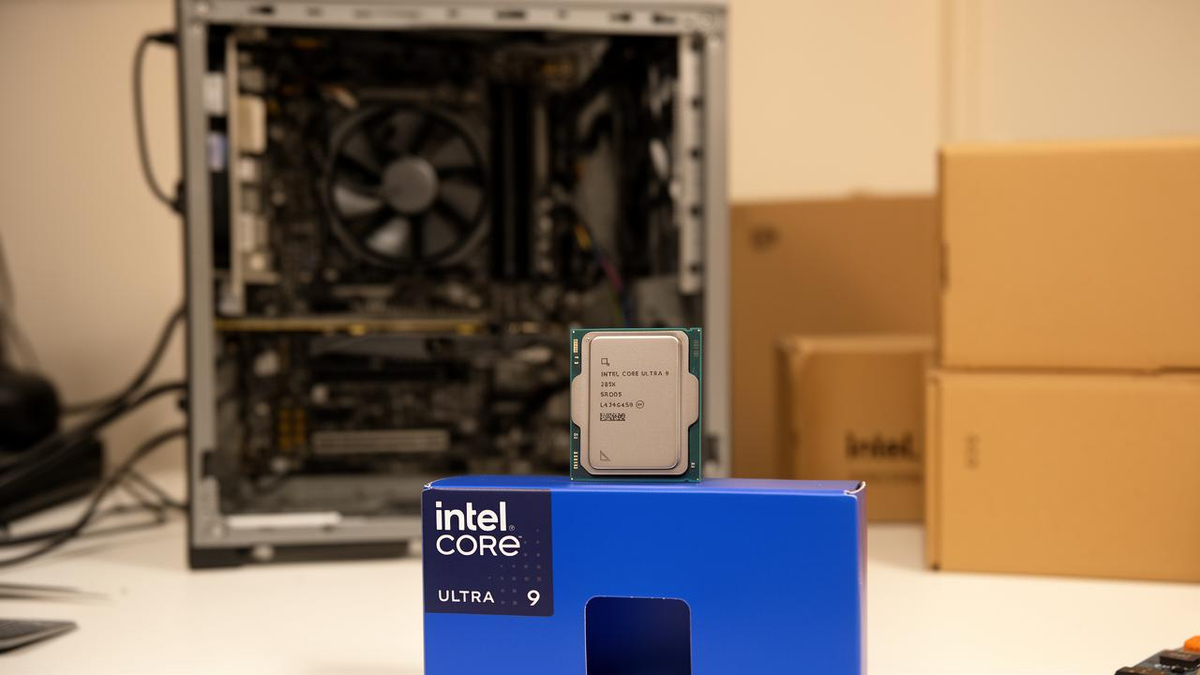
Intel clawed back a meaningful slice of the desktop processor market from Advanced Micro Devices in the third quarter of 2026, ending a long stretch of share losses and pushing its rival below the 30% mark for the first time in years, according to Mercury Research.
The chipmaker gained roughly 5.1 percentage points of desktop CPU share in the July-to-September period, lifting its total to about 70.1% while AMD held 29.9%. The reversal arrived against a softening backdrop for the broader PC market, making the swing all the more notable.
Mercury researchers attribute the shift largely to Intel steering manufacturing capacity toward desktop chips as laptop CPU demand cooled. The company had been under-supplying the desktop segment earlier in 2026, and it capitalized when demand surged during the quarter. A second factor, the firm said, was Intel’s steady volume through OEM and system-builder channels while AMD’s shipments sagged in its core gaming and enthusiast categories, where rising hardware prices and supply constraints took a toll.
AMD’s growing emphasis on higher-margin data-center silicon also played a part. The company has acknowledged it could not keep up with retail demand, choosing instead to prioritize capacity for data-center and AI products as it chases a milestone: surpassing Intel in total quarterly revenue by the end of 2026.
The revenue milestone now looks within reach. AMD reported third-quarter revenue of $13.4 billion, up 45% from a year earlier and above the high end of its own guidance of about $13 billion. Data-center sales reached $8.5 billion, a 97% jump, and the segment’s share of total revenue climbed to 64% from 47% a year ago. Operating margin in the unit widened to 34% from 25%. Client revenue, which covers desktop and notebook processors, rose 7% to $2.9 billion on Ryzen mobile sales even as desktop share slipped, while gaming revenue fell 40% to $773 million on lower semi-custom and graphics sales.
Intel’s own quarter was hardly weak. Revenue rose 21% to $16.5 billion, with the data-center and AI unit up 78% to $7.3 billion, while the client computing and physical AI group slipped 5% to $8.1 billion. Intel chief financial officer David Zinsner said the company expects the PC slowdown to continue at least through the first half of next year, even as demand for its data-center products runs well ahead of available supply.
| Metric | AMD | Intel |
|---|---|---|
| Q3 2026 revenue | $13.4 billion, up 45% | $16.5 billion, up 21% |
| Q3 2026 data-center revenue | $8.5 billion, up 97% | $7.3 billion, up 78% |
| Q4 2026 revenue outlook | About $17.0 billion | $15.0 billion to $16.0 billion |
| Q4 2026 non-GAAP gross margin outlook | About 55% | About 38% |
Note: Figures are from company earnings releases. Intel’s fourth-quarter outlook includes about $300 million of revenue it expects to lose to the Fab 28 shutdown.
On data-center revenue, AMD has already moved ahead of Intel. The edge, however, comes from AI accelerators and rack-scale systems; excluding Instinct GPU sales, Intel remains the larger server CPU supplier.
AMD guided fourth-quarter revenue to about $17 billion, a 66% increase, with data-center sales expected to rise roughly 50% sequentially. Even at the low end of that range, roughly $16.5 billion, AMD would still exceed Intel, whose guidance tops out at $16 billion. Adding back the $300 million of Fab 28 impact would lift Intel to $16.3 billion, still short of AMD’s floor. Shipments of AMD’s Helios AI infrastructure platform are expected to push data-center AI revenue above server CPU revenue on a quarterly basis for the first time. Management projects 2027 revenue growth above 80%, with data centers accounting for more than 80% of the total and server sales roughly doubling.
Counterpoint pegs AMD’s 2027 data-center revenue at about $77 billion. Should that play out, demand for high-bandwidth memory and server DRAM would rise in tandem, opening additional orders for memory suppliers such as Samsung Electronics (005930.KS) and SK Hynix (000660.KS).
The desktop share picture contrasts with the server arena, where Intel keeps the lead but continues to cede ground. Intel supplied 64.5% of server CPUs sold in the quarter, down from 72.2% a year earlier and a single point below the prior quarter. AMD’s server share rose 7.7 points year over year to 35.5%, though the sequential gain of one point suggests the pace of advance has slowed.
Including IoT and embedded SoCs, Intel’s overall CPU share edged up 0.2 points from the second quarter to 66.1%, but remained three points below the 69.1% recorded a year earlier.
| Segment | Intel, Q3 2025 | Intel, Q3 2026 | AMD, Q3 2025 | AMD, Q3 2026 |
|---|---|---|---|---|
| Desktop | 66.4% | 70.1% | 33.6% | 29.9% |
| Server | 72.2% | 64.5% | 27.8% | 35.5% |
| Overall, including IoT and embedded SoC | 69.1% | 66.1% | 30.9% | 33.9% |
Note: Unit shares as reported; components may not sum exactly to 100% because of rounding.
Supply capacity looms as the decisive variable for 2027. Intel has flagged tight yields on its Intel 3 process, a shortage of advanced substrates and the two-week shutdown of its Fab 28 plant in Israel after a fatal accident, which the company estimates will cost about $300 million in fourth-quarter revenue and 200 basis points of gross margin, with a similar revenue hit expected in the first quarter. Intel expects the industry to remain supply-constrained through 2027 and into 2028. AMD, by contrast, has secured production through TSMC to support its growth targets, including the Zen 6 Epyc 9006 server line now shipping on the foundry’s N2 process. Counterpoint said the ability to actually raise shipment volumes will determine competitive standing in the data-center market next year.