Just one day after launch, Anthropic’s newest model, Claude Fable 5.2, has triggered a flood of discussion on social media. Unlike previous models that competed on benchmark scores, what has developers and creators collectively buzzing this time is a capability that no benchmark can quantify: aesthetic sense.
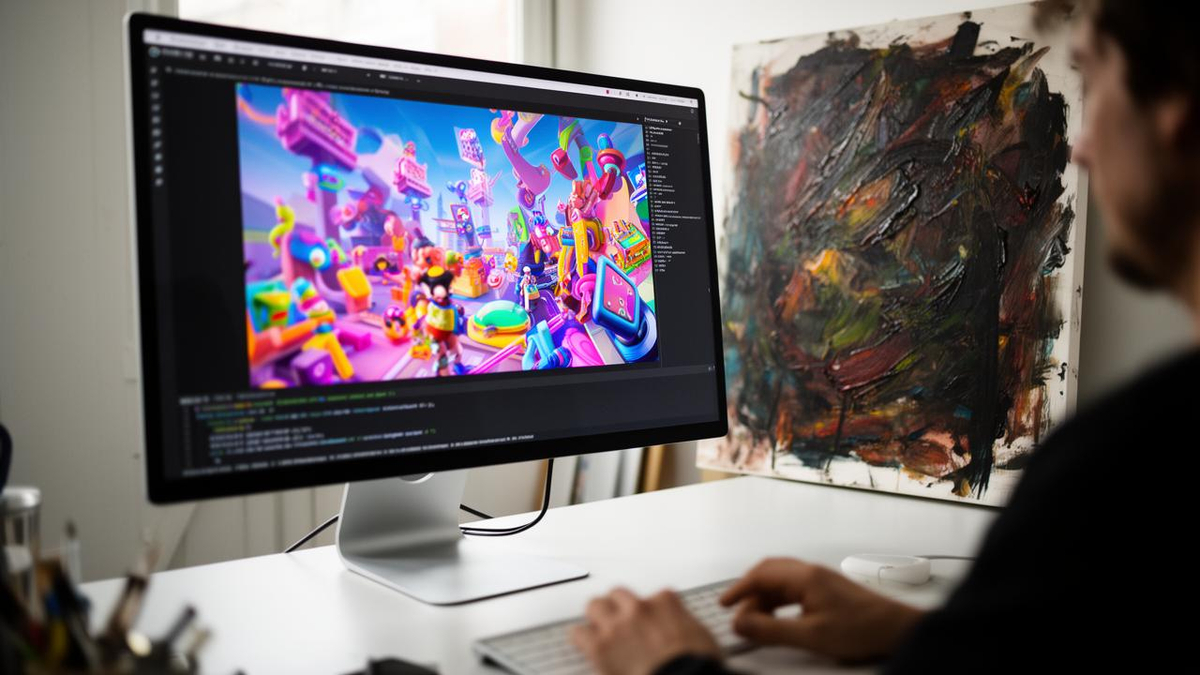
In multiple public cases, Claude Fable 5.2 wrote thousands of lines of Python code to call the Blender API, completing 3D scene construction, rigging, animation and rendering without touching a graphical interface at all. One developer used it to generate a 3D animation of a pelican riding a bicycle, with roughly 4,800 lines of code; another case showed the model independently designing and building a game prototype over eight hours. Even more surprising is the painting domain: the model did not call any image-generation model, but instead wrote about 1,000 to 2,000 lines of code to build a simulated paint engine, letting brushstrokes from different bristles land on the canvas one by one—one realistic work accumulated roughly 700,000 strokes.
These works spread rapidly through the community and also invited direct comparisons with the concurrently launched Gemini 4 Carbon. Several testers believe the latter is no slouch in technical completeness, but that a perceptible gap remains in visual rhythm, handling of light and shadow, and the judgment of shot composition. That gap is hard to quantify, yet it is precisely what makes Claude Fable 5.2’s most talked-about trait.
From a technical standpoint, the core logic behind this leap in capability is no mystery: in the digital world, images, video, music and 3D models can all ultimately be expressed as code. When a model possesses both code-generation ability and a judgment of what “looks good,” it can use code as a universal language to enter creative domains previously considered exclusively human. The fact that code can be executed repeatedly, controlled precisely and self-adjusted based on results means that, at the computational level, there is no essential difference between revising 10,000 feathers and 100,000 feathers.
This trend is now propagating to the tool layer. Adobe is holding its three-day Adobe MAX conference in Miami starting November 10, where it announced that desktop applications including Photoshop, Illustrator, InDesign, Lightroom, Premiere and After Effects will support MCP (Model Context Protocol), enabling external conversational AIs such as Claude, ChatGPT and Gemini to directly call and operate these professional tools. Users can use text or voice commands to have AI complete tasks such as slicing long videos, generating subtitles and automated editing.
Adobe’s move is seen by outsiders as a direct response to the “SaaS is dead” narrative. Over the past year, as AI generation capabilities improved, the market worried that users would no longer need to pay monthly subscriptions for design software, with Adobe first in the line of fire. MCP integration means Adobe has chosen to embed its own tools into AI workflows rather than fight them.
Anil Chakravarthy, who will become Adobe’s chief executive in December, said at the conference: “Adobe believes creativity is uniquely human. One of the most powerful forces in the world is a person with a creative idea, and that will not change.” He also acknowledged that there is a group of creators who do not want any association with AI, and that Adobe respects their position and will continue to offer them choices.
Deepa Subramaniam, Adobe’s vice president of product marketing for Creative Cloud, emphasized that amid the flood of AI-generated content, an individual’s taste and style are what make work stand out: “Experience, skill and, most importantly, ‘taste’ will become the biggest factor distinguishing creative professionals from others.”
In terms of industry impact, this round of change means different things for two types of players. For tool vendors, whether they can be smoothly invoked by mainstream AI may determine their gateway position in the next decade; for creative professionals, the marginal value of repetitive labor is falling fast, while the value of aesthetic judgment, creative direction and final quality control is being amplified. The debate over whether AI possesses aesthetic sense may continue, but the actions of capital and product teams have already pointed the way: code is becoming the universal interface through which AI intervenes in all creation in the virtual world.