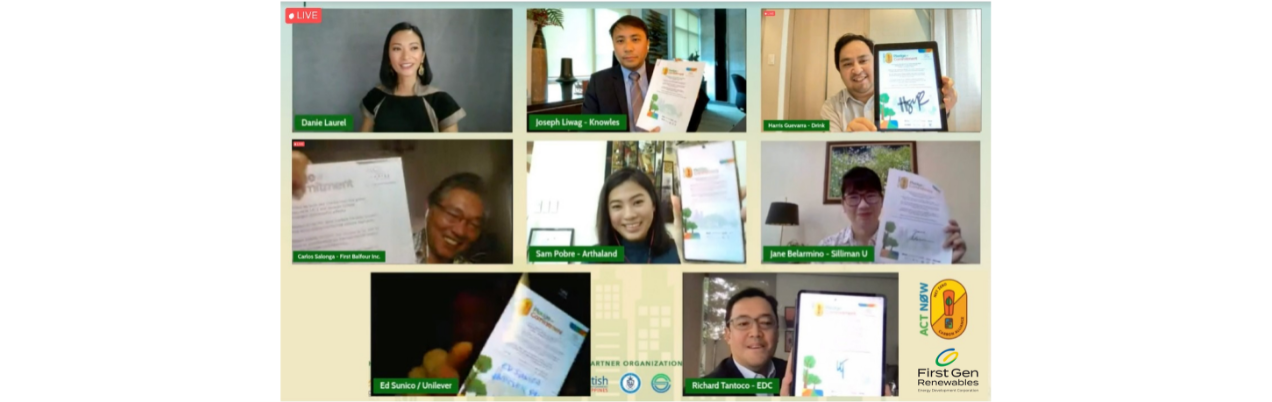
The Net Zero Carbon Alliance (NZCA), with its pioneer partners, is deep into efforts to help the private sector curb greenhouse gas emissions.
It is four years before the Philippine government’s self-imposed deadline to curb greenhouse gas emissions by 75 percent by 2030. This is in line with the 2015 Paris Agreement’s objective of reaching net zero by 2050—that is, removing necessary emissions by eliminating an equivalent amount of greenhouse gases. The Net Zero Carbon Aliance (NZCA), with its pioneer partners, is deep into efforts to help the private sector meet this goal.
In its 3-Year Report, NZCA shares that it continuously and consistently empowers its partners with guidelines, knowledge-sharing sessions, streamlined carbon reduction and tracking methods, and access to green financing. In the same report, NZCA gives an update on the various efforts its pioneer partners are undertaking to collectively meet the Philippines’ target NDC (Nationally Determined Contribution).
Arthaland Corporation
Since it launched its first sustainable residential project Arya Residences in 2009, Arthaland has been among the leading organizations in the Philippines that drive sustainability in the real estate industry. Currently, 10 percent of Arthaland’s developments are sustainably built—the only property developer in the country to achieve such a feat. The company’s efforts have led to a green movement among property developers. Data shows that the number of buildings seeking LEED (Leadership in Energy and Environmental Design) certification has grown 15 fold.
Drink Sustainability Communications
Drink is an active supporter of the government’s aim to reduce carbon emissions. Since 2023, the company has been providing carbon management services, going beyond production of reports and communication materials to help organizations meet their evolving needs. In addition, Drink uses compelling storytelling and inclusive language to interpret and amplify sustainability messages to reach a wider audience.
First Gen’s Energy Development Corporation
The country’s leading renewable energy company established NZCA in 2021 to advance its mission of forging collaborative pathways for a decarbonized and regenerative future, recognizing that this daunting goal can only be achieved through collective action. Central to EDC’s mission is the delivery of reliable, 24/7 clean power from geothermal energy, the “holy grail” among renewable technologies for its unique ability to provide stable baseload electricity to customers such as distribution utilities, condominiums, malls, schools, and factories.
First Balfour, Inc.
A leading engineering and construction company in the Philippines, First Balfour’s mission is to direct collaborations toward a decarbonized and regenerative future. The company does this in several ways. T1 Transport, one of First Balfour’s allied businesses and a proponent of electric vehicle (EV) operations in the Philippines, delivers end-to-end solutions for sustainable transportation. The company also invests in various educational programs, helping to empower communities through its participation in the annual nationwide Brigada Eskuwela program.
Knowles Philippines
From investing in wastewater treatment facilities and a fuel offsetting initiative with Shell Philippines to participating in reforestation and renewable energy initiatives, Knowles Philippines exemplifies persistence in achieving its sustainability goal. In addition to these efforts, Knowles Philippines is actively reducing the use of ozone-depleting substances (ODS) in its operations. In 2022, the company organized cross- functional teams from different departments to determine environmentally safe alternatives to ODS, which has effectively reduced their Scope 1 GHG emissions since then.
Silliman University
Environmental care is deeply embedded in how the Dumaguete-based university runs its campus and educates its students. Powered entirely by renewable energy using solar panels and geothermal sources, Silliman sealed its commitment to environmental causes by declaring a climate emergency in 2022. Today, as a partner of NZCA, the university prioritizes mobilizing resources for climate change education and research, upholding zero-waste initiatives and carbon footprint reduction, and collaborating with various stakeholders to achieve the country’s net zero goals.
Unilever
Sustainability progress is integral to Unilever’s business strategy. The companys Growth Action Plan focuses on four sustainability issues: climate, nature, plastics, and livelihoods. Unilever commits to be more focused on allocating resources for these priorities; be more urgent in driving its long-term sustainability ambitions; and be more systemic as it addresses the enablers and blockers of progress. More concretely, Unilever is set to install and complete ful solar panels within one year to provide solar-powered electricity to the Unilever Nutrition operation in Cavite. It has also renewed its partnership with Linis Ganda, the biggest network of junk shops, wastepickers, and recyclers in the country.
NZCA recognizes its role as a catalyst for change in the private sector. By releasing its 3-Year Report, the organization hopes to empower its partners to maintain their commitment to creating a low-carbon economy, while inspiring others to join the national and global Net Zero efforts.