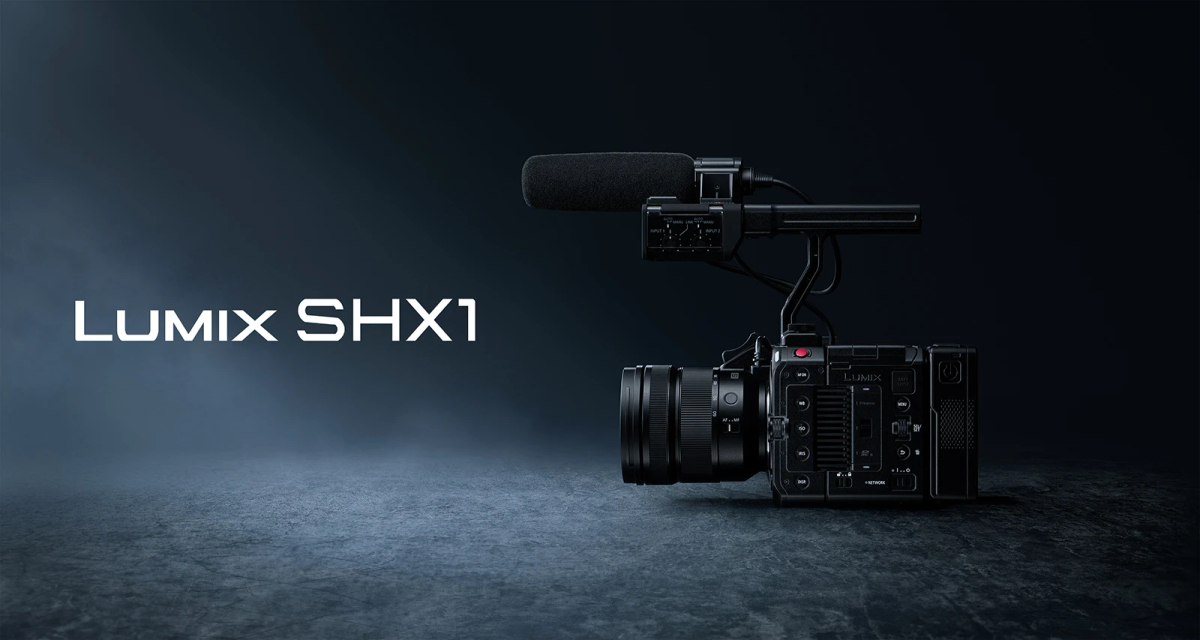
Panasonic announced on the 17th that it will release the LUMIX SHX1, a compact cinema camera for video production, on January 21, 2027. The expected price for the body is ¥810,000 (approximately $5,100). Equipped with an approximately 24.1-megapixel full-frame sensor, it combines cinema-grade image quality with mobility. The company aims to capture a new demand segment positioned between general consumer products and professional equipment for broadcasters and other industry users, including individual creators such as YouTubers, small video production companies, and live streaming operators. Pre-orders will begin at 10 a.m. on November 24.
The actual product is on display at the Panasonic booth at Inter BEE 2026 (Makuhari Messe), a video and broadcast equipment exhibition that opened the same day.
Box-style body with L-Mount, emphasizing expandability
The SHX1 is a box-shaped camera that adopts the same Leica L-Mount as the LUMIX S series. It omits an electronic viewfinder and incorporates a deployable display on the top surface. To allow flexible attachment of peripheral equipment, it features numerous screw holes on each side of the body.
The imaging section is a 6K full-frame sensor with an optical low-pass filter to suppress moiré and false colors. Dynamic range is secured at 15 stops with boost on and 14-plus stops with it off. For color reproduction, it inherits the V-Log/V-Gamut of the company’s VARICAM and LUMIX S1H cinema cameras, and comes with ARRI LogC3 pre-installed, enabling color matching with ARRI digital cinema cameras.
Thanks to a heat-dissipation structure that takes advantage of the box shape, it supports unlimited 4K120p video recording. For image stabilization, in addition to 5-axis in-body image stabilization (B.I.S.), it is equipped with an evolved E.I.S., Active I.S., and Dual I.S. 2, delivering high compensation effects even for handheld shooting such as walking shots. Autofocus uses an image-plane phase-detection system, recognizing and tracking not only people’s eyes and faces but also animals, cars, motorcycles, bicycles, airplanes, and trains.
For recording media, it supports ProRes RAW recording to CFexpress cards as well as Blackmagic RAW recording to external SSDs. Users can choose according to their editing environment.
In addition to the body, peripheral units tailored to different uses are available.
| Product name | Expected price |
|---|---|
| Compact cinema camera AU-SHX1 | ¥810,000 (approximately $5,100) |
| Control grip AU-GRP1 | ¥86,000 (approximately $540) |
| XLR handle unit AU-XHU1 | ¥100,000 (approximately $630) |
| Camera + grip + handle unit AU-SHX1U | ¥950,000 (approximately $6,000) |
| Live production unit AU-LPU1 | ¥170,000 (approximately $1,100) |
Note: All prices are expected prices excluding tax. Release is scheduled for January 21, 2027.
When combined with the Live Production Unit (AU-LPU1), it enables control equivalent to that of remote cameras. It integrates with the company’s remote cameras, studio cameras, controllers (RP200, HRP1010), video production software (Media Production Suite), and live video production platform (KAIROS), contributing to labor savings and automation at production sites.
Targeting the “gap” between consumer and professional
At the announcement event, Toshiyuki Tsumura, Panasonic’s Executive Officer in charge of the AVC business and Director of the Imaging Solutions Division, explained the new structure and goals. As of April 1, 2026, the AVC business returned to being a division of Panasonic Corporation, and in addition to consumer and professional AV, optical devices were also integrated into the division.
Tsumura positioned the SHX1 as a product that fills the space between the consumer and professional segments, where market growth is expected, and expressed hope for its use in one-person operations and small-scale productions. Another feature is that it combines the company’s mirrorless interchangeable-lens cameras with remote camera and live production technologies.
The digital camera brand LUMIX marked its 25th anniversary in 2026. Panasonic holds a high share in professional remote cameras and aims to cultivate new markets by bringing together the technologies and know-how cultivated in both the general consumer and professional fields.
Growing demand for video is a tailwind
Against the backdrop of the spread of video streaming and social media, demand for video shooting is expanding among individuals and small businesses. Panasonic believes a new market will grow between general consumer products and professional equipment for broadcasting and other uses, and wants to make the SHX1 the starting point for that.
The company positions the SHX1 not only for professional production sites but also as an option for users of the higher-end S1H and S5M2 models when they step up. The stance is to attract existing LUMIX users while acquiring new customers in the individual creator segment.
At video production sites, demand is growing for equipment premised on shooting and streaming with small teams. The SHX1, with its box shape, high expandability, and ability to integrate with live streaming systems, can be described as a product that responds to these changes in production styles. The ¥810,000 (approximately $5,100) price is high for individuals, but it is kept within reach for a cinema camera, a setting that reflects an awareness of bridging professional equipment and consumer products.
In its camera business, Panasonic has strengthened both general consumer and professional offerings centered on the LUMIX brand. Whether the new product can cultivate the intermediate segment into a substantial market will likely determine the future growth of its camera business.