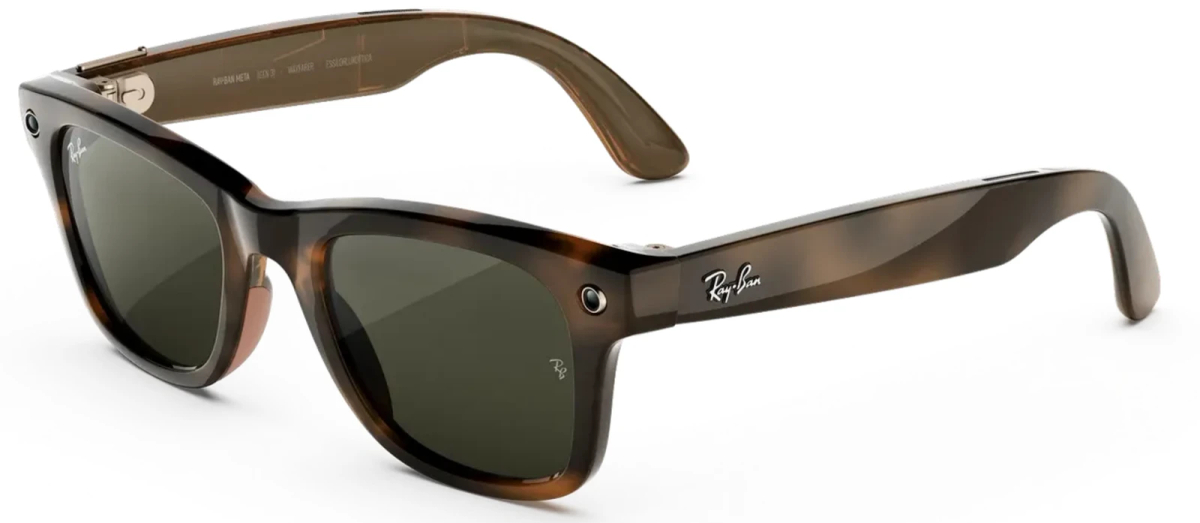
A product comparison has revealed that Meta Platforms’ Ray-Ban-branded smart glasses, the Ray-Ban Meta Wayfarer Gen 3, offer only modest improvements over the previous generation while raising the price by $70 (about ¥11,000). The price has been lifted from $379 (about ¥61,000) for the prior model to $449 (about ¥72,000).
The main changes in Gen 3 include an additional microphone (from five to six), one extra hour of battery life (from eight to nine hours), new frame styles, and a customizable physical button. The camera remains the same 12-megapixel ultra-wide lens as the Gen 2, supporting 3K resolution video at 30fps. The processor also continues to use Qualcomm’s Snapdragon AR1 Gen 1, the same as the previous generation, and there is said to be a slight lag when starting recording or operating the AI assistant.
| Item | Gen 2 | Gen 3 |
|---|---|---|
| Price | $379 (about ¥61,000) | $449 (about ¥72,000) |
| Battery life | 8 hours | 9 hours |
| Microphones | 5 | 6 (claims over 90% noise reduction) |
| Camera | 12MP ultra-wide | Same (unchanged) |
| Processor | Snapdragon AR1 Gen 1 | Same (unchanged) |
| Additional charging from case | 48 hours | 50 hours |
Note: Prices are reference prices in the U.S. market, excluding tax. Yen conversions are approximate, based on roughly ¥160 to the dollar.
On the audio front, the open-ear speakers are unchanged from the previous generation, leaving issues with bass depth and maximum volume. The added microphone, meanwhile, improves call clarity and voice recording quality. Meta says the noise reduction rate exceeds 90%. The glasses also feature hearing-aid-equivalent functionality, with hearing assistance software that has received U.S. Food and Drug Administration (FDA) clearance—a unique advantage for users with hearing challenges.
On the software side, the glasses offer AI features including live translation in up to 20 languages, “Conversation Focus,” which amplifies the voice of a conversation partner in noisy environments, and the “Be My Eyes” network that connects visually impaired users with volunteers and family members. However, many of these features are already available on the Gen 2. As for the dedicated app, the screen layout has been criticized as cluttered, with access to recorded data and settings described as difficult to navigate.
Meta has also introduced the Ray-Ban Meta Audio, a camera-free model. It comes in two frame styles, Clubmaster and Burbank, with 23 color and lens combinations. Weighing about 45 grams including lenses, it is lightweight and can run for up to 12 hours with intermittent use, or about six hours of continuous streaming playback. The dedicated case stores about 48 hours’ worth of power and can restore the battery from 0% to 50% in 20 minutes.
Many market observers view the Gen 3 as a “minor change.” For users who already own the Gen 2, the deciding factor will be whether added elements such as the new frames, improved microphones, and custom button justify the $70 price gap. For those buying smart glasses for the first time, the discounted Gen 2 may still be a compelling option. For those seeking major advances in camera performance, processing power, or battery life, a strategy of waiting for the next-generation model is also reasonable.
In the smart glasses market, privacy concerns over camera-equipped models remain deeply rooted. Meta’s introduction of a camera-free, audio-focused model is seen as an effort to ease surrounding wariness while raising wear rates. By narrowing functionality to a voice assistant and open-ear audio, the company has achieved both an appearance close to ordinary eyeglasses and a comfortable feel for extended wear.
At eyewear retail counters, the ability to accommodate a diverse range of lenses—including prescription, photochromic, and progressive lenses—is encouraging handling by ordinary optical shops. How well the devices balance wearable functionality with the practicality of everyday eyeglasses will likely determine their future adoption.