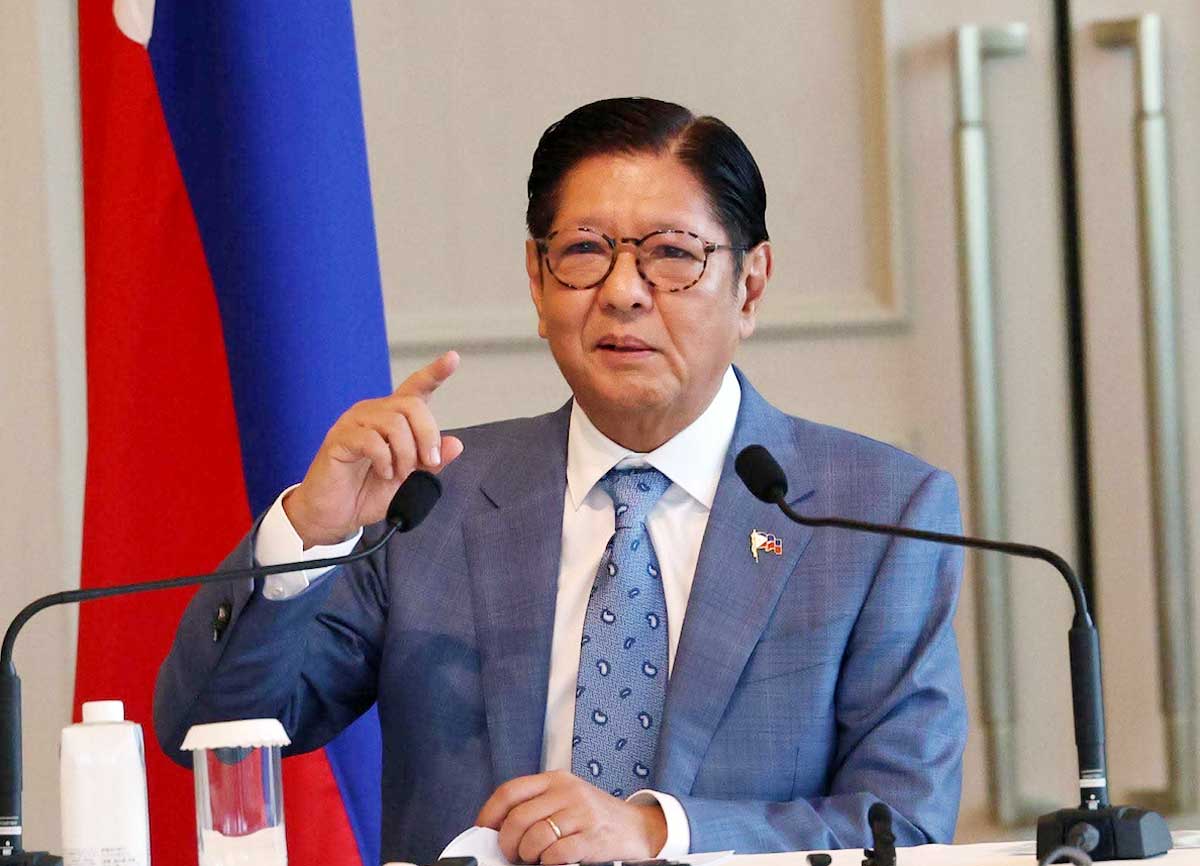
Asked what he would like the present and future generations to take away from his years in office, President Marcos replied: “That I served. That I was true to my principles of, again, duty, honor, country.”
His surname may have triggered divisions and evoked nostalgia and deep wounds, depending on which side is talking, but President Marcos remains hopeful that history will be kind to him and remember him as someone who valued service, duty and honor.
Despite the things he learned from his father, Marcos is convinced that he has to be a different president: “It’s a different time. There are fundamental lessons that I still hold close to my heart. But in terms of the practical things that you do, very few of those things apply any longer.”
Debates about the legacy of the Marcoses continue more than four decades since the President’s late father and namesake was ousted through the 1986 EDSA people power revolt.
The military-backed uprising forced the Marcoses to flee the Philippines and live in exile in Hawaii.
Asked by Bloomberg Television what he would like the present and future generations to take away from his years in office, the President replied: “That I served. That I was true to my principles of, again, duty, honor, country.”
“History is always kinder than the contemporary. When it’s written, I hope that it shines through. I wanted to serve because it’s my duty and I served with honor and I served my country,” he added.
Asked how he would define the presidency of his father, Marcos said there were gains in governance during the period.
“Politics, by its nature, is polarizing. And so there will be those different schools of thought. But if you look at actual governance and performance and when the Philippines progressed into the modern world, I think we can ascribe that period to the time of my father,” the Chief Executive said.
Many historians and civil society groups regard that period as a dark chapter in history characterized by human rights violations and massive corruption.
Rights watchdog Amnesty International said the martial law declared by the first Marcos administration “unleashed a wave of crimes under international law and grave human rights violations, including tens of thousands of people arbitrarily arrested and detained, and thousands of others tortured, forcibly disappeared and killed.”
Marcos loyalists claim that the elder Marcos’ presidency is a “golden age” because of the infrastructure projects completed and citizens’ high level of discipline under his term.
According to Marcos, his parents had reminded him and his siblings that they were not entitled to anything.
“Don’t ever think that they owe you. Nobody owes you anything. And that was a lesson that they hammered into us over and over again,” he added.
Marcos described his mother, former first lady Imelda Marcos, as the “real politician” in his family due to her ability to connect with people.
“My father was an intellect. He was a statesman. We always said that he lived in his head. He was a deep thinker. That’s what I learned. My mother, on the other hand, has this uncanny ability to connect with any kind of person. Any person she runs into in the street. Kings, presidents, anyone,” Marcos said.
Growth target
In the same interview, Marcos expressed optimism that the Philippine economy can grow by more than six percent by the end of his presidency.
“However, with the war in the Middle East, everything has to be redrawn. The uncertainty and lack of stability is going to factor into that. That’s the general risk factor. It’s still there. And that’s not going to diminish immediately. That’s going to taper off,” he said.
Marcos admitted that an eight-percent economic growth may be a “tough number to get to.”
The Philippine economy expanded by a lower-than-expected 2.8 percent in the first quarter due to the impact of the Middle East war and weaker investor confidence caused by the multibillion-peso flood control scam.
The first quarter growth was slower than the government’s five to six-percent target range for this year.