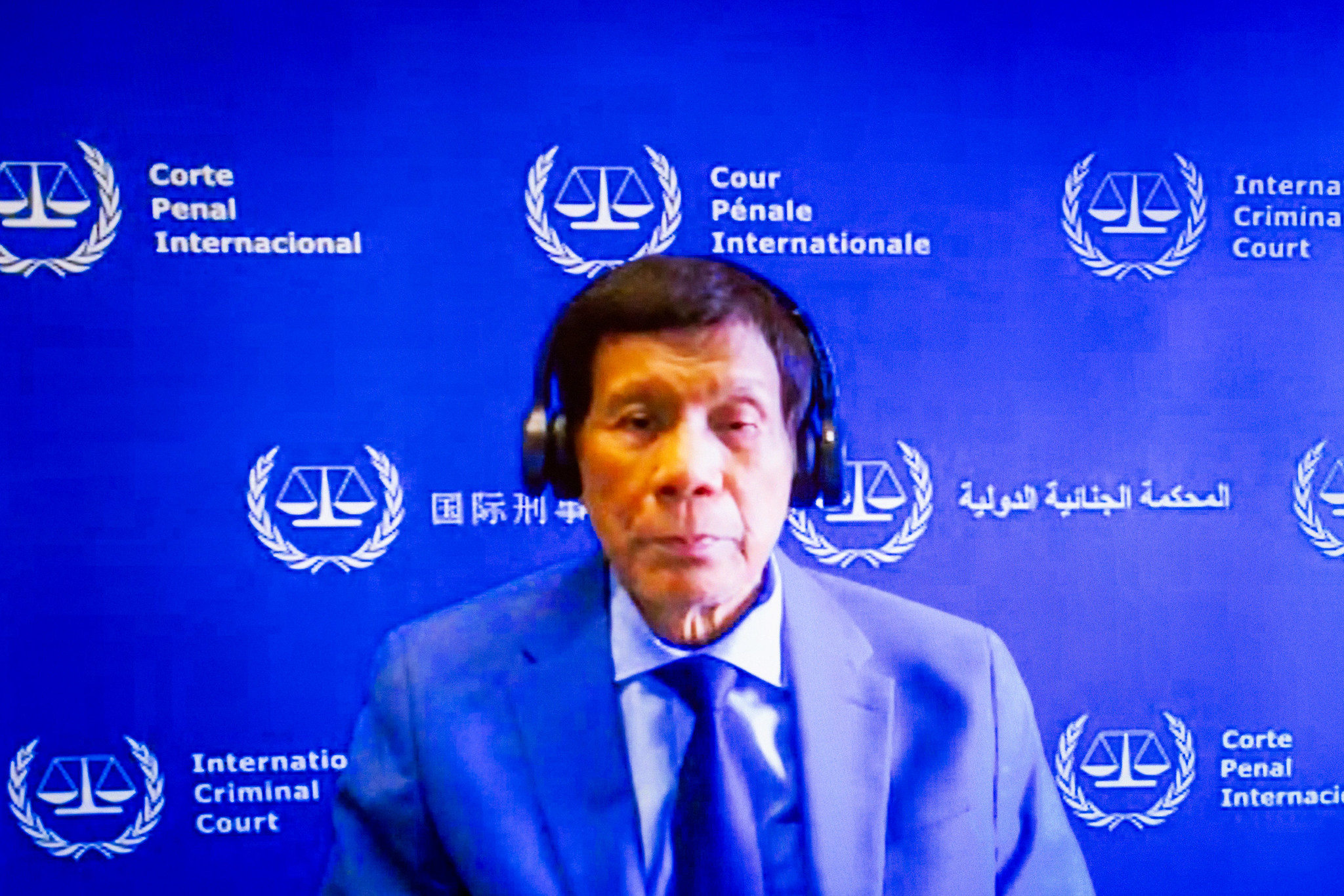
The ICC Trial Chamber III will hold its first status conference on the case against former president Rodrigo Duterte on May 27.
The defense team of former president Rodrigo Duterte will have ample time to prepare for his upcoming trial for crimes against humanity at the International Criminal Court (ICC), according to a court spokesperson.
In an interview with The Philippine STAR, ICC spokesperson Oriane Maillet assured the public of a fair, impartial and independent trial for the former president.
“The trials at the ICC can be complex, (it) may take a little bit longer than at national level because of the type of crimes that require a large amount of evidence to be presented in court, and some of the challenges that can be met during the proceedings,” she said.
“But we are committed to holding a fair and independent trial, impartial trial, where the defense will have enough time to prepare for its case and where the rights of the victims will be upheld,” she added.
Last April 23, the ICC Pre-Trial Chamber I confirmed all charges of crimes against humanity against Duterte, paving the way for a full-blown trial.
The Trial Chamber III, which was constituted following the decision, will hold its first status conference on May 27.
Maillet said it will be up to the trial judges to set schedule for the opening of the trial, based on the submissions of parties to the case.
But she stressed that the defense will have enough time to prepare its case.
“I cannot speculate at this stage. It will be a decision by the judges to set the date for this trial,” she said when asked when the trial would begin.
“There are many issues that need to be resolved before being able to start the trial. And really, they’ll have to see what is best for the parties to be ready for the trial. And it will really depend on the circumstances of the case, so let’s wait and see,” she added.
Experienced judges
According to Maillet, the judges were selected based on the current judicial workload to ensure that the court functions efficiently.
“As you know, all ICC judges are individuals of high moral character, impartiality, integrity. And they have the relevant qualifications back home in their respective states to be appointed at the highest judicial functions,” the ICC spokesperson said.
“And they all have extensive experience in the court’s judicial activity in trial proceedings,” she added.
The ICC presidency earlier appointed Judges Joanna Korner from United Kingdom, Keebong Paek from South Korea and Nicolas Guillou of France to form the trial chamber that will handle Duterte’s case.
Korner was later elected as presiding judge.
Public trial
Maillet said Duterte’s trial will be public, with the proceedings streamed online with some delay.
“The judges may decide to hold certain hearings in closed session. If they feel some information needs to be protected – certain sensitive evidence, confidential evidence – or, if there’s a need to protect the witnesses or the victims, some sessions may be held in closed sessions. But the principle is that it is a public trial,” the ICC spokesperson said.
“Now, what can we expect? On the first days of the trial, you usually have opening statements by the parties and participants, and then the prosecution will start presenting its case. The prosecution has to prove the guilt of the accused beyond reasonable doubt, so it’s quite a high threshold. To do so, they will present evidence. It can be material evidence, it can be photos, videos, witnesses,” she added.
As a rule, the accused’s presence is required during trial, but Maillet said the final decision is with the judges.
Duterte’s defense team earlier raised the issue of the former president’s health during pre-trial proceedings.
Maillet noted the measures adopted by the Pre-Trial Chamber I to ensure Duterte’s participation during the confirmation hearings, including the regular breaks in between sessions.
Duterte ultimately waived his appearance during the said proceedings.
Maillet stressed that the ICC Detention Center where Duterte is presently detained “operates in conformity with the highest international human rights standards.”
“So this is indeed a matter that the ICC is taking very seriously,” she added.