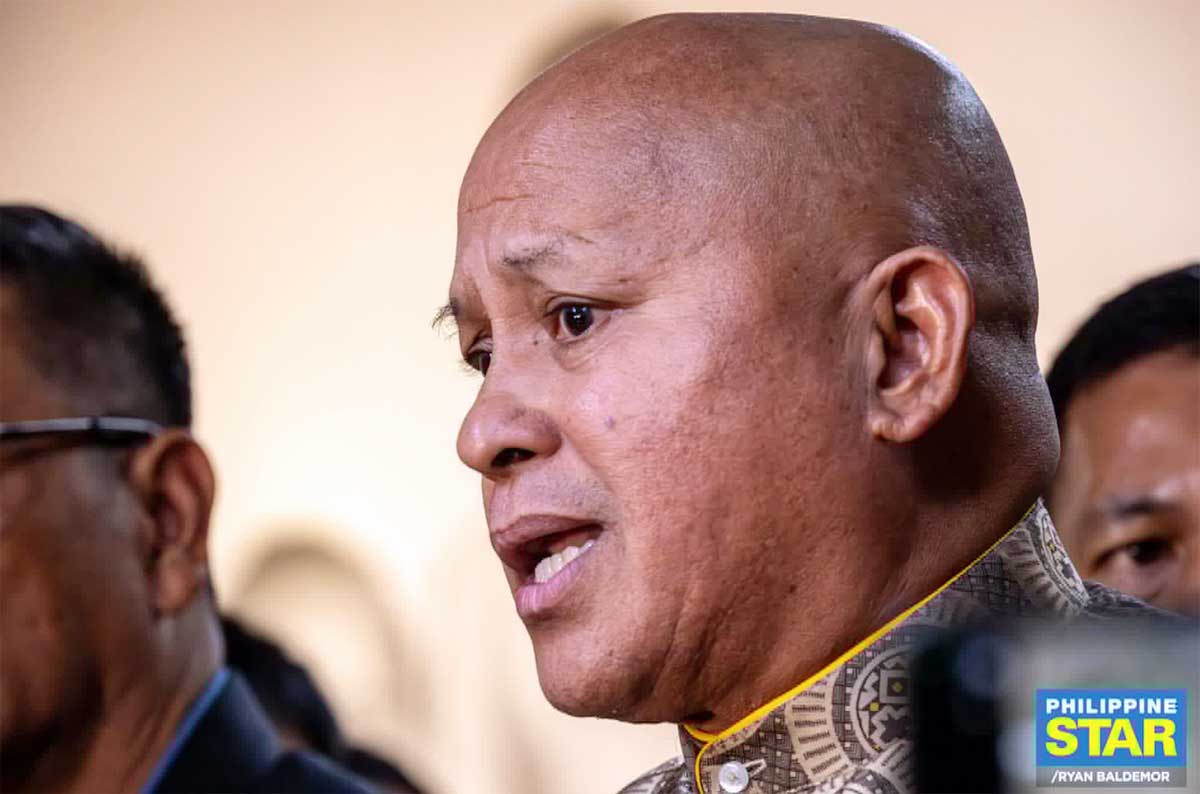
Amid debates over whether Sen. Ronald dela Rosa should be arrested and turned over to the International Criminal Court, the Department of Justice (DOJ) maintained that existing law allows local authorities to do so.
Asked about the agency’s position on implementing the ICC arrest warrant against Dela Rosa, DOJ spokesman Polo Martinez said: “Yes. Same position. Under RA (Republic Act No.) 9851, we may surrender a suspected or arrested person in the Philippines to the appropriate international court or tribunal. The other mode is extradition.”
Asked about the DOJ’s next steps, including possible instructions to the National Bureau of Investigation (NBI) to enforce the ICC warrant and the need for a local court order, Martinez declined to comment.
“We will address the public and answer questions from the press in due time. We are just gathering the necessary information,” he said in a Viber message on Wednesday, May 13.
RA 9851 or the Philippine Act on Crimes Against International Humanitarian Law, Genocide and Other Crimes Against Humanity states the government can turn over a person wanted by an international court or tribunal through extradition or surrender.
The same law was also cited by members of the Senate minority and Palace press officer Claire Castro as basis for the legality of enforcing the ICC warrant.
Martinez, however, maintained it would be “prudent” to wait for the decision of the Supreme Court (SC) on motions by Duterte and Dela Rosa, both challenging ICC jurisdiction over them, which were filed before Duterte was flown to The Hague in March 2025.
‘Don’t be misled’
On the same day Dela Rosa resurfaced after months out of public view, his camp, through the law firm of Israelito Torreon, filed motions urging the Supreme Court to block his arrest.
In an interview over dzBB on Wednesday, Torreon maintained the public “should not be misled” about provisions of RA 9851, citing Section 17, which declares “the Philippine State has primary jurisdiction over crimes against humanity, war crimes and genocide.”
He added that under the law, Philippine authorities “may dispense with investigation and prosecution (and may) surrender or extradite the accused to a foreign authority but subject to applicable extradition laws and treaties.”
He explained that the SC has issued rules of procedure on extradition cases, but there remains none on surrender.
“It is very clear that there is no surrender procedural mechanism that will guide lawyers and judges on the process in case the accused here in the Philippines is surrendered. That is why we have to follow Philippine laws, and we have to respect the rights of the accused because no person shall be deprived of life, liberty and property without due process of law,” Torreon said in Filipino, citing the 1987 Constitution.
Meanwhile, Sen. Panfilo Lacson said Senate protective custody over Dela Rosa would no longer be justifiable once a local court issues an order to surrender him to the ICC.
“Senate protective custody: legal or not, it cannot be justified anymore when a domestic court issues an order to surrender Senator dela Rosa to the jurisdiction of the ICC, unless the Supreme Court restrains or reverses the order,” Lacson said on X.
Lacson maintained that the authority of domestic courts must be acknowledged and respected, including in the case of action from the ICC.
“That is an international warrant. We are bound by treaty obligations, but we must still give importance to domestic courts. So if there is an international warrant, we still have to bring it before a local court, which will issue the authorization or subsequent warrant of arrest to implement the ICC warrant,” he said in Filipino over radio dzBB.
Palace assurance
Malacañang, for its part, assured Dela Rosa that the administration of President Marcos is “fair, law-abiding and does not resort to violence.”
“Our countrymen will not be denied the assistance that can be provided by the government in accordance with the law. So no matter what the person’s political color is, the interests of the people must remain the priority and not selfish financial gain,” Castro said.
The lawmaker earlier appealed to Marcos not to surrender him to the ICC in The Hague after the tribunal ordered his arrest as one of the alleged “co-perpetrators” in the crimes against humanity case against detained former president Rodrigo Duterte.
Castro, in response, said the government would protect all Filipinos, including the victims of extrajudicial killings and those accused in the drug war, in accordance with the law.
“Accused persons like Sen. Bato… will be given protection under the law,” Castro said. “If he is arrested, all rights as an accused will be given to him.”
1Sambayan hits Senate
Opposition coalition 1Sambayan, meanwhile, slammed the Senate for granting protective custody to Dela Rosa, saying the constitutional immunity from arrest does not apply to crimes against humanity.
“Crimes against humanity, whether prosecuted under Republic Act 9851 or under the Rome Statute, carry penalties far exceeding six-year imprisonment. By the plain language of the Constitution itself, immunity from arrest cannot apply,” the group said.
“The Filipino people deserve public officials who obey the Constitution and the laws of the land, not those who manipulate legal technicalities to evade accountability,” it added.
Militant groups led by Bayan also attempted to implement a citizen’s arrest on Wednesday on Dela Rosa but were blocked by police personnel.
Families of victims of the Duterte administration’s anti-drug campaign and Rise Up for Life and for Rights, represented by the National Union of People’s Lawyers, likewise urged the Philippine government to immediately implement the arrest warrant against Dela Rosa. – With Neil Jayson Servallos, Helen Flores, EJ Macababbad, Janvic Mateo