Calvin & Hobbes is considered by many to be one of the greatest comic strip series of all time. It mixes the chaotic imagination of a child with unique observations that take a look at the world from a different angle. Bill Watterson made this comic about a boy and his stuffed tiger incredibly endearing and raucously funny.
While the comic is from the perspective of a child, it was still being written and drawn by an adult man. This means, naturally, that Watterson was able to make jokes that a child wouldn’t get. These “grown-up jokes” were not about topics inappropriate for children; rather, they made points about the complexity of the world which would easily go over a child’s head.
Calvin Imbues the Unliving with Existential Dread
When snow begins to fall, almost every child’s first instinct is to build a snowman. It’s a common form of creativity that accompanies the colder season, and is as simple as rolling at least three balls of snow in decreasing size on top of one another, adding some facial features, and maybe adding a hat, some buttons, and a pipe.
However, this design is too simple and straightforward for Calvin. He wants a more raw and real snowman, so he gives his snowman the existential dread of knowing one is alive “weighed against the horror of nonbeing.” Hobbes compliments Calvin’s “willingness to put artistic integrity before marketability.” The dry and absurd humor is very reminiscent of Far Side comics. This coaxes Calvin into making a normal snowman too. Most children don’t have the existential dread that comes with wondering if you have lived your life in a meaningful manner. Adding the joke about marketability adds to the humor while still being outside of the average kids’ reach of understanding how capitalism works.
Children Don’t Understand Why Some TV Should Be Off-Limits
Daytime television is a different beast, with countless soap operas and daily gossip talk shows that frankly either cannot or should not appeal to kids. Soap operas in particular tend to deal with mature topics not suited for children, but a sick day from school gave children the rare opportunity to access that daytime programming (streaming notwithstanding).
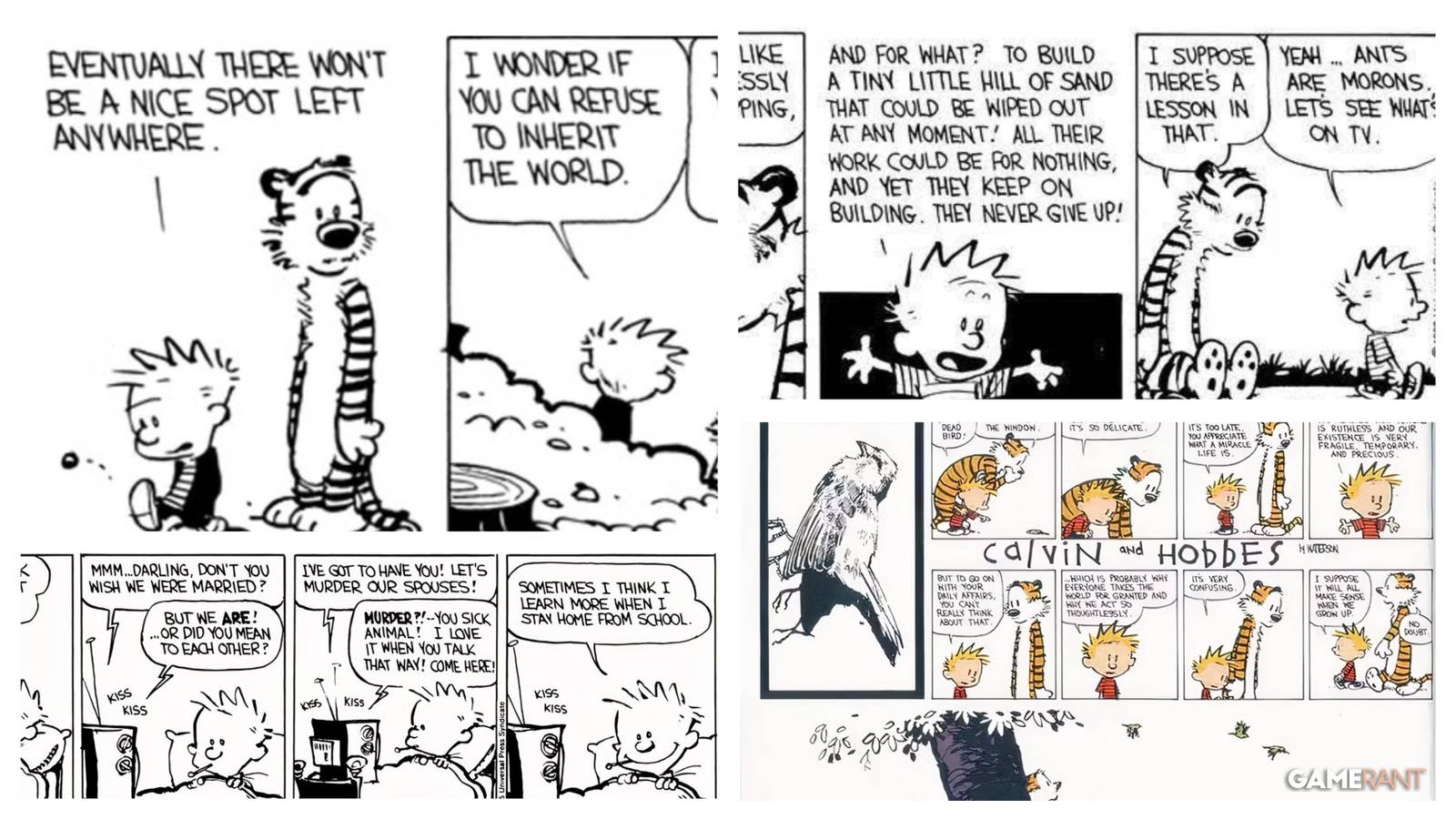
This comic shows Calvin watching what seems to be one of those soap operas while home sick from school. The program includes an affair, murder, and a “skimpy négligée,” prompting Calvin to say, “Sometimes I think I learn more when I stay home from school.” This suggests that Calvin is learning about a lot of concepts he shouldn’t be, and it’s a joke that really only appeals to adults.
The Futility of War is Hard to Grasp for a Kid
Kids safe at home in America do not understand the weight and magnitude of war. Obviously, there are children around the world who have to experience its horrors firsthand, but Calvin certainly does not know what it is like to live in a war zone.
That is why Calvin and Hobbes decide to play war in this comic. They agree that the first to get hit by a dart dies, and then the two shoot one another at the same time. They agree it’s a stupid game, but this acknowledgment doesn’t quite communicate the point in an explicit enough way for a kid. Wars only destroy, not create. They are not fun, and they damage everyone involved. Calvin may not understand this yet, but this comic shows that he’s close.
There Is No Rock Bottom, and That’s Reassuring for Some Reason
This single-panel comic makes a point about the world that is difficult for children to grasp, and if a child does understand this point, adults are often saddened by such pessimism. This comic shows Calvin floating from a balloon and saying, “That’s one of the remarkable things about life. It’s never so bad that it can’t get worse.”
This thought accompanies a bird in the distance, likely getting so close that it could pop the balloon from which Calvin is floating. The comic demonstrates a point that many adults get, but children may not: there is no rock bottom. Things can always get worse. Most adults have experienced enough weary years to get to this point, but kids, most of the time, do not have the life experience to come to grips with how true this is.
Calvin Makes Experiences a Poignant Moment of Pondering Mortality
This comic starts with Calvin and Hobbes finding a dead bird. This triggers an epiphany in Calvin, and he begins to ponder the fleeting nature of life. He talks about how brutal nature can be and how quickly it can snatch the gift of life away. He talks about how this horror of life is probably why people get so buried in their own lives and do not take the time to think about what life means.
Calvin finishes this comic by saying, “I suppose it will make sense when we grow up.” The joke here, which is something only adults will understand, is that being a grown-up does not make all of this clear. Life can still seem random, cruel, and brutal. Adulthood only makes this reality more stark; it does not explain it.
Ants Sure Are Silly Little Guys
This comic finds Calvin and Hobbes watching an anthill. Calvin begins making fun of the ants, talking about how mindless they seem, how hard they are working for something that could be instantly taken from them, and how pointless that work seems to be.
The joke here, of course, is that humans do this exact same thing. We work hard without questioning why and unaware of the fact that all which we gain from our work can be taken away from us by the cruel whims of the universe. Calvin doesn’t understand this, and your average child will not. However, an adult can understand how brutal this truth about the world really is.
The World Is Yours, Whether You Want It or Not
This is a melancholy Calvin & Hobbes comic that finds Calvin observing the destruction of forestry. He sees a tree stump and begins commenting on how long it took the forest to grow versus how quickly it was razed to the ground. He laments about how quickly the area will be made into “a big strip.”
He then asks Hobbes, “If you can refuse to inherit the world.” Hobbes says, “I think if you’re born, it’s too late.” This makes another mature point children don’t usually understand. The world is cruel and fleeting. It’s not fair, and it is your problem the second you are born. The only thing one can do is to make the best of it and try to improve it where they can.
Calvin’s Dad Finally Understands Adulthood in a Way That Only an Adult Can
This particular comic does not feature Calvin or Hobbes at all. Instead, it focuses on Calvin’s parents as they lay down to sleep for the night. However, Calvin’s dad can’t sleep, and he begins to ponder the nature of adulthood. He talks about how, as a kid, adults seem to have it together, but he now understands that no adult could.
He now understands that so much of adulthood is “ad-libbed.” No adult can understand how to tackle every problem and situation that comes their way. Instead, the best an adult can do is just try their best and use their common sense and wisdom. Children cannot understand this because they simply do not have the age and experience yet.