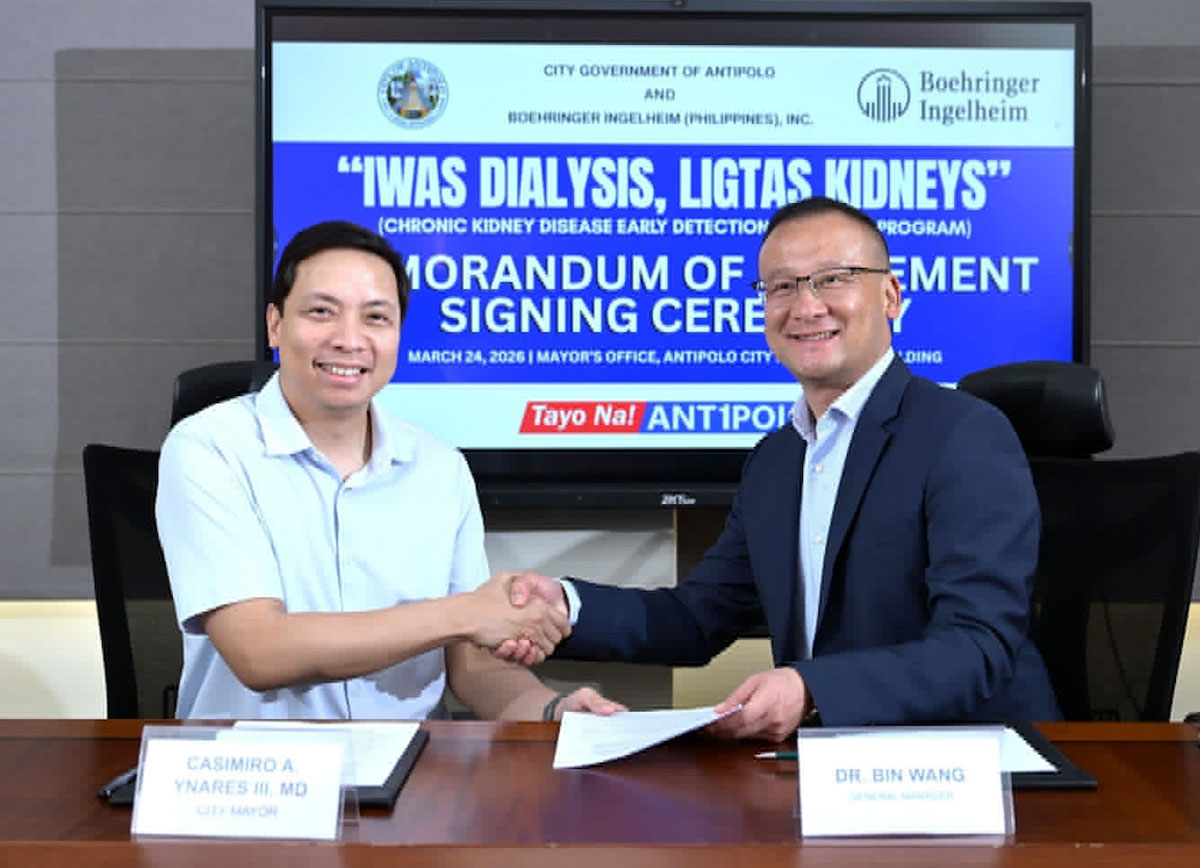
In the Philippines, an estimated 13 million Filipinos or 11.2 percent of the population are living with chronic kidney disease. Currently, one out of three patients are already in Stages 3 to 5.
Chronic kidney disease (CKD) often goes unnoticed until it reaches an
advanced stage, when kidney function has already significantly
declined. By this point, many patients require dialysis, bringing
substantial financial strain and emotional burden to families.
In
the Philippines, an estimated 13 million Filipinos or 11.2 percent of
the population are living with CKD. Currently, one out of three patients
are already in Stages 3 to 5, where the cost of care can increase up to
11 times compared with timely detection and early intervention.
To
help address this growing health challenge, Boehringer Ingelheim
launched “Iwas Dialysis, Ligtas Kidneys: Get CheCKD Habang Maaga Pa!,”an
initiative aimed at improving early detection and increasing kidney
health awareness at the community level.
The program officially kicked off with a pilot run in District 1, Quezon City, followed by a city-wide rollout in Antipolo City.
“Iwas
Dialysis, Ligtas Kidneys: Get CheCKD Habang Maaga Pa!” falls under
Boehringer Ingelheim’s Sustainable Development for Generations (SD4G)
commitment to improve health equity and outcomes for 50 million people
in underserved communities worldwide. By working directly with barangay
health centers, the program ensures that kidney health services such as
screening and education are accessible to all residents.
“Our
SD4G commitment guides us to work where the needs are greatest,” said
Dr. Bin Wang, general manger, Boehringer Ingelheim (Philippines), Inc.
“By partnering with barangay health centers and equipping community
health workers, we help bring essential kidney health services closer to
families who may otherwise have limited access. Early detection can
make a real difference in people’s lives, and we are proud to support
these efforts.”
Key program components include kidney health
screenings, community education sessions, and practical guidance to help
residents better understand their health and reduce long-term risks.
Patients with abnormal screening results are guided towards timely
referrals to appropriate healthcare facilities. To date, more than 1,500
Filipinos have received kidney health screening through the initiative.
“Symptoms
such as fatigue, nausea, or skin irritation are often overlooked or
mistaken for minor concerns,” said Dr. Greta Cortez, head of Medicine at
Boehringer Ingelheim (Philippines), Inc. “As a result, many patients
only receive a diagnosis during an emergency or when managing
conditions. Early screening, especially with individuals with diabetes
or hypertension, allows us to intervene and help prevent progression to
end-stage renal disease.”
According to Antipolo City Mayor
Casimiro “Jun” Ynares III, a medical doctor, the entire family suffers
emotionally and financially when one family member has CKD.
“We
want to break that cycle. By bringing kidney health screenings directly
to our barangays, we are giving our parents and grandparents a chance to
stay healthy and present for their loved ones. Alagaan natin ang ating mga bato, para sa kinabukasan ng ating pamilya (Let’s take care of our kidneys to safeguard our family’s future),”
A
central element of the program is the empowerment of barangay health
workers (BHWs). Through targeted training, BHWs are given training and
tools that empower them to become community kidney health advocates.
BHWs are equipped to perform initial health assessments, master
effective patient communication, and assist in conducting urine
albumin-to-creatinine ratio (uACR) tests. The program has trained over
200 healthcare providers (doctors and barangay health workers),
representing 20 barangays.
Albumin, a specific type of protein, in
the urine is an important early indicator of kidney damage. With
portable and user-friendly technology, BHWs support nurses in conducting
uACR tests that deliver quick results and enable earlier identification
of at-risk individuals – often before symptoms appear.
While
diabetes and hypertension remain the leading causes of CKD, additional
factors such as age, smoking, obesity, and family history also increase
risk. Lifestyle habits, particularly high-sugar and high-sodium diets,
chronic stress, and physical inactivity, further contribute to the
disease burden.
“Early detection is life-saving. We welcome
efforts that strengthen early kidney screening and raise awareness
across our barangays about the importance of renal health,” stated
Quezon City Councilor Dorothy Delarmente. “With the support of our
health partners and dedicated barangay officials, more residents will
now have access to free check-ups, proper medical knowledge, and
essential services.”