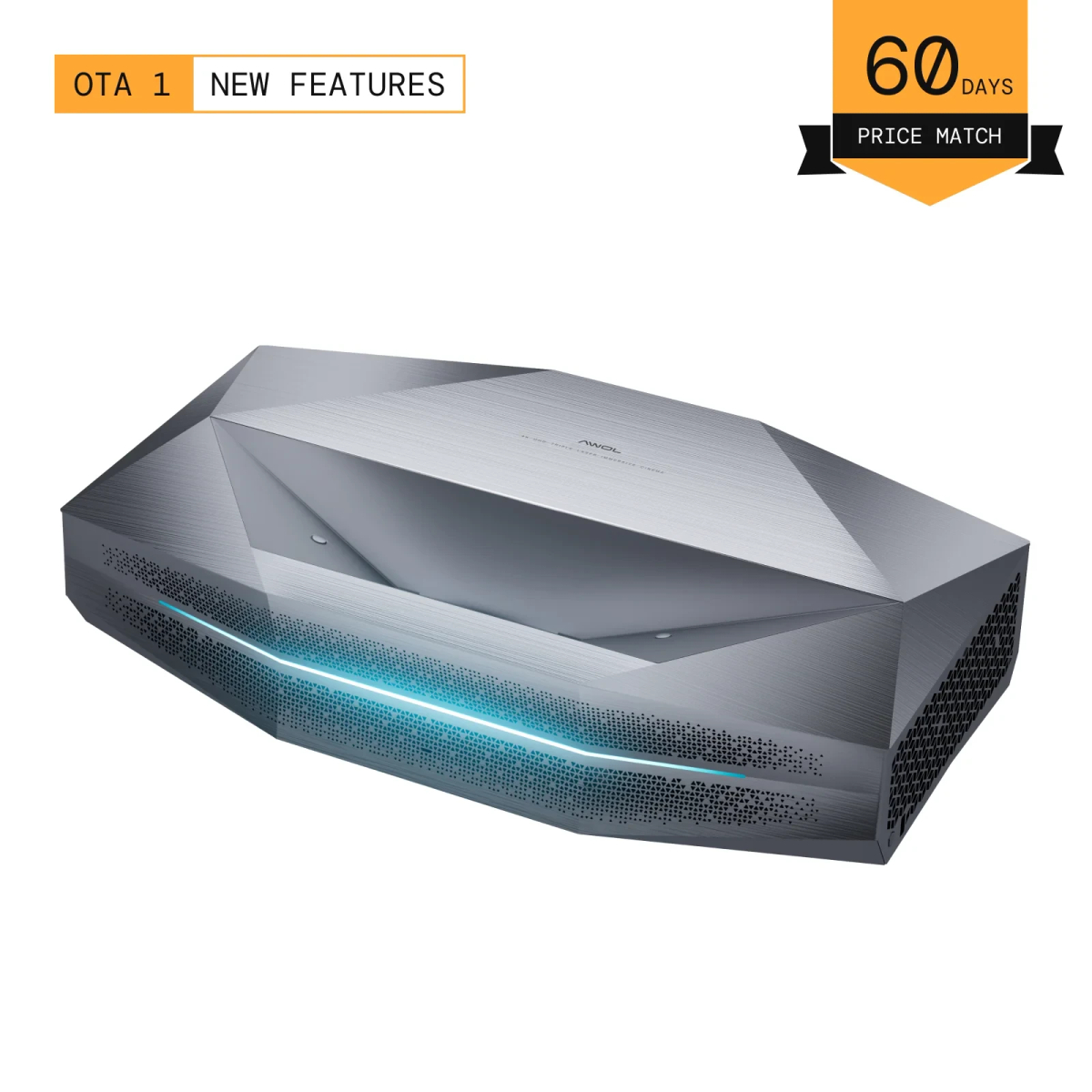
AWOL Vision has begun general sales of its Aetherion ultra-short-throw 4K projector line in Japan, adding a cheaper entry model that brings the brand’s triple-laser imaging within reach of more buyers.
The Aetherion Plus carries a manufacturer’s suggested retail price of 379,800 yen (about $2,400), or 439,600 yen (about $2,700) bundled with a 120-inch projection screen. It sits below the Aetherion Pro at 559,800 yen and the Aetherion Max at 719,800 yen, and is sold through AWOL Vision’s Japanese site, Amazon and Rakuten Ichiba, among other channels.
The lineup uses RGB triple-laser light sources with 4K UHD resolution and a 0.21:1 throw ratio, letting the unit cast a 100-inch image from roughly 15.8 centimeters off the wall. Projection sizes range from 80 inches up to 200 inches, and the company says an eight-point automatic keystone and image-alignment system simplifies placement.
| Model | Price (Japan) | Brightness | Native contrast |
|---|---|---|---|
| Aetherion Max | 719,800 yen | 3,300 ISO lumens | 6,000:1 |
| Aetherion Pro | 559,800 yen | 2,600 ISO lumens | 6,000:1 |
| Aetherion Plus | 379,800 yen | 2,400 ISO lumens | 3,500:1 |
Note: Prices are Japanese suggested retail; Max and Pro use the company’s Noirscene System to reach a claimed 60,000:1 viewing contrast.
The entry model steps down in output to 2,400 ISO lumens and a 3,500:1 native contrast ratio, both below its siblings, which AWOL positions as better suited to brighter living rooms. Even so, the Plus covers 110% of the Rec.2020 color gamut and carries Dolby Vision, IMAX Enhanced, HDR10+, HDR10 and HLG certification, so it should hold up in dimmed or nighttime viewing.
Gaming features include auto low-latency mode and variable refresh rate, with AWOL claiming 2 ms of input lag at 4K 60 Hz. The projector also handles 3D content, taking 48 fps source input and outputting 24 fps per eye. Audio comes from a stereo system with two 20-watt tweeters and two 25-watt drivers, certified for Dolby Atmos and DTS.
Google TV is built in, giving access to Netflix, YouTube, Prime Video and Disney+, while AirPlay, Chromecast and Miracast support wireless casting from laptops and phones.
The launch follows a successful crowdfunding run. The Aetherion series raised 548,750,320 yen (about $3.4 million) from 1,374 backers on the Japanese platform Makuake, a total the company says ranks fourth among all projects on the service and first among ultra-short-throw projectors.
AWOL Vision, a home-entertainment brand operated by Elevation Technology Partners, is also using the Japan push to preview a new flagship. It plans to show the AWOL LuxVision publicly in Japan for the first time at Inter BEE 2026, running Nov. 18-20 at Makuhari Messe. That model pairs an RGB triple-laser light engine with 4K resolution at up to 120 Hz, 6,000 ISO lumens and a vertical optical lens shift for flexible positioning. The booth will place the LuxVision in a roughly 130-inch living-room setting and the Aetherion Max in a 120-inch home-theater setup, alongside a sports-viewing display built around the long-throw AWOL Valerion Max.
For buyers in the United States, AWOL has signaled the Aetherion Plus will reach its Amazon store soon, though no date or dollar pricing has been confirmed. The Max and Pro are currently on promotion for Black Friday.
The Plus arrives in a crowded ultra-short-throw segment where brightness and contrast, rather than resolution, increasingly separate premium units from value models. By holding Dolby Vision and the same laser architecture while trimming lumens and contrast, AWOL is betting that price-sensitive buyers will accept a dimmer picture in exchange for a roughly 340,000 yen gap to the flagship. That strategy also puts pressure on rival laser-TV makers, which have leaned on bundled screens and installation services to justify higher prices. Whether the entry model can match the halo effect of the crowdfunded launch will depend on how it performs in ordinary living rooms, where ambient light is the deciding factor.