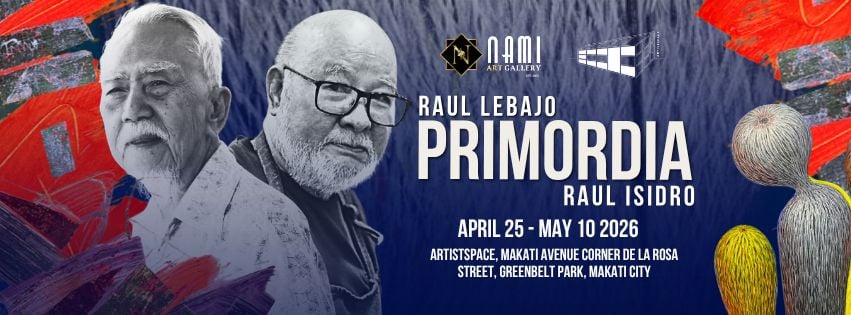
A rare moment in Philippine art history: a meeting of two masters whose visual languages differ yet converge in their reverence for the natural world.
A profound stillness settles over the ArtistSpace at the Ayala Museum, where the raw, elemental beginnings of life unfold in “Primordia,” a joint exhibition by Philippine modernist masters Raul Isidro and Raul Lebajo, organized by Nami Art Gallery. More than a display of canvases, the exhibition becomes an intimate dialogue between two lifelong students of the natural world who have spent over five decades refining their respective artistic languages.
Both artists are Visayans belonging to the Waray language group of Eastern Visayas. Isidro hails from Calbayog City in Samar, while Lebajo comes from Tacloban City in Leyte. Despite their strong regional roots, both were shaped by Manila’s major art academies. Isidro trained at the University of Santo Tomas, often considered a historic stronghold of modern art in the country, while Lebajo studied at the University of the East before completing his degree at the Philippine Women’s University.
One of the exhibition’s central achievements is its transformation of Western abstraction into a distinctly Filipino idiom. While Western modernism often privileged pure form and non-objectivity, Isidro and Lebajo root abstraction in the landscapes, flora, and psychic textures of the Visayas. Their works reconnect modernist experimentation to lived geography and memory, bridging academic training with the sensibilities of the “promdi,” or province-born artist.
Lyrical abstraction
Born in 1943, Isidro has long been celebrated for a lyrical abstraction that captures what may be called the “soul” of nature. His paintings in “Primordia” function like layered deposits of sensation, using a rich chromatic vocabulary to create what critics have described as “chromatic currents.” The shifting hues and iridescent surfaces evoke Samar’s marine and mineral landscapes, as well as its exposure to Pacific storms.
In Isidro’s hands, the boundary between abstraction and representation dissolves: a rock becomes not merely geological matter but a vessel of emotional and spiritual resonance. His canvases evoke tides, weather, and atmospheric depth, allowing viewers to experience nature not as a fixed image but as a living pulse.
Caption: Raul Isidro with his lyrical abstract paintings and prints.JPG
In contrast, Lebajo, born in 1941, presents a vision of nature’s body through the lens of “environmental surrealism,” a genre he helped pioneer in the Philippines during the 1970s. His contribution to “Primordia” includes works from his celebrated “Bulb Series,” in which botanical forms possess such tactile weight and texture that they seem almost sculptural.
Fantastic but organic
Lebajo’s flora is fantastic, tubular, and unsettlingly organic. His imagery recalls the “rhizomatic” philosophy of Gilles Deleuze and Félix Guattari, where life unfolds through nonlinear and interconnected growth.
Though influenced by surrealist masters such as René Magritte, Lebajo’s imagery remains deeply rooted in the strange vegetation and lush landscapes of Leyte. He describes his organic forms – threaded with delicate lines resembling seeds, fibers, or neural networks – as “psychological vessels.” Their warped and spiraling structures create a subconscious landscape that invites reflection on memory, desire, and the persistent mystery of nature.
Primal energies
“Primordia” thus becomes a rare moment in Philippine art history: a meeting of two masters whose visual languages differ yet converge in their reverence for the natural world. Isidro gravitates toward fluid, elemental abstraction, while Lebajo constructs meticulously surreal forms. Yet both seek to uncover primal energies beneath visible reality.
The exhibition ultimately testifies to the maturity of artists who have moved beyond simple representation to create a visual language that is at once modernist and unmistakably Filipino. Through the vision of gallery owners Tin and Gabriel Yap, “Primordia” reminds viewers that the Philippine landscape – from Samar’s storm-lashed coasts to Leyte’s fantastic blooms – remains a profound source of artistic imagination and cultural identity.
Now on view at ArtistSpace, Ayala Museum, “Primordia” offers a compelling dialogue between two masters whose works distill five decades of artistic pursuit into meditations on nature, memory, and becoming.