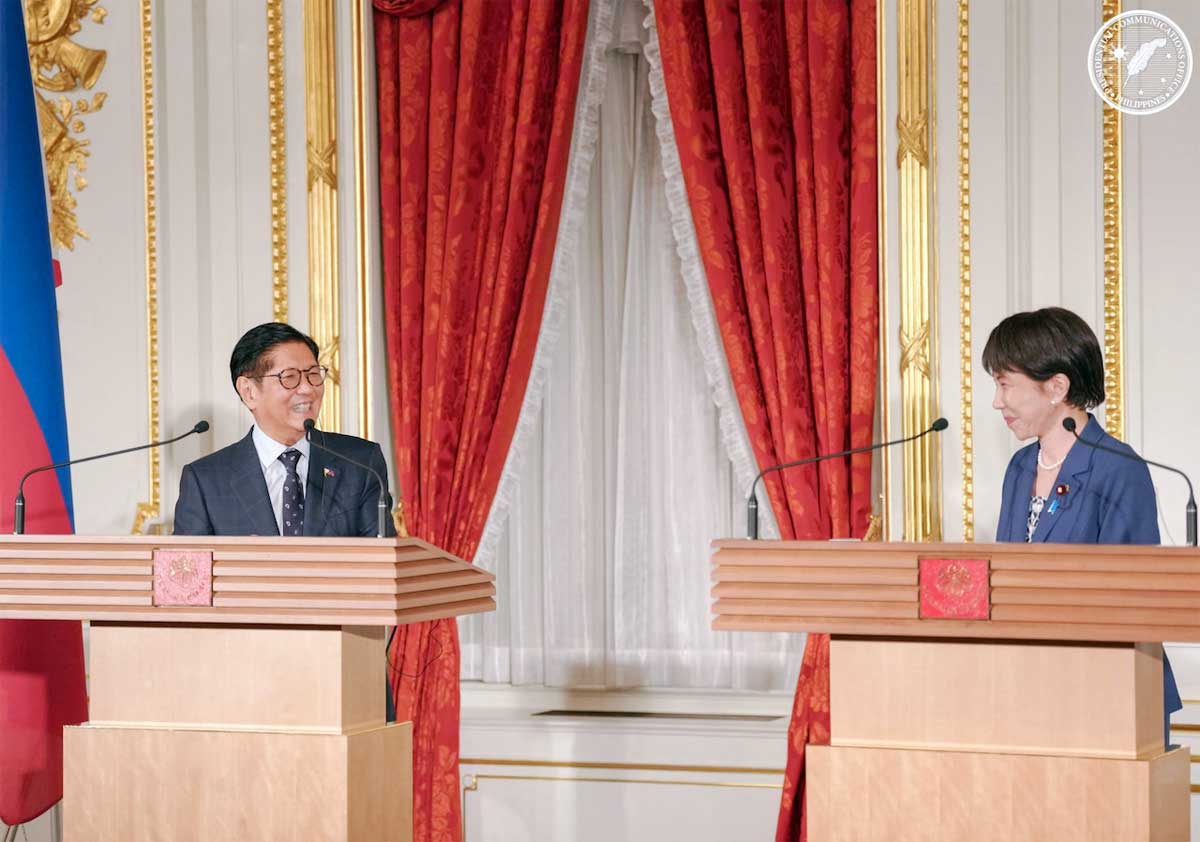
TOKYO – Japan and the Philippines said on Thursday, May 28, they
would begin talks on an agreement to share classified information to
allow Tokyo to step ?up transfers of military equipment to Manila,
including warships.
Tokyo and Manila have been steadily upgrading
defense and security ties in response to China’s growing assertiveness
in the South China Sea and around Taiwan. Japan recently ?scrapped
longstanding restrictions on combat equipment exports, a change expected
to benefit the Philippines.
“We concurred on commencing formal
negotiations for the Agreement on the Protection of Classified Military
Information,” Japanese Prime Minister Sanae Takaichi said at a press
announcement with President Marcos after they agreed to ?elevate ?ties
to a “Comprehensive and Strategic Partnership.”
Japan is
considering providing naval destroyers and patrol aircraft to Manila
under a new framework for defense equipment cooperation.
“We also
concurred to accelerate the exchange between the defense authorities
toward the transfer of Abukuma-class destroyers and others. In order to
respond to the regional strategic environment, which is growing more
severe, Japan will further deepen cooperation with the Philippines,” she
added.
For Marcos, closer alignment with Japan dovetails ?with
his push to shore up security partnerships with the United States and
its allies as the Philippines contends with repeated confrontations
?with Chinese vessels in disputed waters.
According to previous
reports, six Abukuma-class destroyer escort ships would be provided to
the Philippines, a move widely seen as an effort to counter China’s
aggressive actions in the South China Sea.
Marcos said the Philippines and Japan intend to start talks on the delimitation of maritime borders.
“We
jointly announced the commencement of the negotiations for the General
Security of Military Information Agreement, as well as for the
delimitation of our maritime borders,” he said.
Takaichi and
Marcos also agreed to cooperate on energy security, including an
initiative ?by Takaichi to help Asian countries better cope with energy
shocks in the wake of the US-Israeli war on Iran.
Takaichi said
Japan stands with the Association of Southeast Asian Nations under
POWERR Asia, including the activities of Japanese businesses to
strengthen supply chain resilience of medical products, realize an oil
reserve system in the Philippines and joint oil stockpiling arrangements
in the region. Japan has offered to provide up to $10-billion in
assistance through the POWERR Asia orPartnership on Wide Energy and
Resources Resilience launched by Takaichi last April.
Takaichi
also expressed support for the Philippines’ candidature for a
non-permanent seat at the United Nations Security Council in the
election to be held next month.
Marcos and Takaichi also witnessed
the signing of an agreement on the avoidance of double taxation, a deal
that aims to enhance the business environment and promote greater
cross-border investment.
Before his meeting with Takaicihi, Marcos
delivered an address before Japan’s National Diet, where he emphasized
the need to maintain peace and stability, respect rule of law and ensure
that seas are “governed by rules, not by force.”
3 business deals signed
Three
business deals seeking to harness the capabilities of artificial
intelligence (AI) and make processes more efficient were signed on the
sidelines of Marcos’ state visit here.
The three memoranda of
understanding among Philippine and Japanese firms signed on May 27
intend to advance smart cities, digital connectivity and financial
technology, the Department of Trade and Industry (DTI) said in a
statement.
The deal involving Ayala Corp., Globe Telecom,
Mitsubishi Corp. and KDDI Corp. aims to study “Intelligent City”
initiatives in Makati City, a project that may expand to other
Philippine urban areas. It seeks to use AI, Internet of Things, urban
data integration platforms and advanced telecommunications solutions to
enhance transportation, retail and commercial services, energy
management and digital city services.
Another agreement signed by
conglomerate Ayala Corp., Mynt and Mitsubishi Corp. intends to develop
“Smart Life” digital services that could make daily transactions more
convenient for Filipinos. The deal, which is seen to generate about P7
billion in revenues, will cover rewards programs, ticketing services,
online payment platforms and digital marketing solutions.
Ayala
Corp., Mitsubishi UFJ Financial Group, Mitsubishi Corp. and Mynt also
inked a deal to help expand GCash money transfer services in the
Philippines and in other countries.
“The partnership will develop
better digital payment systems, lending services, investment products
and stronger online security while integrating GCash into Ayala and
Mitsubishi’s business ecosystems across retail, real estate, energy,
mobility and digital services,” the DTI said.
President Marcos and
Trade Secretary Ma. Cristina Roque witnessed the signing of the deals,
which the administration said reflected “strong investor confidence” in
the Philippines.
“We welcome these investments to the Philippines
because they will bring meaningful benefits to Filipinos – from smarter
and more connected communities to safer and more accessible digital
financial services. These partnerships will make everyday transactions
faster and more convenient while creating more opportunities for
Filipino consumers, businesses and workers,” Roque said.
On
Wednesday, May 27, Malacañang announced that Japanese businesses have
committed to invest P210 billion or $3.4 billion in the Philippines, a
development seen to generate “substantive” macroeconomic benefits,
expand domestic industrial capacity and create thousands of high-quality
and specialized jobs.
The commitments were made during Marcos’ high-level roundtable meeting with investors on the sidelines of his state visit here.
Malacañang
said four Japanese firms – Tsuneishi Group Corp., Furukawa Electric Co.
Ltd., Sumitomo Electric Industries and MinebeaMitsumi – are planning to
expand their operations in the country with P61.3 billion worth of
investments.
The investments are expected to generate 10,200 additional jobs, according to the Presidential Communications Office.
Political
analyst Froilan Calilung, a professor at the University of Santo Tomas’
Department of Political Science, sees the pledges as something that
will not only create fresh jobs but also position the Philippines as a
premier investment destination.
“So when we try to forge economic
ties with them, when we open globalization and integration ties with the
country like Japan, it also sends a strong signal to other countries
who may also be wanting to have investment schemes with us as well,”
Calilung told “Bagong Pilipinas Ngayon” on PTV.
‘Force for good’
Marcos
said the Philippines is determined to work with Japan to serve as a
“force for good” in the Indo-Pacific, as he emphasized the importance of
a rules-based order and international law.
Marcos noted the
cooperation between the Philippines and Japan now extends further into
maritime security, humanitarian response and regional stability. – With Christine Boton, Helen Flores