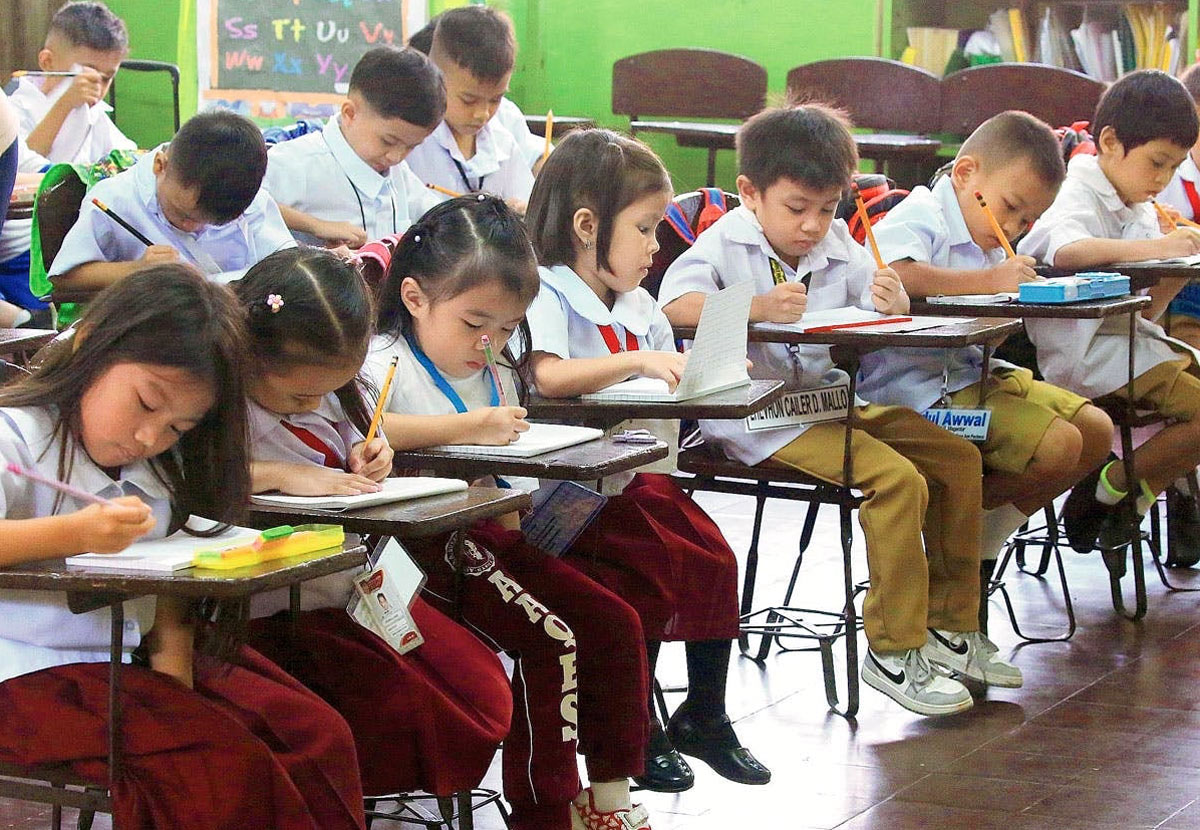
This measure one of those being considered by the Department of Education to close the classroom gap.
The Department of Education (DepEd) is considering the pilot
implementation of a “4+1” blended learning model, composed of four days
of on-site classes and one day of online learning, to help address
congestion in schools.
Education Secretary Sonny Angara said on
Tuesday, March 10, the agency is also exploring the expansion of
vouchers to primary education, as well as the leasing or acquisition of
foreclosed private properties that could immediately provide about 1,000
classrooms.
The DepEd is likewise seeking to mobilize private
sector donations for an additional 2,000 learning spaces to help reduce
the classroom deficit.
Angara led the ceremonial signing of a
memorandum of understanding between DepEd and the League of
Municipalities of the Philippines to formalize a nationwide effort to
accelerate classroom construction.
During the event, he rallied more than 1,300 municipal mayors to help address the persistent classroom shortage.
“We
are no longer content with the old system. We are changing the way we
deliver to make it faster, more efficient, more effective and more
transparent,” Angara said.
The education chief said DepEd is
implementing several measures to close the classroom gap, including the
delivery of 30,000 classrooms through conventional procurement by 2028.
Another
16,000 classrooms in high-congestion areas are planned under
public-private partnerships through the recently approved PPP for School
Infrastructure Project Phase 3.
“Education is a shared
responsibility, and our LGUs are the best-positioned partners to ensure
these funds are translated into actual, usable classrooms for our
learners.”
Angara noted that under the 2026 General Appropriations
Act, LGUs are now authorized to serve as primary implementers of school
building projects alongside the Department of Public Works and Highways
and the AFP Corps of Engineers.
The arrangement allows mayors to identify priority sites for classroom repairs or new construction.
Angara
also promoted the use of prefabricated learning continuity spaces,
which he described as a cost- and time-efficient solution already
piloted in Masbate and Davao del Norte.
A total of 2,571 units are scheduled for installation across 1,017 municipalities this year.
DepEd
likewise encouraged municipalities to pool their Special Education
Funds to finance large-scale programs such as central kitchens for
school-based feeding.
“We are not just sharing resources, we are
actualizing President Marcos’ vision to modernize our classrooms through
the kind of innovative funding that ensures no student is left behind
by a lack of local budget,” Angara said.
DepEd earlier signed a
memorandum of agreement with provincial governors and city mayors to
implement the special provisions of the General Appropriations Act
related to school building construction.
Angara urged mayors to
coordinate with provincial governors to maximize the flexible
construction provisions, which aim to speed up the delivery of
much-needed classrooms.