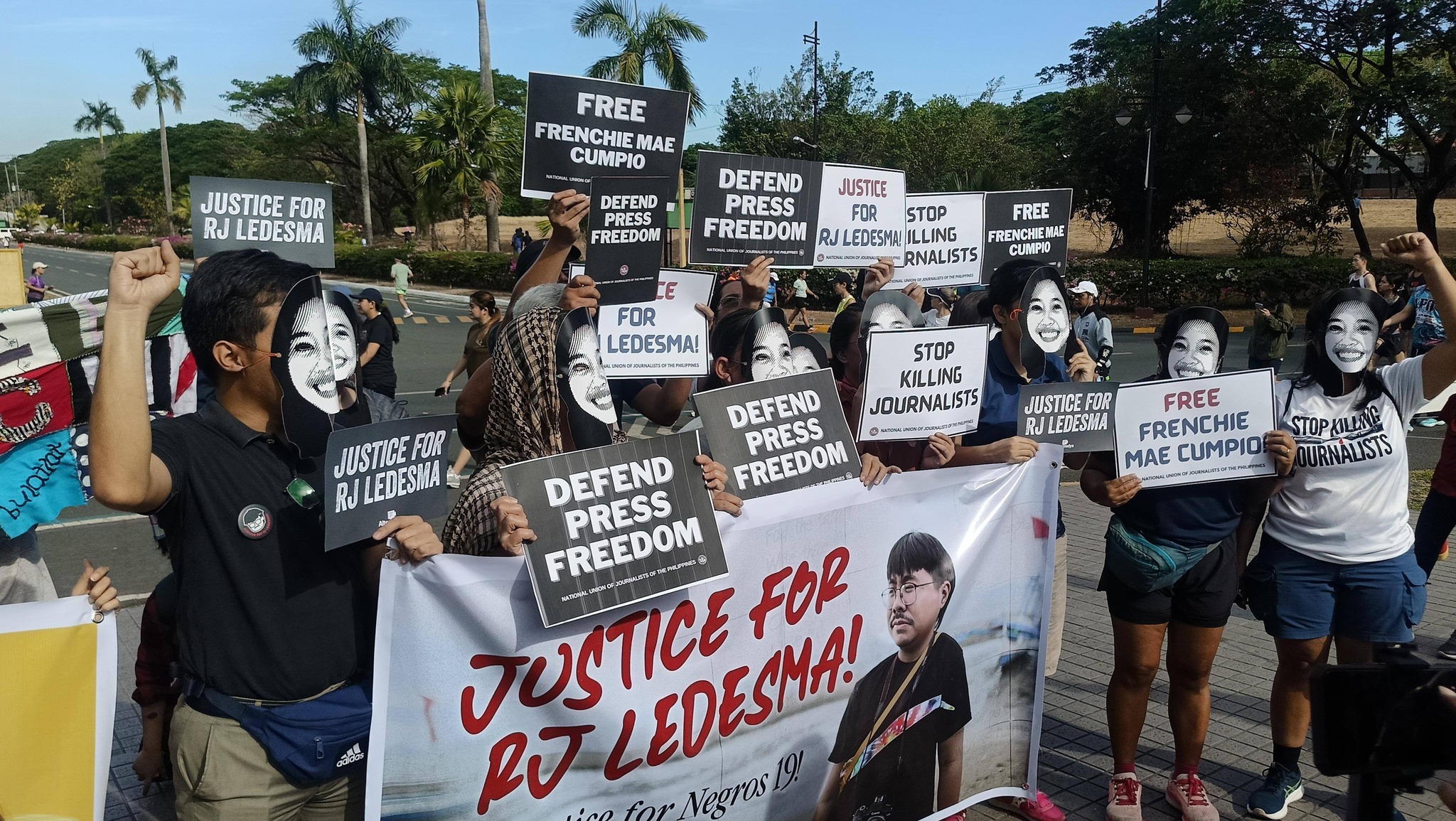
The NUJP stressed that the state has failed to protect journalists.
CAGAYAN DE ORO — Filipino journalists and media workers commemorated the World Press Freedom Day with urgent calls for freedom and justice.
The National Union of Journalists of the Philippines (NUJP) held a protest walk at the University of the Philippines Diliman, calling for the immediate release of Tacloban-based journalist Frenchie Mae Cumpio and justice for the killing of community journalist RJ Nichole Ledesma in Toboso, Negros Occidental.
The NUJP stressed that the state has failed to protect journalists given the continuing detention of Cumpio—who remains included in the 10 most urgent press freedom cases in the world—for fabricated charges, and the killing of Ledesma, who was accused of being a combatant of the New People’s Army.
The group slammed the Ferdinand Marcos Jr. administration for maintaining the National Task Force to End the Local Communist Armed Conflict (NTF-ELCAC) despite calls from United Nations independent experts and international human rights organizations to abolish the agency for its persistent red-tagging remarks.
“The Marcos Jr. administration has also chosen to ignore the Supreme Court’s 2024 ruling, which declares red-tagging a threat to life, liberty, and security,” the NUJP said in a statement.
Read: Rights groups support UN expert’s recommendations to abolish NTF-ELAC, repeal Anti-Terror Act
The group documented 242 alleged press freedom cases under the current administration as of April 2026. Harassment (surveillance and verbal) topped the list with 75 cases, followed by red-tagging with 39 incidents.
Meanwhile, 10 journalists and media practitioners were killed, two of whom were initially declared as not work-related by the police.
People’s Alternative Media Network (Altermidya) said the cases of Cumpio and Ledesma, who were part of the network, reflect the brutal truth of the press freedom situation in the country. “It continues to be under grave threat, primarily from state forces that regard truth-telling as a crime and critical journalism as an enemy.”
In the 2026 Press Freedom Index released by Reporters Without Borders (RSF), the Philippines’ ranking slightly improved, climbing from 116th placement in 2025 to 114th spot this year. However, it still implies a “difficult” state of press freedom.
Read: Philippines remains dangerous for journalists
Avon Ang, Altermidya national coordinator, criticized the Presidential Task Force on Media Security (PTFoMS) for saying that journalists covering conflict zones should wear any markings so they can be identified as members of the press and not combatants.
She echoed veteran journalist Inday Espina-Varona’s assertion that journalists should not bear the burden of proof.
“Every killing, every wrongful imprisonment, every act of harassment sends a chilling message meant to spread fear and normalize censorship and disinformation,” Altermidya said in a statement, pointing out that press freedom violations transcend individual journalists, as they also undermine people’s fundamental right to know.
Aside from calls to stop red-tagging and media killings, both NUJP and Altermidya urged the government to decriminalize libel, saying it, including the Data Privacy Act, has been weaponized often for retaliation against media workers.
During the protest walk, they carried out a signature campaign for the decriminalization of libel.
The NUJP also emphasized the need to address the climate of impunity in the country. If this still exists, it said “no amount of safety measures would be enough to protect ourselves from harm.” (RVO)
Disclosure: Bulatlat editor-in-chief Ronalyn Olea is the secretary general of the National Union of Journalists of the Philippines.