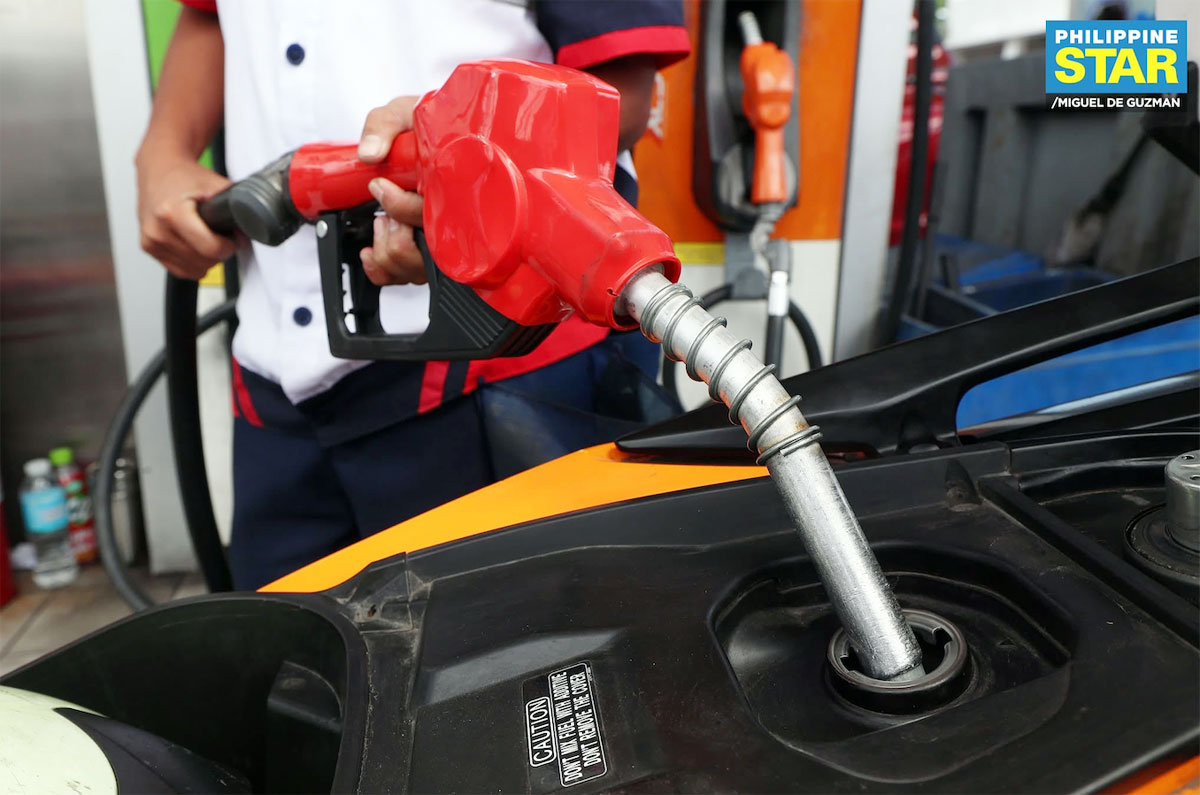
After recent rollbacks, pump prices are expected to rise again next week as prolonged supply disruptions have fueled global market concerns.
Following a shortened trading week due to Labor Day, an industry source pointed to a potential price increase of P1 to P2 per liter for diesel and P2 to P3 per liter for gasoline.
The estimates were based on the four-day average of the Mean of Platts Singapore, a key pricing benchmark for refined petroleum products across the Asia-Pacific market.
Price adjustments will be announced on Monday and take effect the following day.
Global oil markets remain on edge as the standoff in the Strait of Hormuz, a vital chokepoint that typically carries around 20 percent of the world’s oil and gas supplies, continues to threaten supply stability.
Tehran has maintained its chokehold on the narrow waterway, while the US military continues to enforce a blockade on Iranian ports.
“US data this week also showed larger-than-expected draws in crude and fuel stocks, adding to the rally,” the source said.
If the price hike pushes through next week, it would end three consecutive weeks of diesel rollbacks.
Last Tuesday, diesel prices went down by at least P12.94 per liter, while the cost of gasoline rose by as much as P0.53 per liter.
It has been three weeks since the Department of Energy began mandating maximum price hikes and minimum rollbacks at domestic pumps.
With prices starting to stabilize, former energy secretary and incumbent Leyte Gov. Jericho Petilla told The Philippine STAR that it may now be appropriate to stop limiting adjustments.
“The government should suggest, but not basically dictate,” Petilla said, noting that another round of mandated price movements could force smaller oil firms to suspend operations temporarily.
‘Gov’t can run its own gas stations’
The government can operate its own gas stations not only to offer fair pump prices to consumers, but also to ensure transport workers receive their subsidies efficiently, Petilla said.
With the Philippines powerless to control most cost components of petroleum products, from the fuel itself to shipping, pump prices now vary with each company’s profit margins, and many accuse oil players of riding the crisis to reap windfall profits.
Petilla, who served as energy chief under former president Benigno Aquino III from 2012 to 2015, said the government should explore running the Philippine National Oil Co. (PNOC) as a business, competing as a government-owned and controlled corporation with the private sector, which will not be subsidized and has to “survive on its own.”
“What will PNOC do? It will import. It will have gas stations,” he told The STAR.
“When you run a business, you have to make sure that you won’t lose money, but as a government entity, you also make sure that you’re not taking advantage, so you will now set the right price,” Petilla said.
A PNOC-run gas station will force a balancing act with the private sector, according to Petilla: if private companies charge more than PNOC, consumers may flock toward the state-run firm. If they charge much less, no one will buy at PNOC, but will hit the private sector.
Petilla’s suggestion incorporates two of three roles embodied by national oil companies worldwide, as outlined by the New York-based non-profit organization Natural Resource Governance Institute: a “state supplement,” in which the state-run firm prioritizes public service over commercial success, and a “profit seeker,” in which the company’s goal is to earn a profit and provide significant long-term financial returns to the state through dividends and income taxes.
Besides price stability, Petilla said PNOC can handle fuel subsidies for qualified transport workers.
“I will put P1 billion in PNOC, then all who need subsidies will go to PNOC,” he said.
“If you have PNOC, it is government-to-government; there is no problem when transferring money for subsidy,” Petilla explained, adding, “The red tape and the issue of audit are actually diminished or lessened because it is a GOCC.”
Can the government, though, spend on yet another capital expenditure when its fiscal space is narrowing?
Petilla said that “a lot of people are selling gas stations for the right price and are not worth it for their owners.”
Former energy undersecretary Jay Layug has some doubts.
“Based on the current fiscal space, the current budget portfolio that we have, engaging in downstream oil is not easy,” Layug, now executive board member of the Philippine Energy Research and Policy Institute, told The Philippine STAR.
Selling oil at cost or with a very small margin means such an endeavor may not be an undertaking that can earn the government enough revenues, Layug stressed. – With an additional report from EJ Macababbad