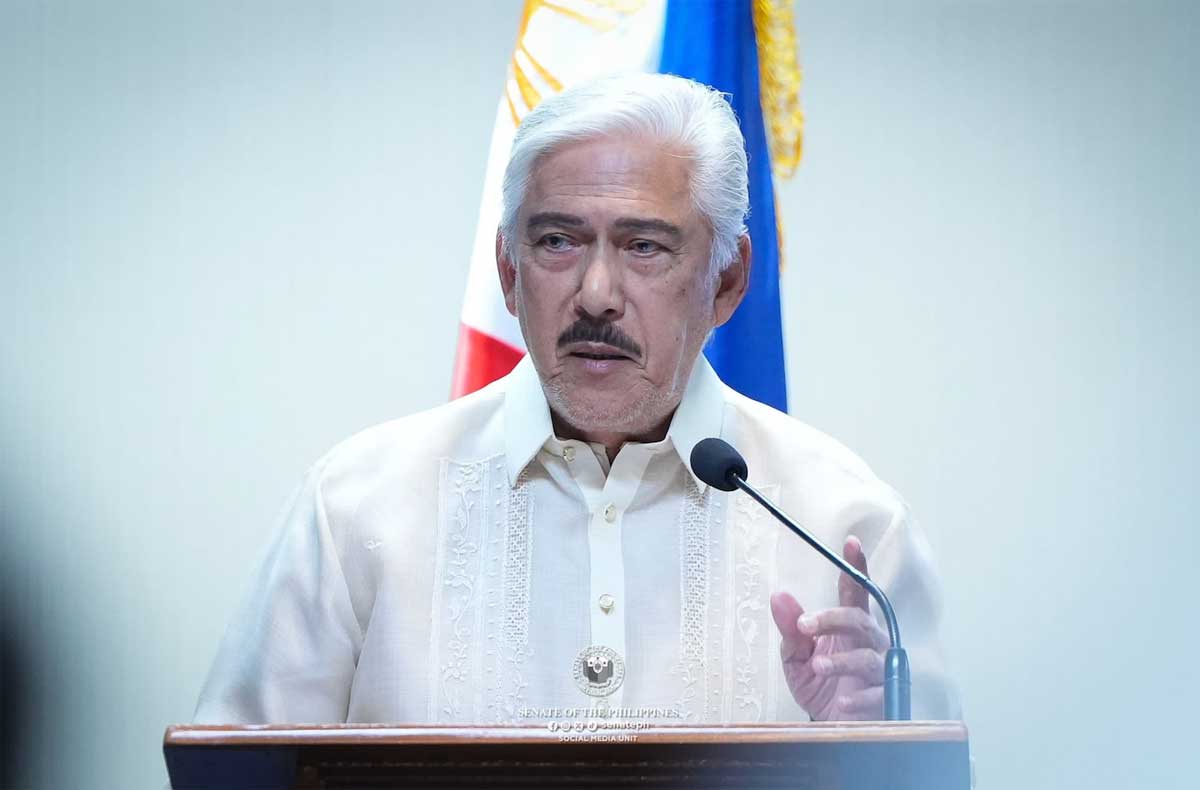
If the impeachment complaint against Vice President Sara Duterte is transmitted to them, Senate President Vicente Sotto III said the upper chamber, under his leadership, will act on it “forthwith.”
The Senate leadership called for an all-senator caucus on Thursday
afternoon, April 30, to prepare for the possible transmittal of the
Articles of Impeachment against Vice President Sara Duterte, after the
House justice committee found probable cause.
The caucus was
attended by senators from across the political spectrum – Senate
President Vicente Sotto III, Senate President Pro Tempore Panfilo
Lacson, Majority Leader Juan Miguel Zubiri, and Senators Risa
Hontiveros, Pia Cayetano, Lito Lapid, Loren Legarda, Raffy Tulfo and
Camille Villar from the majority bloc; and Sen. Robin Padilla from the
minority.
Sotto said he met with the senators available to inform them of the need to prepare for the transmittal of the complaint.
And
while the Supreme Court has officially defined the term “forthwith” in
the 1987 Constitution provision on impeachment, for Sotto it still meant
without delay.
He explained that the SC ruling was based on a
petition assailing the first impeachment complaint that was later struck
down as unconstitutional, not the upcoming one.
Sotto said the
Senate under his leadership as Senate President is a separate branch of
government which may still convene the impeachment court the soonest
time possible without delay.
“The Supreme Court decision does not
cover the work of the Senate. It doesn’t have anything to do with it. It
doesn’t have anything to do with the work of the Senate. We’re a
co-equal branch,” Sotto said.
“That’s why their decision is
correct as far as that petition that was filed to them was concerned,
not on the way the Senate is conducting itself,” he added.
Sotto
said the Senate under his leadership – if the impeachment complaint is
transmitted to them – “will act on it, ‘forthwith,’ which for me means
‘the following day.’”
“As soon as we receive it, then that’s the
time we will officially decide on what to do with the timing. Definitely
there’s one thing for sure: once we receive it, we will convene the
following day as an impeachment court, he said.
Citing as a
hypothetical example, Sotto said if the House transmits the complaint on
May 11 or 12, the Senate can already convene the impeachment court on
May 13.
“But that is all speculative. Let us wait for the Articles
of Impeachment to be transmitted first. Then we discuss everything
else,” he said.
For Lacson, the Senate’s sine die break won’t affect the looming impeachment trial of Vice President Duterte.
Lacson
said that the impeachment court – once convened in May after the
transmittal of the complaint – can still continue holding trial hearings
well into the break.
“It will continue. The impeachment trial is
separate from the session. So, the sine die adjournment will not in any
way affect the schedule of the impeachment trial,” he said.
The
Senate is currently on break and will resume session from May 4 to June
5. It will adjourn session sine die from June 6 to July 26, enough time
for the impeachment proceedings to continue once convened in May.
As
Senate accounts committee chair, Lacson said the Senate still has
leftover budget from last year’s aborted impeachment trial to use in
this year’s second bout.
Lacson said only P500,000 had been spent
out of a P27-million allocation under the 2025 General Appropriations
Act. The Senate last year had 60 impeachment judges robes made at P7,000
each, Lacson said.
“Since the fund is good for two years under
‘continuing appropriations,’ the Senate is financially able and ready to
conduct the trial if and when the Articles of Impeachment are
transmitted,” he added.
Objection
Supreme
Court Senior Associate Justice Marvic Leonen objected to the ruling of
the majority that the Senate acted “in a timely manner” in tackling the
debunked Articles of Impeachment against Vice President Duterte in 2025
in compliance to the constitutional mandate to proceed “forthwith” with
the impeachment trial.
Leonen maintained the Senate – which was
constituted as an impeachment trial court – “should have been convened
immediately,” according to a revised statement from the SC last April
29.
He added the Senate as an impeachment court, “not merely the
Senate President,” should have taken charge of organizing the court.
Vindicated
The
former spokesperson of the Senate impeachment court under then Senate
president Francis Escudero said they felt vindicated after the Supreme
Court agreed with their interpretation of “forthwith” as within
reasonable time.
“The Supreme Court’s near-unanimous decision
proves that under the leadership of then-Senate President Chiz Escudero,
the Senate was right to choose constitutional prudence over the
reckless haste demanded by so-called experts,” lawyer Regie Tongol said
in a statement.
Tongol said the Supreme Court decision thus proved
wrong the critics of the Escudero-led Senate impeachment court’s move
not to immediately convene the court despite the 1987 Constitution
provision for trial to “proceed forthwith.” — With Ghio Ong