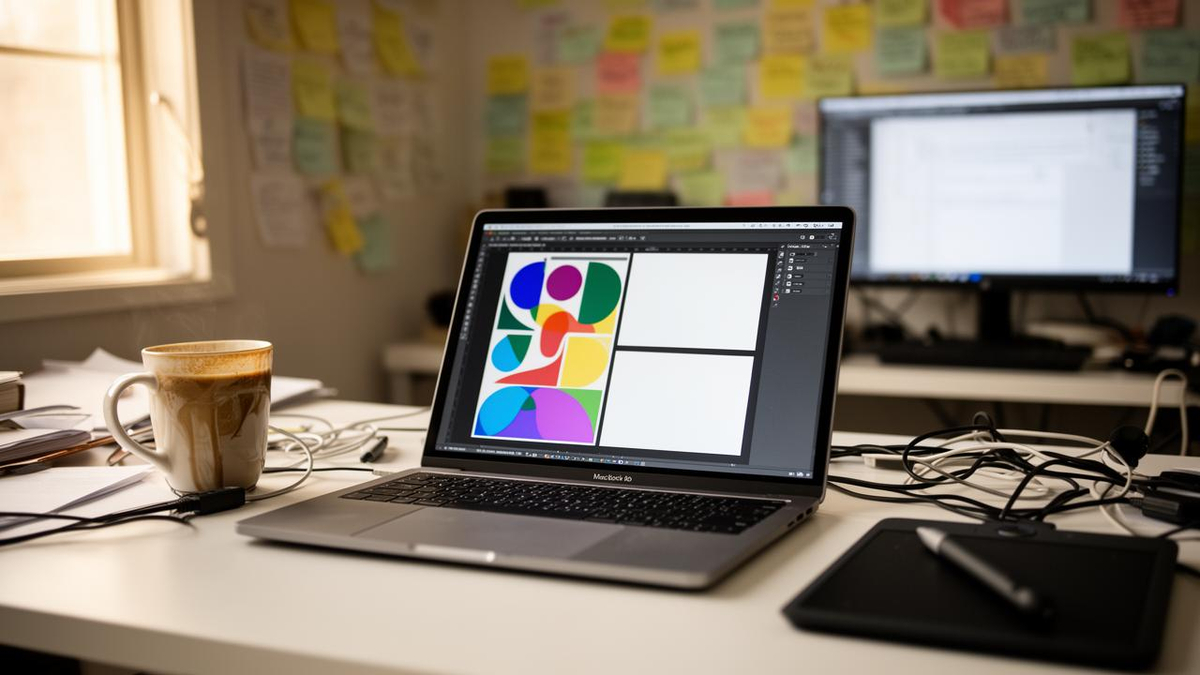
Brandon Thomas says his team rebuilt Photoshop in a day. Not a rough sketch — a working photo editor with the UI/UX split out, MCP and command-line compatibility, and importers for Adobe’s file formats, built from a large structured prompt in roughly 24 hours and starting about ten times faster than the original.
The claim is the centerpiece of a talk Thomas, founder of ArtCraft, gave to the AI Engineer podcast, in which he walked through a project he admits went viral faster than he could prepare for. What began as an AI image and video tool for filmmakers has turned into a campaign to clone the commercial creative software stack as open source — and, by his count, it is already reaching a million and a half people a day.
The grievance that started it is a cancellation fee
Thomas’s indictment isn’t abstract ideology. It’s Adobe’s billing. He says the company’s monthly plans carry a cancellation fee buried in fine print — up to roughly $200 if you cancel before 12 or 18 months. For a filmmaker who uses the tool over a weekend before a festival, that’s a bill for an app used briefly.
He zooms out from there. The web of the 1990s and early 2000s was open by default, he argues: IRC servers people owned, messaging apps that tolerated third-party clients, data exports and APIs on every site, mashups of Reddit, Flickr and Twitter trending on Slashdot, customizable MySpace pages. Wikipedia was born from that ethos. Then broadband and smartphones “brought everybody into the fold,” technical users got pushed to the sidelines, and protocols were replaced by platforms.
“The web that was once really really promising and open and free has turned into this extractive owned rented rent-seeking world,” he said.

The clones are self-measured, and the team is candid about it
The Photoshop approximation began with a large structured prompt: the basic shape of a photo editor, plans for every tool, data structures, file-format importers. Parity is measured rather than declared finished — 50% at first, now past 60%, with what Thomas calls a Pareto path to 99.99%. The team deliberately matched Adobe’s look and feel first to preserve artists’ muscle memory, before layering on new agentic interfaces.
The results, as Thomas reports them:
| App / product | Status Thomas reports |
|---|---|
| Photoshop | ~60%+ parity, functional, ~10x faster startup |
| InDesign, Premiere | Built; Arabic localization added despite being told InDesign didn’t support it |
| Adobe Animate | Revived after end-of-life; animation studios asked for continued support |
| PDF Craft | Thomas calls it the best app; works on Linux and NetBSD |
| Figma | Client plus server component with Raft/Paxos multi-user collaboration |
| Solid Craft | Community-led, open engineering kernel, MCP-driven 3D printing |
| Microsoft Office core apps, Google Docs | Cloned |
| CAD, Flash, DAWs | Cloned |
| Total | ~300 apps in development by the community |
The Animate revival is the tell. When Adobe killed the tool, animation studios that had built their careers on it asked ArtCraft to keep it alive. That is the open-source argument in miniature: software people depend on doesn’t have to disappear when a vendor’s roadmap moves on.
The growth numbers came from Reddit, not Hacker News
The project leaked on Reddit rather than the usual Hacker News launch, and Thomas says a New York Times interview request arrived two days later. What followed was a “sleepless month” of VC meetings and inbound from companies and universities.
| Metric | Figure (as stated by Thomas) |
|---|---|
| GitHub stars | “over 3,000 300,000” (stated ambiguously; likely 300,000) |
| Contributors | 4,000 |
| Downloads | ~1.7 million per day, accelerating |
| Linux share of users | ~25% |
| Discord | grew from 3,000 members |
He notes Linux has long been “a second class citizen” in creative software, which makes a quarter of users on Linux “really fascinating.” The apps also run on NetBSD and tablets and deploy natively to the web via Wasm. His Discord comparison — larger than Jev, Suno and Higgsfield combined — comes without a figure.
Rust was the non-negotiable bet
Thomas calls Rust “probably essential” to the product’s success. Others had tried Electron, he says, but high-quality creative apps need native performance; he cites Google research on low defect rates, fast startup, cross-platform support and Wasm deployment.
The interesting part is who writes it. Thomas has used Rust since before version 1.0, but much of his team learned it on the job. His message to working engineers is blunt: “Do you need to know Rust to start using Rust today as an engineer? Definitely not. Your agents will drive it just fine.”
The friction he flags is more mundane than language choice: compile times, permissions, GitHub scaling, and continuous integration that is “falling over” — prompting the team to spin up its own runners on co-located servers picked for cheap RAM.
Hand agents the desktop; keep humans on the database
Thomas draws a hard line through the engineering workflow, and it is organized by how reversible the work is, not by how much he trusts the model.
“If you’re doing backend work or things that require schema migrations, API design, let your humans do that,” he said, “but for like desktop apps and games and anything that’s basically immutable, throw your agents at it and give them like full confidence.”
The scale of what that permits is already visible in the community. One member is running 40 machines to rebuild Unreal Engine in Rust — unattended.
That system is Autocraft, which Thomas describes as a “completely autonomous software factory”: it ingests issues, triages them, runs agentic development, and post-trains models on every decision it makes. He plans to open source it, along with the app factory and an open-source code-review tool in the style of CodeRabbit. Every decision becomes training data for evals and post-training on decision trees — a feedback loop in which the factory gets better at being a factory.
Adobe is making the same bet from the other side
The timing of Thomas’s pitch is not accidental. At Adobe MAX in Miami this week, Adobe said third-party AI agents from ChatGPT, Claude and Gemini will be able to operate Photoshop, Illustrator, Premiere and After Effects directly on a user’s desktop, editing native project files in place so layers and vectors stay editable. The Model Context Protocol integrations enter private beta in early 2027.
“Whether it’s 10 or 15 years ago, if you wanted to remove a background from a photo you had to open Photoshop and do the work,” Adobe CTO Eli Greenfield said at a briefing. “Now you can use Photoshop capabilities from ChatGPT, Gemini and Claude.”
Adobe also signed a multi-year partnership making it Disney’s official AI innovation partner, and expanded its Google tie-up to put Acrobat inside Workspace and Adobe tools inside Gemini. Incoming CEO Anil Chakravarthy told the conference that “Adobe believes creativity is human,” while acknowledging a segment of creators who want nothing to do with AI.
Both sides now agree the interface is dissolving. They disagree about who owns the file underneath.

The unanswered questions matter more than the demo
Every number in Thomas’s talk traces to a single speaker in a promotional setting, and several are loose — the GitHub star count is spoken as “3,000 300,000,” and the Discord comparison is given without a figure. The parity claim is self-measured against an undefined rubric.
The strategic tension he names but does not resolve is whether to keep chasing Adobe parity for muscle memory or to build the agentic, net-new interfaces he says will come “in the fullness of time.” Those goals pull in opposite directions: one is a clone, the other is a replacement.
“Let’s take back the entire internet,” he said. “Let’s rebuild everything. All software, all platforms. We can turn all of these things into proper protocols.”
None of the code is closed, he stresses — including the infrastructure and data models — and employees get time for their own projects. He points interested engineers to hello@storyteller.ai.
For investors, the signal to watch isn’t the parity percentage. It’s the 25% Linux share and the 1.7 million daily downloads. If those hold, demand for professional creative tools outside the Adobe and Microsoft subscriptions is larger than the desktop software market has assumed — and agent-generated clones are a real distribution channel, not a parlor trick. The open questions are whether the autonomous factory ships as promised, and whether 4,000 contributors can sustain 300 apps with the founder no longer in the loop. Adobe’s answer, arriving in early 2027, is to let the agents in rather than fight them. Both bets assume the same thing: the next generation of creative work will start in a chat window, not an app.