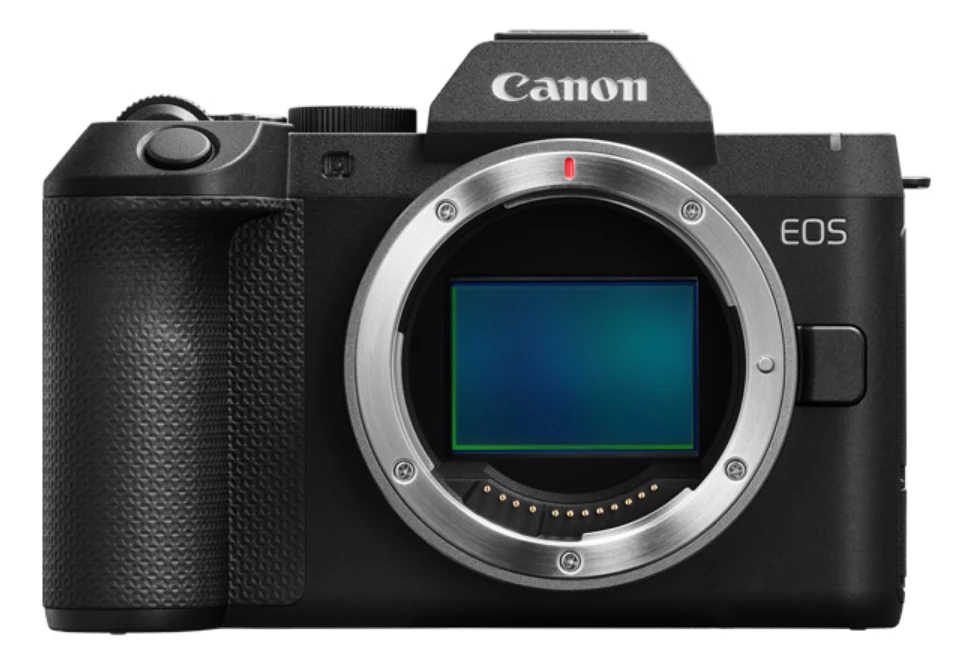
Map Camera, a specialty camera retailer, on November 7 published its October 2026 popularity rankings for new and used digital cameras. In the new-camera category, Canon’s EOS R8 Mark II, released October 29, debuted in first place, pushing Sony’s α7 V — which had topped the list nine times since launch — down to second.
The EOS R8 Mark II sold briskly as a lens kit paired with the RF45mm F1.2 STM prime lens, nearly matching body-only sales, according to the retailer. Canon also placed the compact PowerShot G7 X Mark III at seventh and the EOS R6 Mark II at tenth, putting four models in the top 10. The PowerShot SX740 HS slipped to fifth from second previously but retains strong support as a compact model with a high-magnification zoom.
Sony’s α7 V, now second, maintained a high sales level, with more than 90% of buyers choosing the body alone. The company’s α7C II jumped to third from eighth previously, returning to the top three. Map Camera attributed the gain to last-minute demand from a cashback campaign plus demand for compact full-frame models ahead of the autumn holiday season.
In the used category, the α7C II took first place, with the α7 III a close second. The α7R V rose to fourth from ninth previously, capturing demand for high-resolution models ahead of the autumn foliage and landscape photography season. Fujifilm’s X-E5 (third) and X-T5 (sixth), which had ranked first and second previously, were affected by shrinking used inventory amid strong sales, according to the retailer. The lens-integrated X half placed seventh, its first ranking since February 2026. Nikon models occupied the eighth spot and below, with the APS-C Z50II at eighth and the Zf and Zfc tied for ninth.
Top of the Rankings
| Rank | New cameras (October) | Used cameras (October) |
|---|---|---|
| 1 | EOS R8 Mark II (Canon) | α7C II (Sony) |
| 2 | α7 V (Sony) | α7 III (Sony) |
| 3 | α7C II (Sony) | X-E5 (Fujifilm) |
| 4 | GR IV (Ricoh) | α7R V (Sony) |
| 5 | PowerShot SX740 HS (Canon) | EOS R6 Mark II (Canon) |
Note: Based on October 2026 data published by Map Camera.
Price Pass-Through Concerns Emerge Behind Strong Sales
As the rankings show, demand for new products and popular models remains solid. Separately from these sales trends, however, Canon’s notice of product price increases warrants attention. At its fiscal 2026 third-quarter earnings briefing, the company said tight component supplies would push up procurement costs through 2027, and it disclosed plans to offset higher costs by revising product prices from next year onward. It has not specified which models will be affected or by how much.
Behind the move are supply constraints for printed circuit boards and electronic components. Expanding AI-related demand has shifted production capacity allocation in the semiconductor industry, making it harder to procure components for cameras. Canon has pushed back the timing for normalizing production from its initial plan of September 2026 to 2027 or later, and in its medical business it raised its projected revenue impact for fiscal 2026 to approximately ¥90 billion (approximately $564.1 million) from about ¥45 billion (approximately $282.1 million).
In the camera industry, Fujifilm and Nikon have already moved to revise prices, and Canon’s decision is seen as in line with the industry-wide trend. With the market consolidated among a handful of major players, each company is increasingly prioritizing profitability over volume growth.
Market Impact
The strong launch of the EOS R8 Mark II shows Canon is gaining the upper hand over Sony in the mid-priced full-frame segment. Meanwhile, rising component costs could feed into new-camera prices from 2027 onward, making it harder for those considering an upgrade to decide when to buy. In the used market, inventory of popular models continues to shrink, and higher new-camera prices could help support used prices. Earnings at camera makers are entering a phase in which unit prices and product mix matter more than sales volume.