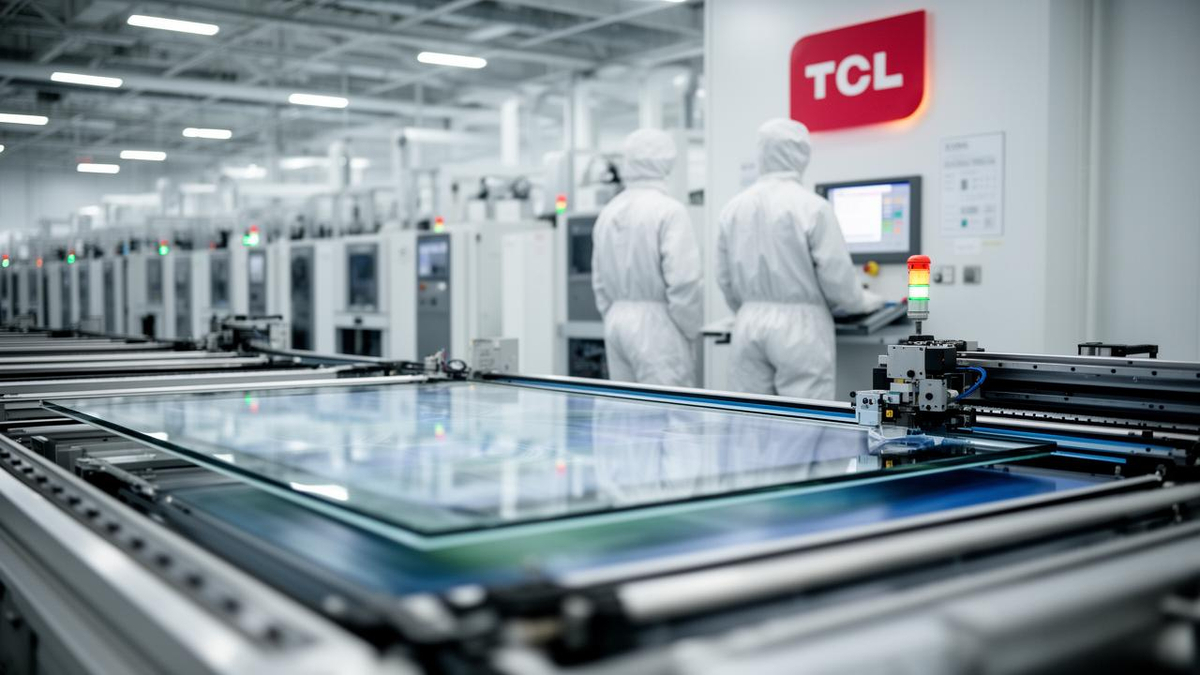
Speaking at TCL CSOT’s Global Display Ecosystem Conference (DTC2026) on Nov. 13, TCL Technology Group CEO Wang Cheng offered a rather blunt assessment: competing on scale and cost is merely the basic craft of manufacturing and is far from enough in the AI era. What display companies must fight for next is the power to define products.
The remark reflects a shift in the display industry’s role. Over the past few years, the dominant narrative in the tech industry has revolved around computing power, chips and large models. As model capabilities accelerate into phones, PCs, cars and a widening array of smart terminals, AI’s influence has extended from cloud computing buildout to the design and manufacture of end products—and the screen is the last link through which AI reaches users. Wang described it this way: screens used to show the world to people; in the AI era, displays are no longer a one-way output of information but must also take part in the interaction between people and devices.
Around this judgment, TCL CSOT is advancing two paths: Display for AI, which rethinks the form and value of display products around the new demands of AI terminals; and AI for Display, which brings AI into R&D, manufacturing and operations.
Demand side: the standard for a “good screen” is being rewritten
In AI-assisted work scenarios, users often need to view conversations, edit content and review generated results at the same time, and insufficient screen space interrupts the workflow. TCL CSOT’s planned 44-inch 24:9 AI ultrawide screen targets this need, using wider horizontal space to support three uses on one screen. Wang disclosed that the company is exploring rollable OLED notebooks with industry partners, redefining product size, power consumption and usage patterns by changing how the screen unfolds.
Power consumption is another main thread. With more AI tasks running locally on devices, processors and memory draw more power, and 3C products need to find a new balance among performance, battery life and heat dissipation. TCL CSOT’s 6.36-inch blue-phosphorescent OLED phone screen uses new emissive materials to cut EL power consumption by about 40%; its Super Pixel technology reduces SoC power consumption by 25% compared with conventional SPR solutions at the same equivalent PPI image quality.
These metrics have been consolidated under the technology brand APEX, which re-anchors the standard for a good screen across four dimensions: display experience, visual health, green and low-carbon, and future imagination.
Manufacturing side: vertical large models and printed OLED
Panel manufacturing is a classic heavy-asset industry, where a single high-generation line often requires tens of billions of yuan in investment and the cost of trial and error is high. Wang said plainly that while computing power is expensive, it is not yet so expensive that TCL cannot afford it; general-purpose large models struggle to directly solve specific engineering problems, and companies need industry knowledge and engineering experience to give models professional judgment. TCL CSOT began building a vertical model for the display field about four years ago, organizing technical documents and engineers’ decision logic for training.
According to disclosures, Star Intelligence X-Intelligence is the world’s first vertical-domain multimodal large model with strong reasoning capabilities for the display industry, and in 2025 it ranked first in the semiconductor display field in global industrial large-model evaluations. Around this model, the company has built a “1 lake, 1 model, 3 platforms” architecture: the Star Lake data lake aggregates training corpora to support inference by the Star Intelligence model, while the Xingyun, Xingzhou and Xingyu platforms apply it to yield optimization, production scheduling efficiency and virtual simulation. On the R&D side, the time needed to parse customer specifications and generate circuit design proposals has been compressed from at least a month to under a day; on the manufacturing side, ADC automatic defect classification has raised defect-judgment accuracy from 85% to 95%, and together with ADR automatic defect repair it closes the loop from inspection to judgment to repair, with related applications generating more than CNY 50 million (approximately $7.5 million) in benefits each year.
On process routes, TCL CSOT is placing its chips on printed OLED. Compared with evaporation routes that rely on fine metal masks (FMM), printed OLED deposits emissive materials through point-to-point inkjet printing, avoiding mask constraints and achieving material utilization of more than 90%. By the company’s estimates, it could deliver a cost advantage of more than 15% at scale.
| Production line | Generation | Positioning | Latest progress |
|---|---|---|---|
| Wuhan t12 | 5.5G | Medical displays, IT products | Mass production of IT products achieved in Q3 2026; capacity raised from 3K to 9K large substrates; yield around 70% |
| Guangzhou t8 | 8.6G | Tablets, notebooks, monitors and other mid-size IT | Equipment move-in began at the end of October; mass production planned for end-2027; total investment CNY 29.5 billion |
Note: The t8 project is expected to light up by the end of April 2027, and printed OLED screens for notebooks and professional monitors have already begun volume shipments.
Cyclical pressure and a second growth curve
Beyond the core display business, industry cycles remain an unavoidable variable. Zhao Jun, senior vice president of TCL Technology Group and CEO of TCL CSOT, acknowledged at the same event that OLED competition is currently relatively brutal, and soaring memory prices have left customers torn between pricing and sales volume, significantly suppressing downstream OLED demand. Data from market research firm Counterpoint Research show that global smartphone OLED panel shipments are expected to fall about 7% year on year in 2026, with the chill concentrated in rigid OLED panels for low- and mid-range smartphones, while foldable and rollable screen shipments buck the trend with 23% growth.
Zhao said the hard times may persist, but he is not entirely pessimistic about the future. He summed up the variables for a demand recovery in three points: memory prices returning to rationality, OLED penetrating from the mid-to-high end into entry-level segments, and the adoption of OLED in products that previously did not use it, such as automotive and tablets. Citing institutional data, he said demand in the foldable phone market is about 28 million units in 2026 and could grow to 46 million units by 2031. In his view, the core reason FMM OLED phone makers are all struggling is that too many production lines have been built on the same technology route, creating homogeneous competition—which is also an important reason TCL CSOT is sticking with printed OLED.
Looking further ahead, Wang has set his sights on new AI infrastructure. He acknowledged that there is still a gap to cross from existing capabilities to AI infrastructure, but TCL’s accumulated expertise in large-scale precision component manufacturing and its semiconductor talent provide a foundation for reuse—deepening its own technological roots while letting existing technology and process capabilities spill over into new areas. Specifically, as high-performance chip packaging moves toward larger sizes and higher interconnect density, glass substrates have become an important exploratory path for advanced packaging, and TCL CSOT showcased large-size glass-core substrates for advanced packaging at this year’s conference. In optical communications, the company expanded its upstream LED chip footprint by acquiring Fujian Zhaoyuan Optoelectronics and plans to enter via indium phosphide laser chips, gradually exploring optical devices and high-speed optical modules.
The energy foundation is carried by TCL Zhonghuan. In the first three quarters of 2026, its photovoltaic wafer shipments reached 83.4 GW, ranking first in the industry by market share. Wang also noted that beyond 12-inch wafers for memory and logic, Zhonghuan Leading’s years of accumulated 8-inch and 12-inch specialty-process products have formed relatively stable cash flow and profit that can support further investment in the future.
Judging from the third-quarter report, TCL CSOT remains the global leader in esports monitor panels, while its share of notebook panels and LCD phone panels rose to second globally in the second and third quarters, respectively. For investors, the near-term focus is when the suppression of OLED end demand by memory price hikes will ease; the medium term depends on whether the ramp-up of printed OLED capacity can deliver the promised cost advantage, and whether the efficiency gains from vertical large models can be continuously converted into profit.