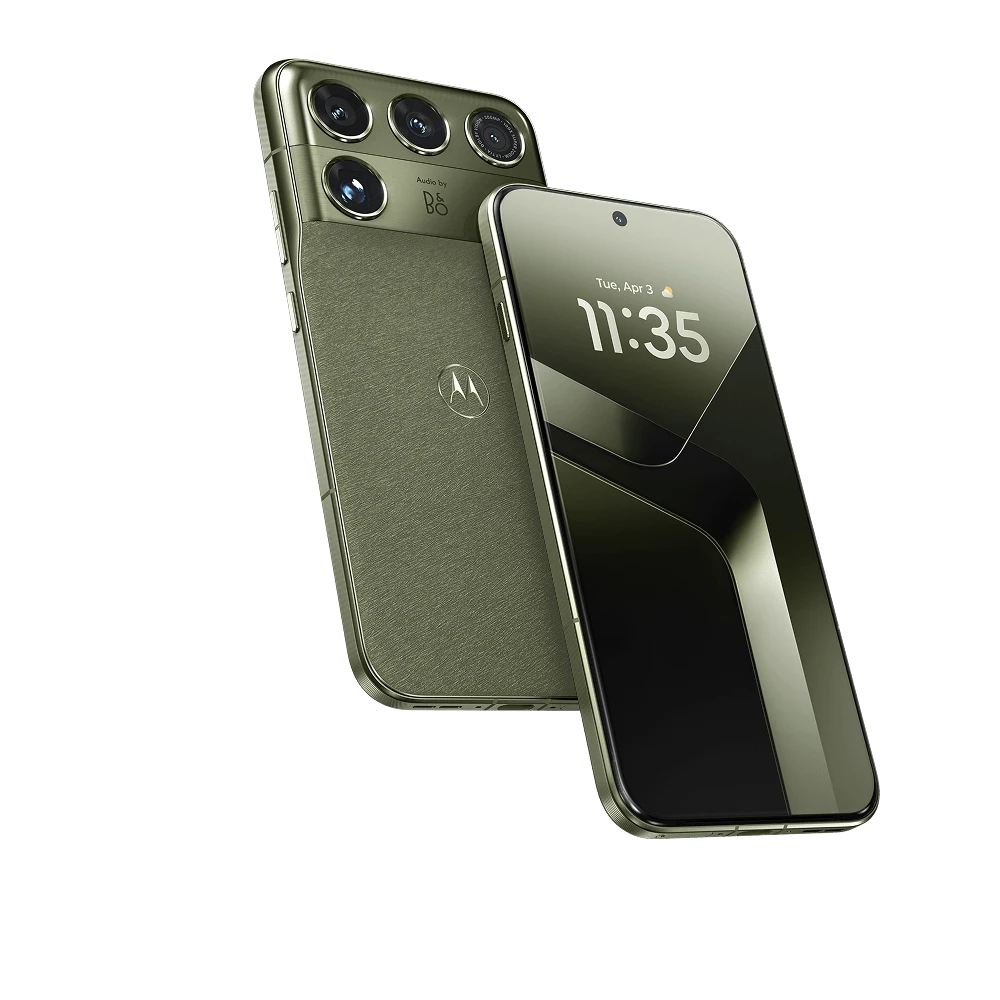
Motorola has announced its flagship smartphone, the “Motorola Signature 27.” The highlights are Qualcomm’s latest SoC, the “Snapdragon 8 Elite Extreme Gen 6,” a large 7,000mAh battery, and a 12,000-nit dual OLED display—but it’s the wireless standards, barely emphasized in the press materials, that have drawn the attention of industry observers. The phone is among the first to incorporate Bluetooth 7.0 and Wi-Fi 8, next-generation standards that no rival product currently features.
The centerpiece of Bluetooth Core 7.0 is “High Data Throughput (HDT),” which raises maximum transmission speeds from the current 2Mbps to 7.5Mbps. That works out to roughly four times the throughput, dramatically speeding up fitness-data syncing, large photo-album transfers, and video downloads from smart glasses. Wi-Fi 8, too, focuses not on a speed race but on connection reliability and latency reduction. It reworks the data-transmission hierarchy to cut interference and is designed to suppress signal-strength drops and audio dropouts that occur when moving between access points.
What both standards anticipate is the spread of wearable devices packed with AI features. Smart glasses, headphones, and smartwatches are evolving by offloading part of their processing to smartphones, and data throughput between devices will determine the quality of the experience. In the smart-home arena as well, Wi-Fi 8 improves reach to devices at the network’s edge, smoothing video checks on security cameras. Bluetooth 7.0 adds “Transient Application Keys” for issuing temporary digital keys and “Channel Sounding” for higher-precision distance measurement, helping reduce the risk of erroneous unlocks and relay attacks on smart locks.
However, early adoption of a standard doesn’t immediately translate into a better experience. No peripherals supporting Bluetooth 7.0 or Wi-Fi 8 exist on the market yet, and the industry group Bluetooth SIG says the first products with HDT will be premium audio devices arriving in 2027. In addition, many Core-spec features, including HDT, are optional for manufacturers to implement, and both 2022’s Auracast and 2024’s Channel Sounding saw slow initial uptake.
Looking at peripheral support, Google and Samsung Electronics’ “Intelligent Eyewear,” slated for release in December 2026, uses Bluetooth 5.4; the Apple Watch Series 12, launching in September, uses 5.3; and the Sonos Ace Ultra tops out at 6.0. The most recent version confirmed is Bluetooth 6.2 on Samsung’s Galaxy Buds On—a wide gap from 7.0.
The phone’s own specs, meanwhile, are commensurate with the price. The 6.8-inch “Extreme AMOLED Duo” uses the same tandem OLED technology as the panels for Apple’s MacBook Pro, and its 12,000-nit peak brightness far exceeds the 2,600 nits of the Galaxy S26 Ultra. The camera array pairs a 50-megapixel Sony LYTIA L910 main sensor with a 50-megapixel ultra-wide and a 200-megapixel telephoto with 3x optical zoom, and it is the first smartphone to carry an EVS sensor that captures pixel-level light changes. The battery uses silicon-carbon chemistry and supports 90W wired and 50W wireless fast charging. It also carries IP69 dust- and water-resistance.
| Specification | Motorola Signature 27 |
|---|---|
| SoC | Snapdragon 8 Elite Extreme Gen 6 |
| Display | 6.8-inch tandem OLED, 12,000-nit peak |
| Battery | 7,000mAh, 90W wired / 50W wireless |
| Camera | 50MP main + 50MP ultra-wide + 200MP telephoto + EVS sensor |
| Wireless | Bluetooth 7.0, Wi-Fi 8 |
| Price | $1,599 (approximately ¥260,000) |
| OS update guarantee | 7 years |
Note: Price is the expected U.S. price. Japanese domestic pricing has not been announced.
Motorola guarantees seven years of OS updates for the Signature 27. The company applies guarantees of this length only to flagships, and the design can be seen as absorbing, on the handset side, the “waiting time” until peripherals support Bluetooth 7.0 and Wi-Fi 8. No additional cost is incurred at present, but the benefits of the standards are a fair way off. The substance of the $1,599 price lies in the large battery, high-brightness display, EVS sensor, and licensing fees for Bang & Olufsen and Pantone.
In terms of market impact, the announcement reads less as competition over the smartphone itself and more as a gambit in the ecosystem battle over extended-reality (XR) devices. Google, working with Samsung, will launch its display-less “Intelligent Eyewear” in the U.S. and South Korea on December 10. The Warby Parker collection starts at $395 (approximately ¥63,000) and the Gentle Monster collection at $449 (approximately ¥72,000); both run Qualcomm’s Snapdragon AR1 Gen 1 and last up to nine hours standalone. An LED lights up when the camera is active, and Gemini automatically masks passersby’s faces when processing visual information—privacy protection is front and center.
In the same Android XR camp, XREAL will launch the “XREAL AURA” in Japan on November 27. The 12GB/256GB model is ¥229,800 and the 16GB/512GB model is ¥269,800 (both tax included). Full prepayment preorders take ¥29,900 off. The glasses themselves weigh under 95g, while an approximately 265g “compute pack” houses the Snapdragon Reality Elite and Android XR, running apps standalone. NTT Docomo and KDDI will also begin carrying it the same day.
Motorola’s early adoption is meaningful as a way to secure, ahead of time, the data-processing capacity that such XR devices and AI wearables will demand. That said, the adoption curve for standards is gradual, and for investors and consumers the yardstick will likely be overall cost-performance—including the seven-year update guarantee—rather than the novelty of the supported standards in the near term. Whether it’s “too early” for early adopters will be answered by the timing of peripheral launches from 2027 onward.